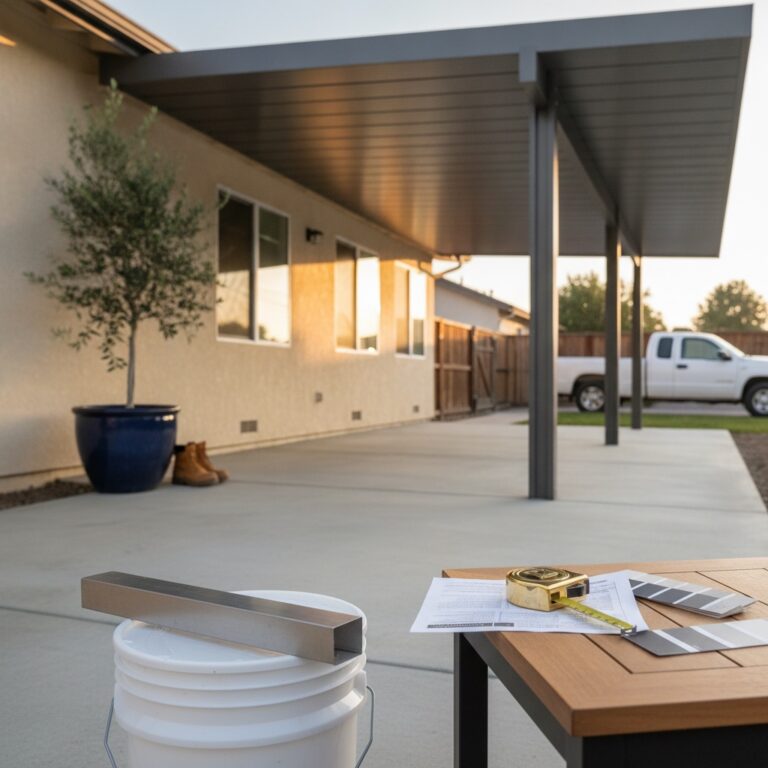


A Yorba Linda homeowner asked in late August whether a new cover could be finished before Thanksgiving. The honest answer had nothing to do with crew speed. It came down to which week the paperwork started. Orange County permit review on a standard attached patio cover runs two to four weeks. Fabrication adds another two to three. The install itself is one to three days. Count backward from the third Thursday in November and the consult has to happen in the first half of September.
That is the whole point of this post. September is not early. For a cover you want to use during holiday season, September is the last comfortable month to start, and October is the month where the calendar starts making the decision for you.
The Calendar Math Nobody Runs in September
Here is how a typical Orange County or Inland Empire project actually stacks up, week by week. Week one is the in-home consult and measurement. Week two is design sign-off, color selection, and engineering if the span calls for it. Weeks three through six cover permit submittal and approval. Weeks five through seven overlap with fabrication at the shop. Week eight is install. Final inspection follows roughly a week after the crew leaves.
Two things stretch that window in this region. If your tract has an HOA, architectural approval usually has to land before the city application, and many OC cities want that approval letter attached to the submittal. Separately, patio covers and trellises in the county require Orange County Fire Authority sign-off. Neither step is hard. Both take calendar days that do not show up on a contractor’s install schedule.
Run the numbers against real dates. A consult on September 8 puts final inspection in the first week of November, with a month of margin. A consult on October 20 lands the inspection somewhere in mid-December, right when city desks thin out for the holidays and fabrication shops cut hours. A consult on November 10 is a January project. There is no version of that math where a late-October start beats a mid-September one.
What a Real Cover Costs Going Into Q4 2026
Current national data puts aluminum patio covers at roughly $25 to $45 per square foot installed, with insulated foam-core panel systems running $30 to $50. Angi’s 2026 figures show a national patio cover average near $8,500, with most homeowners landing between $4,500 and $12,000. Southern California sits in the upper half of those ranges, mostly because of engineering, wind and seismic load requirements, and the cost of doing business in this permit environment.
A named example is more useful than a range. Take a 16 by 20 attached solid-roof cover, 320 square feet, .050 gauge aluminum roof pan, 3 by 8 beams on 10-foot post spacing, powder-coated in a standard color. At $34 per square foot that is roughly $10,900 before permit fees. The same footprint in open lattice runs closer to $22 to $30 per square foot. Step up to a 3-inch insulated panel with a finished underside and the same 320 square feet moves into the $12,000 to $16,000 window.
Ask two questions about every number a contractor hands you. First, does the price include the permit fee and the engineering stamp, or are those line items added later? Second, what does the warranty actually cover? A structural limited lifetime warranty and a 20-year powder-coat finish warranty are two separate promises, and plenty of quotes mention one while staying quiet about the other.
Financing That Still Pencils Out at September Rates
Rates matter more than they did two years ago, so it is worth knowing where things actually sit. As of the first week of September 2026, the average adjustable HELOC rate is about 7.16 percent, a new low for the year according to Curinos data, with the broad market range running from roughly 4 percent to 11.6 percent depending on lender and credit profile. Fixed home equity loans average around 7.35 percent. Unsecured home improvement loans span 7 percent to 36 percent, with the low end reserved for strong credit.
Four structures cover almost every patio cover in this price band:
- Fixed home equity loan. One lump sum, fixed payment, no rate surprises. Cleanest fit for a single defined project. An $11,000 balance at 7.35 percent over 10 years runs about $130 a month.
- HELOC. Draw what you need as the project bills out. Variable rate, so it favors homeowners who plan a second project within a year or two and want the line available.
- Manufacturer or dealer promotional financing. Often 0 percent for 12 or 18 months. Read the deferred-interest language carefully. If the balance is not clear by the promo end date, back interest can apply to the original amount.
- Unsecured personal or in-house financing. Fastest approval, no lien on the house, highest rate. Reasonable for smaller lattice projects where the balance clears in two or three years.
One planning note that comes up every fall. Homeowners who expect a year-end bonus sometimes want to hold the whole project until December. A better sequence is to start the permit and design work now, then apply the bonus to the balance at install. The paperwork clock and the payment clock do not have to run together.
What Slips If the Consult Waits Until November
The industry-wide picture supports moving now rather than later. Contractor backlog nationally measured about 8.0 months in July 2026, down from the same month a year earlier, which means capable crews still have open slots in the fall. That changes fast once the last quarter compresses. Permit counters close for holidays, inspectors take time off, and fabrication shops shorten hours through the last two weeks of December.
There is a real argument for a January or February start, and it deserves a fair hearing. Winter scheduling in most markets moves faster than spring because homeowner demand drops, and a winter start can shave a week or two off total calendar time through better crew availability. The tradeoff is that you spend the best patio weather of the year, September through November in Orange County, standing on an uncovered slab. For most families the cover is worth having during the months they would actually sit outside.
The other quiet cost of waiting is price. Aluminum and steel input costs moved up through the first half of 2026, and quoted material pricing generally resets at the start of a new year. A quote signed in September holds numbers that a February quote may not.
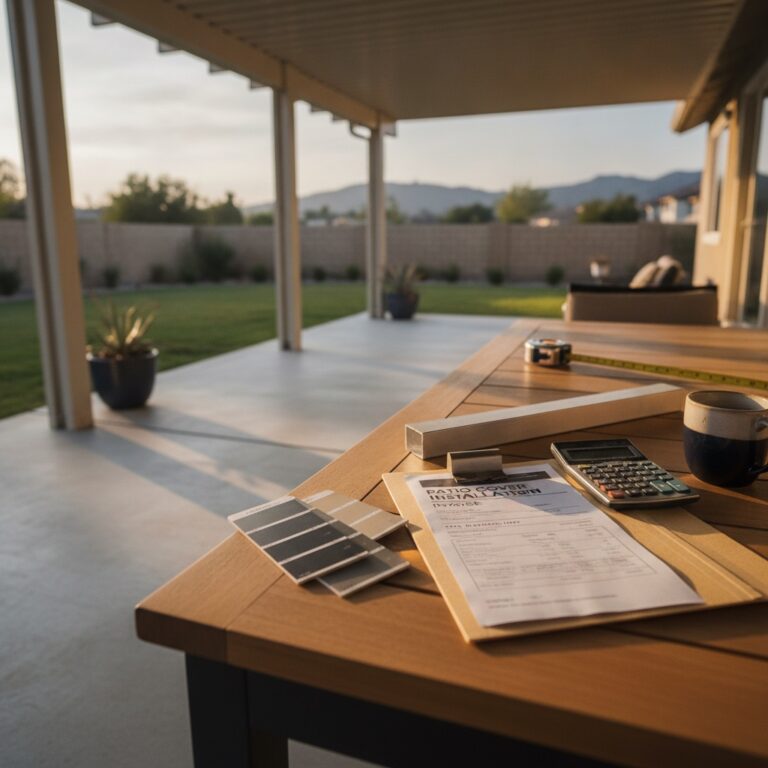
If a covered patio is on the list for this year, the useful next step is small. Get an in-home measurement, a written scope, and a real number on paper while the fall calendar still has room. We do the consult at no charge, and it takes about 45 minutes at the kitchen table with a tape measure and color samples. Call or request a free in-home quote, and the answer to whether it can be done before the holidays becomes a date instead of a guess.
Morning-context sources used: https://www.bankrate.com/home-equity/heloc-rates/ , https://finance.yahoo.com/personal-finance/mortgages/article/heloc-and-home-equity-loan-rates-today-thursday-september-3-2026-borrowing-needs-will-dictate-your-interest-rate-100000999.html , https://www.bankrate.com/loans/home-improvement/rates/ , https://www.angi.com/articles/patio-cover-installation-cost.htm , https://homeguide.com/costs/covered-patio-cost , https://pwds.oc.gov/service-areas/oc-development-services/permitting-services/faqs , https://www.abcsouthtexas.org/construction-backlog-in-2026-how-to-read-abcs-indicator-and-plan-for-south-texas/