

Sunset in Anaheim tonight lands at 7:16 p.m. On September 30 it lands at 6:38 p.m. That is 38 minutes of patio time gone in three weeks, and the slide keeps going. Once the clocks change on November 1, the sun drops behind the fence just before 5 p.m., which means dinner happens in the dark for the rest of the year.
Most SoCal homeowners respond to that by moving everything back indoors around Halloween. The families who do not are the ones who added light overhead before the days got short. A covered patio with a real lighting layer stays in use through Thanksgiving and past New Year’s. An uncovered slab with one motion floodlight by the back door does not.
The Fullerton Evening That Changed After the Cover Went Up
Picture a two-story house off Bastanchury in Fullerton. Four people, two of them teenagers, an 18 by 12 concrete slab facing west, and a sliding door off the kitchen. Before the cover, that slab was a July afternoon problem and an October evening problem at the same time. Too hot at 4 p.m. in summer, too dark at 6 p.m. in fall.
They put up a 20 by 14 solid-roof aluminum cover with three posts and a fascia gutter. The extra two feet past the slab on each side matter more than people expect, because rain sheets off the roofline and lands on dirt instead of on the chairs. Installed, a cover that size in Orange County commonly runs between $8,000 and $14,000 depending on post count, beam spans, and whether the electrical gets pulled at the same time.
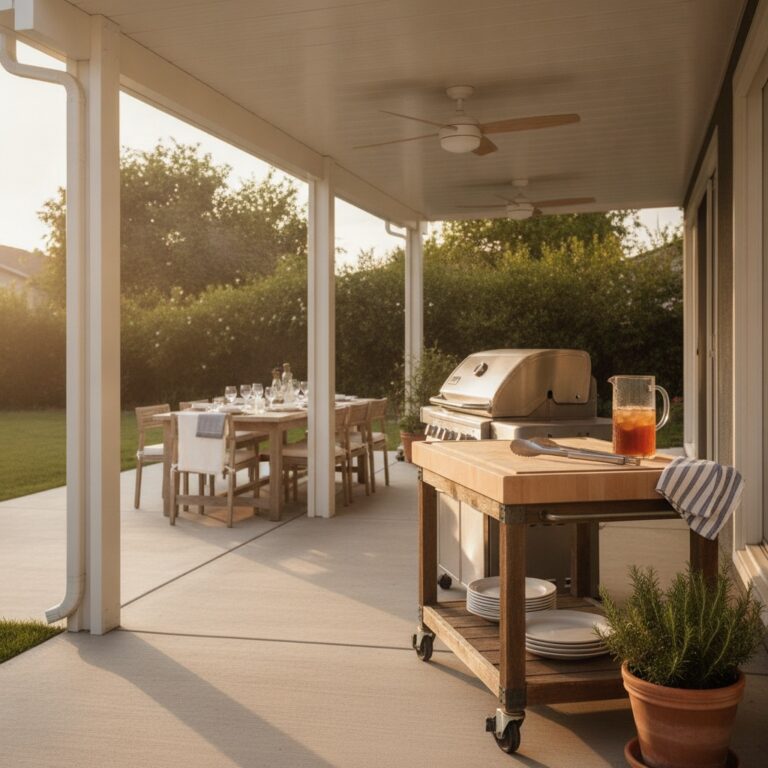
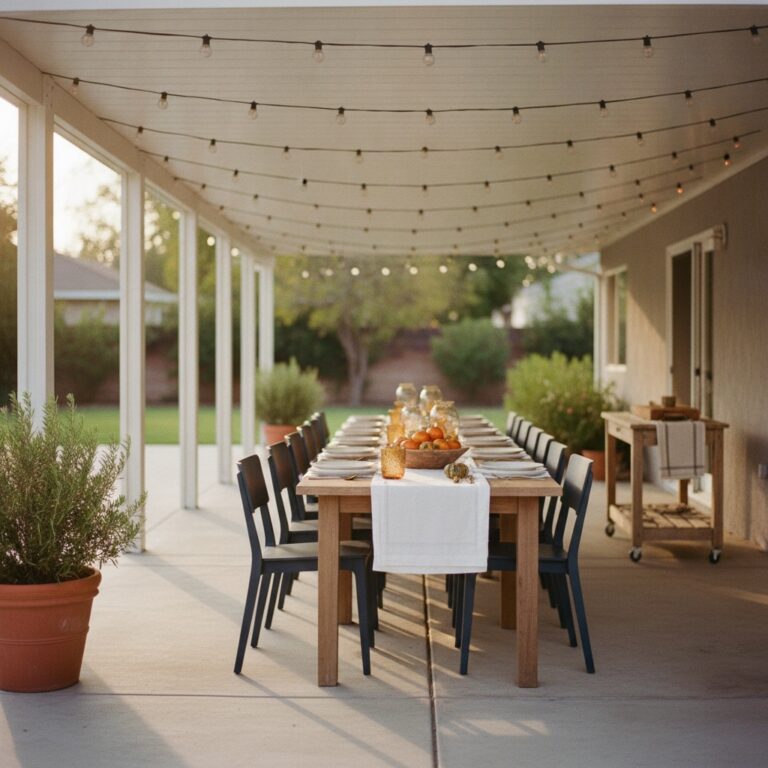
The lighting is where the evening actually got won. Two strands of G40 string lights at 2700K run the long axis under the beams. A 52-inch wet-rated ceiling fan with an integrated dimmable light sits dead center at eight feet of clearance. One 20-amp GFCI outlet lives on the post nearest the door. That is three layers of light, and none of them is a floodlight.
How String Lights Actually Attach to an Aluminum Cover
This is the question homeowners ask at the kitchen table and almost nobody answers well. Aluminum patio cover components are hollow extrusions, not solid lumber, so you do not sink a lag bolt into them and hope. The right approach is stainless steel eye hooks or eye screws with a #10 self-tapping tip, driven into the beam web or the underside of the W-pan rib where the metal is thickest.
A few specifics worth writing down before you climb a ladder:
- Use stainless hardware only. Zinc-plated hooks streak rust down a white powder-coat finish within one wet winter.
- Space hang points about every 6 to 8 feet so each span carries a deliberate 10 to 12 inch sag. The sag is what makes the light look designed instead of strung.
- Run a 1/8-inch stainless guide wire with turnbuckles for spans over 20 feet. The strand hangs from the wire, not the other way around.
- Pick 2700K bulbs, not 4000K. Warm white reads as dinner. Cool white reads as a parking structure.
- Terminate at a GFCI outlet on a post, not an extension cord snaking through the slider.
A 24-foot commercial-grade strand with 15 sockets and shatterproof G40 bulbs typically costs $50 to $90. Two strands, the hardware, and a plug-in dimmer land the whole lighting layer under $300 if you do it yourself. Powder-coat finishes on quality aluminum covers carry warranties in the 20-year range, so the penetrations you make matter. Ask your installer to pre-drill and seal the eye hooks during the build. It costs almost nothing while the crew is already on the roof.
What a Tuesday in Late October Looks Like
Dinner is at 6:30. The sun is already gone. The fan light comes on at 40 percent, the string lights at full, and the slab reads warm rather than lit. A 72 by 38 inch table seats six with elbow room, and it needs roughly 12 by 8 feet of clear floor to pull chairs without anyone standing up to let someone by. On a 20 by 14 cover that leaves a genuine second zone at the far end.
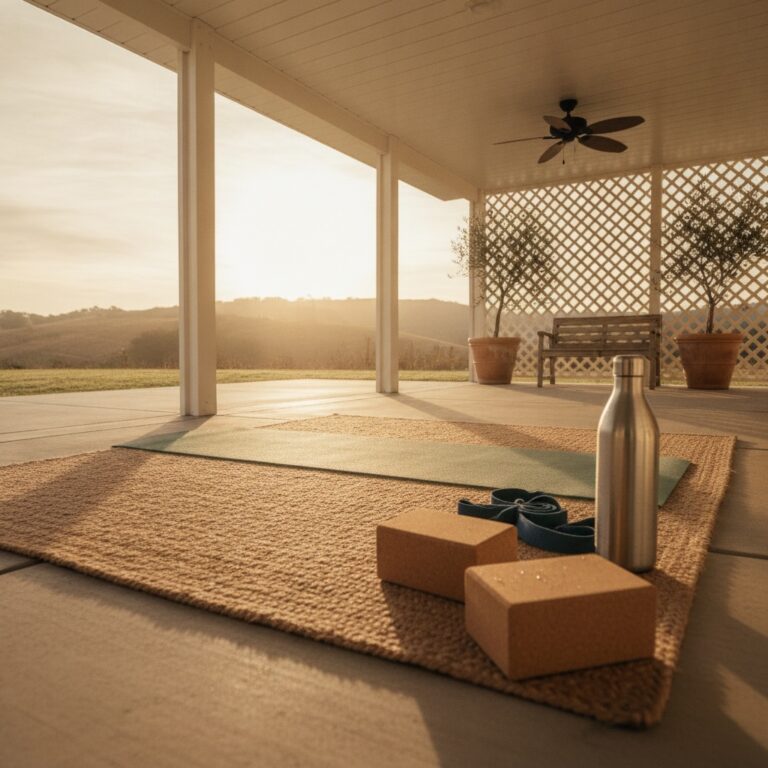
That second zone is two lounge chairs and a small side table under the fan. Homework happens there at 4 p.m. while it is still light. Someone reads there at 8 p.m. under one strand. The point of a covered patio is not one activity, it is a room that changes use three times between four o’clock and nine.
Weather is doing exactly what makes this argument right now. The National Weather Service in San Diego has a Heat Advisory running from 10 a.m. Tuesday through 8 p.m. Thursday for Orange County coastal and inland areas, the Inland Empire, and the Santa Ana Mountains. Overnight lows are forecast 8 to 15 degrees above average with a tropical airmass parked overhead. ABC7 has Los Angeles and Orange counties in the upper 80s and low 90s midweek, with the Inland Empire hitting triple digits Wednesday.
Read that carefully. The days are shrinking and the evenings are still warm. That combination, short and mild, is the best patio window Southern California gets all year, and it runs from now through early December. Eighty-two degrees at 7 p.m. in Yorba Linda is better patio weather than anything July delivers. A cover with light under it is the only reason you get to keep that hour instead of spending it in the living room.
Furniture, Plants, and Fan Placement That Survive Fall
Fall on a SoCal patio is not cold, it is damp and dark. Santa Ana events dump dust across everything on the slab, then a December storm comes through and turns that dust into grit that grinds into cushion fabric. Anything you put out there needs to survive a hose-down every few weeks without fading or growing mildew. Choose accordingly.
For furniture, powder-coated aluminum frames with solution-dyed acrylic cushions hold up. Untreated teak turns gray by February unless somebody oils it, and nobody oils it. For plants, skip the summer annuals and set 18-inch pots along the perimeter with dwarf olive, rosemary, and kangaroo paw. All three take the dry heat this week and the wet weeks in December without complaint. Star jasmine on a post reads green year-round and smells like spring in March.
Fan placement gets rushed more than anything else. Center it over the seating people occupy longest, which is usually the table, not the middle of the cover. Keep blade tips at least 24 inches from any beam and mount for a minimum of seven feet of floor clearance, though eight feet feels better under a solid roof. A wet-rated fan is required if any rain reaches the fixture. Damp-rated is fine only under a fully solid roof with generous overhangs.
One more thing that gets skipped: run the wiring during the install. Adding a fan box, a switch leg, and a GFCI outlet while the beams are open costs a fraction of what it costs to retrofit conduit onto a finished cover two years later. Retrofits mean surface-mounted conduit running down a post, a second permit, and an electrician billing a half day for work that took twenty minutes during the original build. Decide on the fan now even if you install it next spring.
Book the Design Walkthrough Before the Clocks Change
The autumnal equinox arrives at 5:05 p.m. on Tuesday, September 22. From there the light goes fast. Homeowners who call in September get a cover finished in time for Thanksgiving overflow seating. Homeowners who call in November are looking at a February install and another dark holiday season on the wrong side of the slider.
If you have a slab in Fullerton, Yorba Linda, Corona, Chino Hills, or anywhere across Orange County and the Inland Empire that goes unused after six o’clock, we will come measure it, walk the sun angles with you, and lay out where the lights, the fan, and the outlet should go before anything gets ordered. The in-home design walkthrough and the quote are free, and there is no obligation on either side. Bring your table dimensions. That one number decides more of the design than anything else.
Morning-context sources used: National Weather Service San Diego Area Forecast Discussion, issued 11:28 a.m. PDT September 7, 2026 (https://forecast.weather.gov/product.php?site=sgx&issuedby=SGX&product=AFD); ABC7 Los Angeles, “Hot, humid conditions remain as showers from Marie begin to move out of SoCal,” September 7, 2026 (https://abc7.com/post/los-angeles-weather-temperatures-southern-california/58983/); timeanddate.com, Anaheim sunrise and sunset times for September 2026 (https://www.timeanddate.com/sun/usa/anaheim?month=9); Livingetc, “Livingetc Style Awards 2026 – Outdoor,” July 28, 2026 (https://www.livingetc.com/features/livingetc-style-awards-2026-outdoor); Bela Development, “Outdoor Living Trends for 2026,” June 24, 2026 (https://beladevelopment.com/insights/outdoor-living-trends-2026).