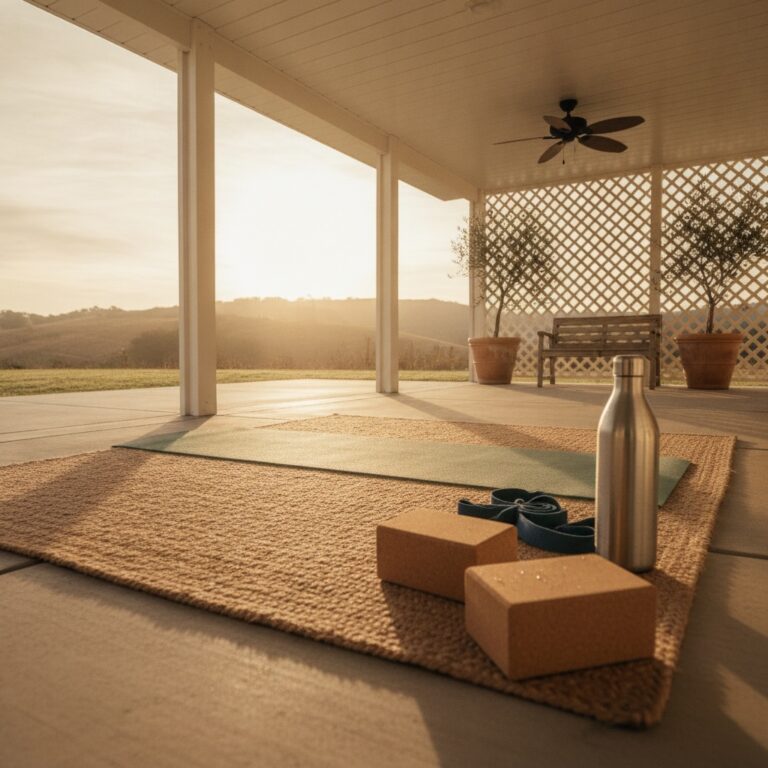


The 2026 NFL season opens Wednesday, September 9, and the first full Sunday slate lands September 13. Back east those early games kick at 1 p.m. In Fullerton they kick at 10:05 a.m. That single time-zone fact reshapes what a football patio has to do in Southern California. Your guests are not showing up at dusk with jackets. They are showing up mid-morning, into 88-degree sun that sits low enough in September to fire straight under a west-facing eave and wash out any screen you put outside.
Most homeowners plan the fall patio around cold. In SoCal, the first six weeks of the season are a heat and glare problem, and only the last six are a temperature problem. A cover that handles both is a different build than a cover that handles one.
The 10 a.m. Kickoff Nobody Plans For
Take a common Orange County setup: a 20-by-12 concrete slab off the back slider, facing southwest, no cover. On September 13 the sun clears the neighbor’s roofline around 9:15 and hits that slab flat until early afternoon. Surface temperature on bare gray concrete in Corona or Rancho Cucamonga runs 125 to 140 degrees under direct September sun. Nobody sits there voluntarily, and no outdoor television is readable in it.
A solid aluminum cover with 3-inch insulated roof panels drops the air temperature underneath by roughly 15 to 20 degrees against open slab, and it kills the glare problem outright because the screen is in full shade from the first snap. Lattice will not do this job. Lattice at 3-inch spacing still throws moving bars of light across a display, and a 10 a.m. September sun angle sends most of that light under the cover sideways anyway. For a viewing patio, solid roof wins, and it is not close.
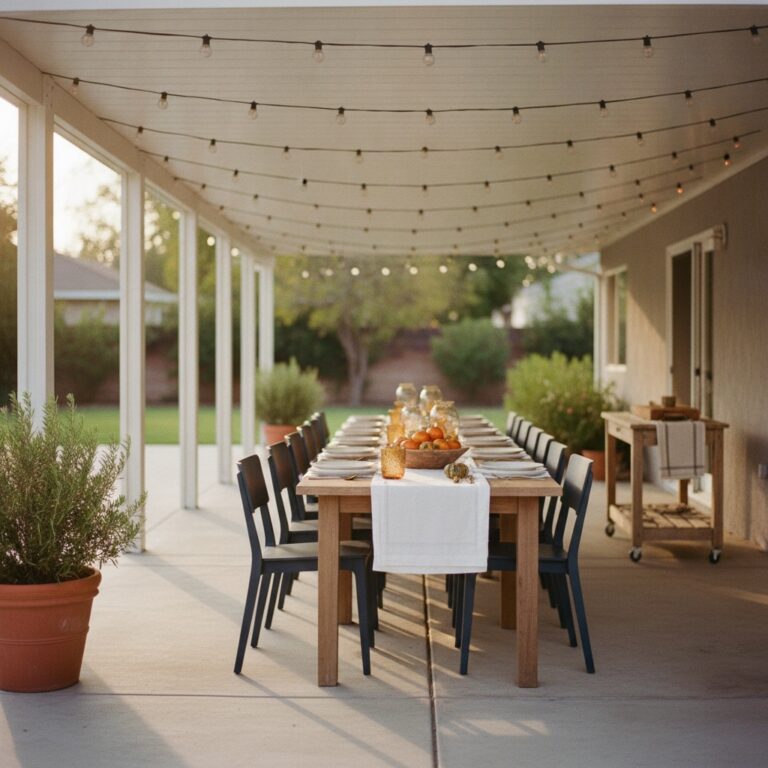
The side-light issue is real and worth solving with the layout instead of more structure. Turn the seating so the screen faces east or north, putting the back of the display toward the low sun rather than the face of it. A 24-inch drop valance on the west-facing beam adds another two hours of usable shade in September and October for a few hundred dollars, and it disappears visually once the string lights go up.
Laying Out a Room That Holds Twelve People
A football patio fails on circulation before it fails on square footage. People do not sit still for three hours. They get up between drives, they cluster at the food, and they need a path that does not cross in front of the screen.
The layout that works on a 20-by-12 cover looks like this. Put the screen on the house wall, centered, mounted at 42 to 48 inches to the bottom edge so seated sightlines clear the heads in front. Run a 96-inch outdoor sofa plus two swivel lounge chairs in a loose U, 8 to 9 feet back from the display. Swivels matter more than they sound. They let somebody turn to talk without dragging furniture across the slab.
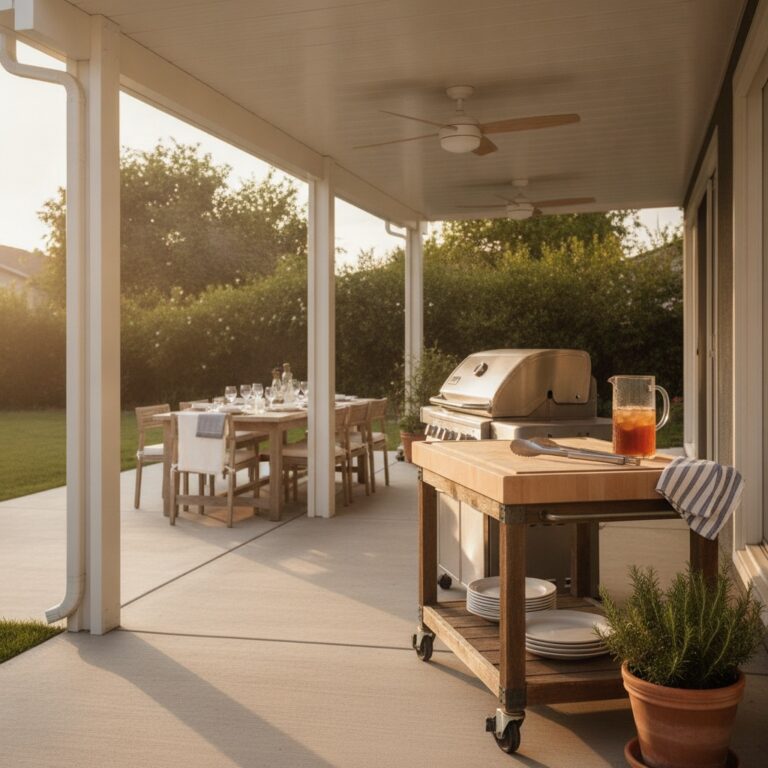
Push the food to the far end, on the post line rather than the wall. A 60-by-30 folding table or a 6-foot prep cart along the outer post keeps the buffet traffic in a lane behind the seating instead of through it. Leave 36 inches of clear walkway between the back of the sofa and the food line. That gap is what separates a patio that feels roomy from one that feels crowded at the same guest count.
The Houzz 2026 outdoor trends study found 83 percent of renovated outdoor spaces now include a lounge or seating area and 71 percent have sofas or lounge chairs, which tracks with what actually gets used. Dining tables came in second at 55 percent. For a viewing patio, weight the budget toward deep seating and treat the table as overflow.
Fans in September, Heat in December
The same 200-square-foot cover has to run two completely different comfort systems across one season, and both of them come down to electrical work you want done during the install, not after. September wants moving air. December wants radiant heat. Neither one is optional if the goal is a patio the household uses from Week 1 through the playoffs, and both are far cheaper to build in than to add on once the panels are set and the beams are closed up.
September through mid-October is fan season. A 52-inch damp-rated ceiling fan mounted in the beam bay moves enough air across a 12-foot depth to make 88 degrees sit like 82. It has to land on a fan-rated junction box, not a standard box, and the box has to be integrated into the aluminum beam during fabrication. Retrofitting a fan into a finished cover means cutting and fishing wire through an installed structure, which costs more and looks worse. Two fans on a 20-foot run beats one oversized fan every time, spaced roughly 10 feet apart.
Mid-November through January is heat season, and SoCal evenings mislead people. A 4:25 p.m. Eastern kickoff is 1:25 p.m. here, so the fourth quarter of a December game lands right as the sun drops behind the Chino Hills and the slab gives up its warmth. Temecula and the inland valleys fall from 72 at 3 p.m. to 52 by 6 p.m. that time of year.
Two workable answers. Propane mushroom heaters at roughly 40,000 BTU warm about a 10-foot radius each, so a twelve-person patio wants two of them positioned behind the seating, not between the seating and the screen. Or mount 1,500-watt infrared electric units to the cover itself, angled down at the seating cluster. Electric costs more up front and requires a dedicated 20-amp circuit, typically 400 to 900 dollars of electrical depending on panel distance, but the heat is instant, silent, and there are no tanks to swap at halftime.
Either way, plan the circuit before the cover goes up. A patio running two fans, a television, a receiver, and two infrared heaters pulls more than a single 15-amp garage circuit will carry. Ask the installer to pull a dedicated line and land two weatherproof outlets on the post line, one at each end of the cover. Extension cords crossing a slab full of guests is the kind of shortcut that gets someone hurt during a third-quarter beer run.
What the Structure Actually Has to Carry
Hanging a 75-inch display, two fans, and a pair of heaters off a patio cover is a real load, and the specs matter. Look for 6-by-8 extruded aluminum beams on a 20-foot span, which lets you hold post spacing at 10 feet and keeps a post out of the middle of the seating area. Roof panels should be 3-inch insulated with a minimum .024 skin. Anything thinner drums under rain and flexes when a fan is running below it.
Ask what powder-coat spec the frame carries. AAMA 2604 is the mid tier at five years of South Florida exposure testing. AAMA 2605 is the ten-year tier, and it is what you want in Long Beach or Carlsbad where salt air is in play. Frames from a reputable fabricator carry a limited lifetime structural warranty with 20 years on the finish, and the difference between a 2604 and 2605 quote on a 240-square-foot cover is usually a few hundred dollars. Take the better finish.
One more item people skip. If the patio is going to hold a television, ask for a chase or conduit run inside the beam during fabrication. Clean cable routing through the structure costs almost nothing at build time and saves you from stapling coax to an aluminum post later.
Football season is a good forcing function. It gives you a date on the calendar and a specific list of things the space has to do, which makes the design decisions concrete instead of theoretical. If you want to see the sun angles on your own slab and get the fan and heater placement mapped out before Week 1, we will come out, measure the yard, and put together a free in-home quote with the electrical and structural details spelled out. Most SoCal installs run three to five weeks from permit to finish, so there is still runway to be sitting under it before the games that matter.
Morning-context sources used: 2026 U.S. Houzz Outdoor Trends Study; Stacker, Investing in outdoor living: 5 of the biggest backyard trends of 2026 (Aug 6, 2026); NBC Sports, When does the 2026 NFL season start (Aug 2026); AOL, These 6 Backyard Trends Are Defining Outdoor Living in 2026; Blue Haven, How to Host the Ultimate Backyard Football Party This Fall; Old Farmer’s Almanac, Long-Range Weather Forecast for Los Angeles.