

There is a backyard in Yorba Linda that sits about a quarter mile off the mouth of the Santa Ana Canyon, on a lot that steps down toward the riverbed. Nine months of the year it is the best patio on the street. Then late September arrives, the pressure gradient flips, and the air comes down the canyon from the high desert at 40 mph with gusts past 55. The homeowner there has a wood-framed cover with corrugated panels on it. Every offshore wind event, the whole thing chatters like a loose gutter, and one panel has already lifted a corner off its screws.
That is the style question nobody asks until mid-September. Most patio cover shopping happens in June, when the only thing that matters is shade. Wind is a style decision too, and the choice you make between solid, lattice, and louvered changes how your patio behaves during the six or seven offshore events a typical SoCal fall throws at you. This year the setup is worth paying attention to: forecasters have flagged an active offshore wind pattern building from late September onward, and the National Weather Service has already been issuing red flag products across California in the second week of the month.
Why Santa Ana wind is a different load than ocean breeze
A sea breeze pushes laterally. It hits the side of a structure, spills around the posts, and leaves. Offshore wind coming down a canyon does something meaner. It arrives as a downslope flow, hits the slab, and rolls. That rolling motion gets under the roof plane and pulls up. The engineering term is uplift, and it is the load that breaks patio covers in Southern California, not the sideways push people picture.
The numbers matter here. Wind advisories for inland Orange County routinely call for sustained easterly winds of 20 to 30 mph with gusts to 50, and the canyon-adjacent zones see isolated gusts near 65. A 12 by 20 foot roof plane under that kind of uplift is not a shade structure anymore. It is a wing.
The California Residential Code handles this in Appendix AH, which governs patio covers specifically and requires that every part of the structure be interconnected well enough to resist uplift and lateral displacement, and to carry those forces all the way down to the foundation. The same appendix sets a floor on the metal itself: extruded aluminum members have to run at least 0.040 inch wall thickness. Engineered aluminum cover systems commonly carry ratings starting around 95 mph and running past 130 mph, but that rating only holds if the anchoring matches it.
Solid roof: the most shade, the most sail
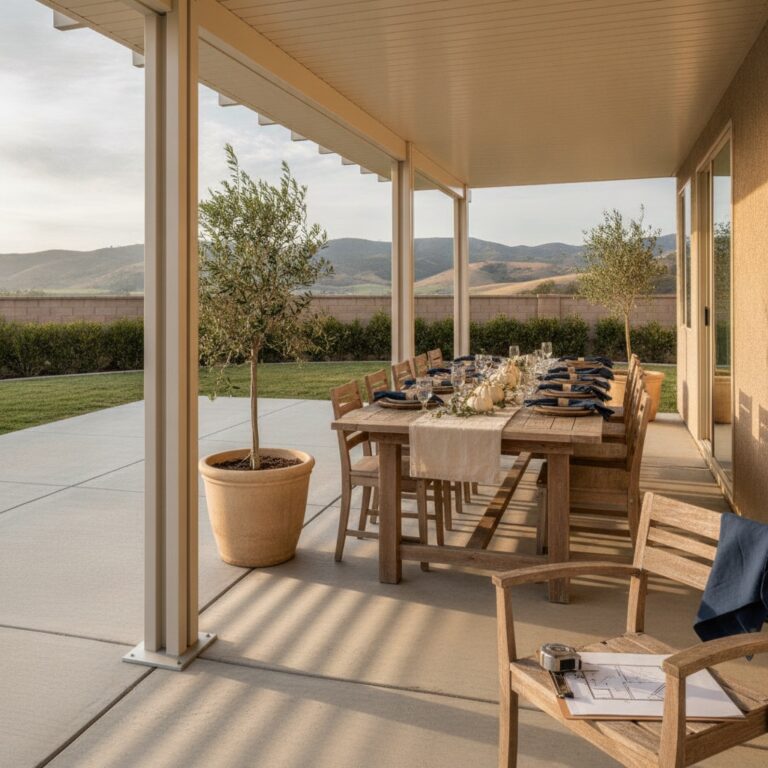
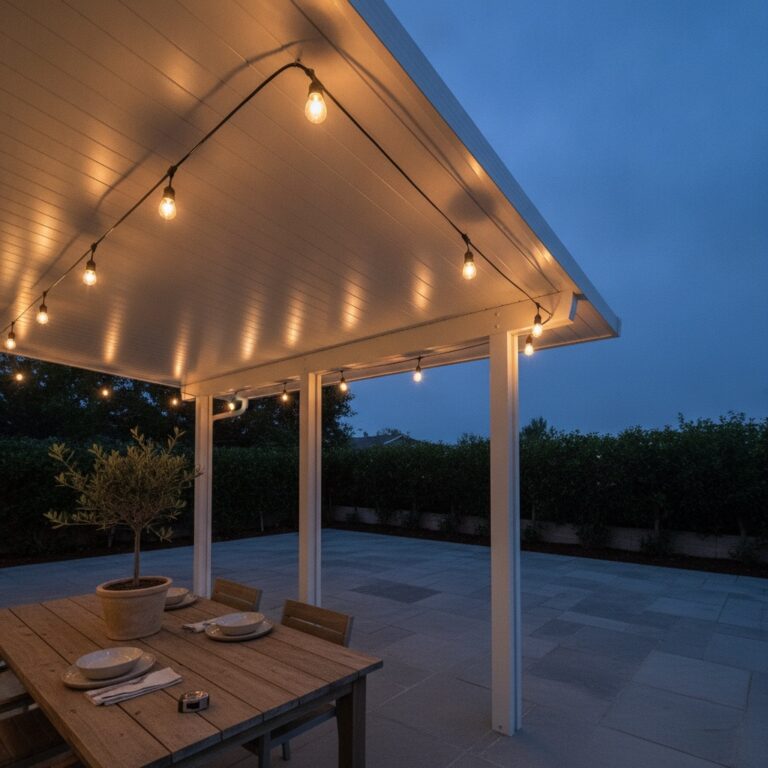
A solid roof gives you the full package. No sun at 3pm, rain protection, and a ceiling you can mount a fan and can lights into. It also gives the wind the largest continuous surface on the menu. That is not a reason to avoid it. It is a reason to spec it properly.
The difference between a solid cover that rides out a 55 mph gust and one that oil-cans and rattles comes down to three things. First, pan gauge. A 0.019 inch W-pan is fine on a coastal Costa Mesa slab and marginal in Yorba Linda or Rancho Cucamonga. Step up to 0.024 or move to a 3 inch foam-core insulated panel, which behaves as a structural deck rather than a sheet of corrugated metal.
Second, post spacing. Ten feet on center is common. Eight feet on center in a wind corridor costs you one extra post and buys a meaningful reduction in the span that has to resist uplift. Third, the attachment at the house. An attached cover ledger lagged into the rafter tails with a proper flashing detail is dramatically stiffer than a freestanding frame of the same size, because the house itself becomes the wind brace on one side.
Insulated panels are the quiet upgrade in both senses. The foam core kills the drumming sound that makes a patio unusable during a wind event, and the panel stiffness means the roof plane stops flexing. A 3 inch insulated roof on a 12 by 20 cover typically runs 20 to 30 percent over a standard W-pan build in SoCal, which is real money, and it is the single change that most improves how the patio feels in October.
Lattice: less shade, far less to push against
Open lattice is the style that takes Santa Ana season in stride, and homeowners in wind-exposed lots undersell it. A lattice roof lets air pass through instead of trapping it. There is no continuous plane to lift. The rafters and cross members carry wind through the openings, and the whole structure sits quieter under gusts than a solid roof of the same footprint.
What you give up is real and you should hear it plainly. Lattice gives filtered shade, not full shade. On a west-facing slab in Riverside at 3pm in July, dappled shade is not enough to make the patio usable. Lattice sheds no rain at all. And in fall, when the low sun angle comes in under the roof line anyway, the shade you do get drops off further.
The style fit is specific. Lattice earns its place on ridge lots, canyon-adjacent yards, and second-story deck covers where wind exposure is high and the patio is used mostly in the morning and evening. Pair a 2 inch by 6 inch lattice rafter at 12 to 16 inches on center with a solid-roof section over just the dining zone, and you get the practical combination: real shade where the table lives, open air over the rest.
Louvered pergolas and the freestanding question
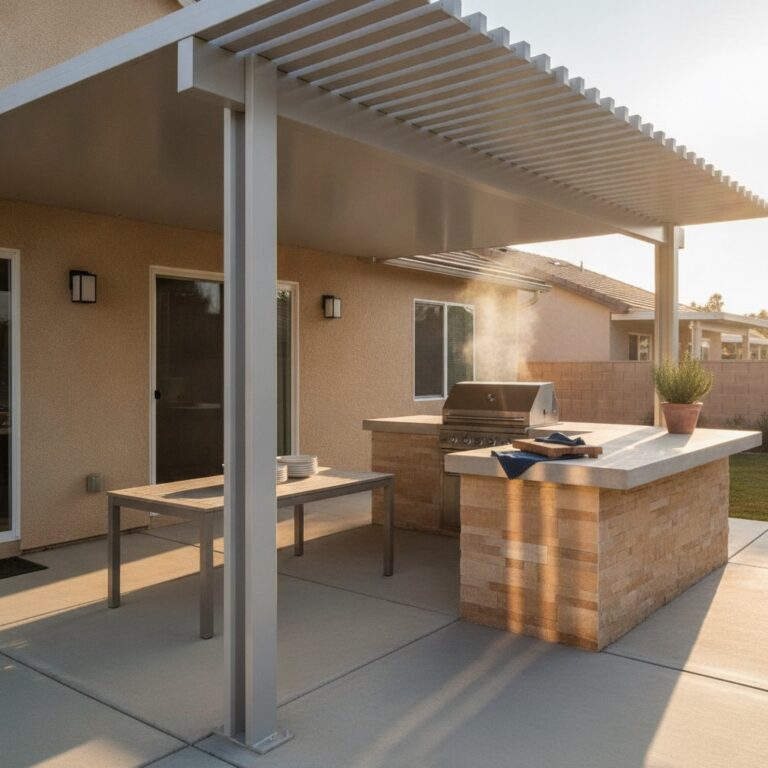
Adjustable louvered roofs have moved from a luxury item to something homeowners now expect to see quoted, and manufacturers have leaned into motorized and app-controlled versions for 2026. For wind, a louvered system has a genuine advantage: open the louvers and the roof plane stops being a plane. Many systems also include a wind sensor that opens the blades automatically above a set speed. That is a real feature in a Santa Ana corridor, not a gadget.
The tradeoff is cost and complexity. A louvered aluminum roof runs well above a fixed solid cover per square foot in SoCal, and there are moving parts, seals, and a motor that a fixed cover does not have. Ask what the warranty covers on the mechanism separately from the frame, because those are usually different terms. A quality powder coat finish at AAMA 2604 or 2605 should carry a long finish warranty on the extrusions, while a motor and controls package is typically shorter.
The last style call is attached versus freestanding, and in wind country it is not close. A freestanding cover has four or six posts resisting everything on their own. Every one of those post bases needs proper anchorage into the slab, and a 4 inch residential pour is often the limiting factor, which is why a freestanding build in a wind corridor frequently needs a footing dug and poured at each post rather than wedge anchors into existing concrete.
An attached cover borrows the house for lateral bracing on one full side. If the roof line and drainage work, attached is the stronger structure and usually the cheaper one. Freestanding still wins when the cover needs to sit over a pool deck, a detached kitchen, or a spot where the house eave makes attachment ugly.
If your yard sits anywhere near a canyon mouth, a ridge, or a pass, the honest first step is having someone stand on your slab and look at the exposure before talking panels and colors. JNL builds these covers across Orange County, the Inland Empire, and north San Diego County, and the wind exposure at a given address changes the spec more than the style catalog does. A free in-home quote gets you the post spacing, panel gauge, and anchoring detail written down in specifics, so you know exactly what your patio will do the next time the canyon starts blowing.
Morning-context sources used: Weather West, September 2, 2026, record SoCal summer humidity and the El Nino-boosted fall pattern; NWS Red Flag Warning product effective September 14, 2026; NWS Red Flag Warning product effective September 13, 2026; California Residential Code Appendix AH, Patio Covers, uplift and 0.040 inch extrusion minimum; ABC7 Los Angeles, Santa Ana wind advisory gust ranges for Orange County; Outdoor living trends 2026, motorized louvered roofs and wind sensors.