

On September 6 the leftovers of Hurricane Marie dragged a band of rain across Orange County and the Inland Empire, and forecast models for the Prado Dam catchment above Corona spread from about a third of an inch to well over an inch depending on which run you trusted. That is a rounding error compared to what NOAA is signaling for winter. The agency’s summer ENSO updates put the odds of a very strong El Nino by December in the low 80 percent range, and past events of that size have delivered 150 to 230 percent of normal rainfall to Southern California. Your patio cover is about to become a small roof with a big job.
Most homeowners in Corona, Chino Hills, Norco, and Yorba Linda buy a cover for shade. Shade is the easy part. Aluminum handles 105 degrees and UV 11 without blinking. What separates a cover that survives a wet winter from one that turns a back door into a wading pool is drainage, and drainage gets decided at the quote stage, not after the first storm.
Run the Water Math Before You Run the Shade Math
Take a common size: a 12 foot by 20 foot attached solid cover. That is 240 square feet of catchment. One inch of rain across that footprint is roughly 150 gallons of water. It has to go somewhere, and gravity has already picked the spot.
Now shorten the clock. Forecasters watching the Eaton and Palisades burn areas talk about a half inch per hour as the level where things get serious on scorched ground. That same half inch per hour off a 240 square foot cover is about 75 gallons in sixty minutes, arriving at whatever edge sits lowest. Without a gutter, it sheets off the front beam in a curtain, hits the concrete, and splashes back against your stucco and your slider track. Homeowners usually describe this as “the cover leaks.” It does not leak. It is doing exactly what an unguttered roof does.
Bigger covers scale the problem fast. A 16 by 30 freestanding cover is 480 square feet, which doubles every number above. Ask your installer for the square footage on the drawing and do the multiplication at the kitchen table. It takes ten seconds and it changes the conversation.
Integrated Gutters Beat Bolted-On Gutters
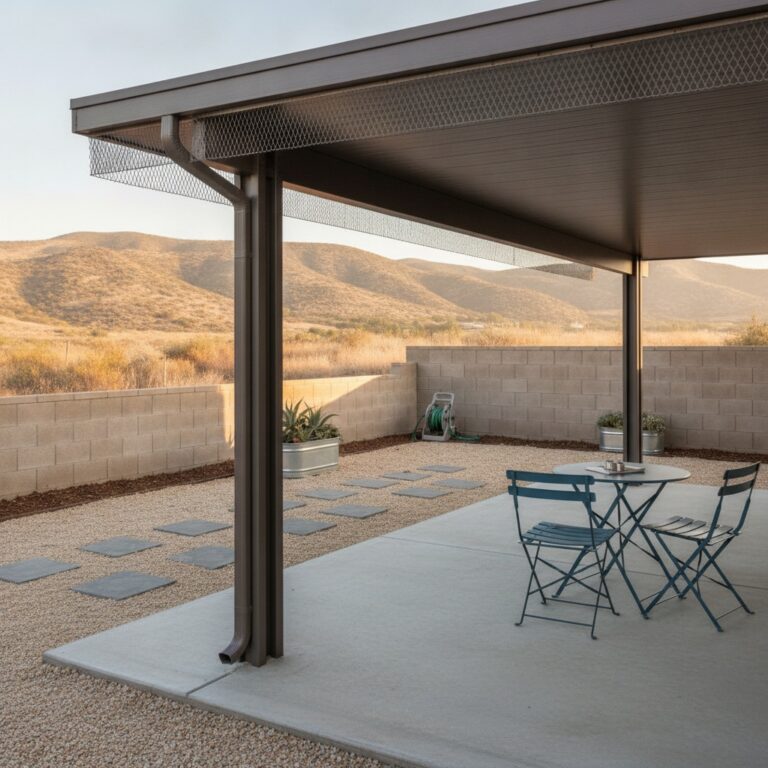
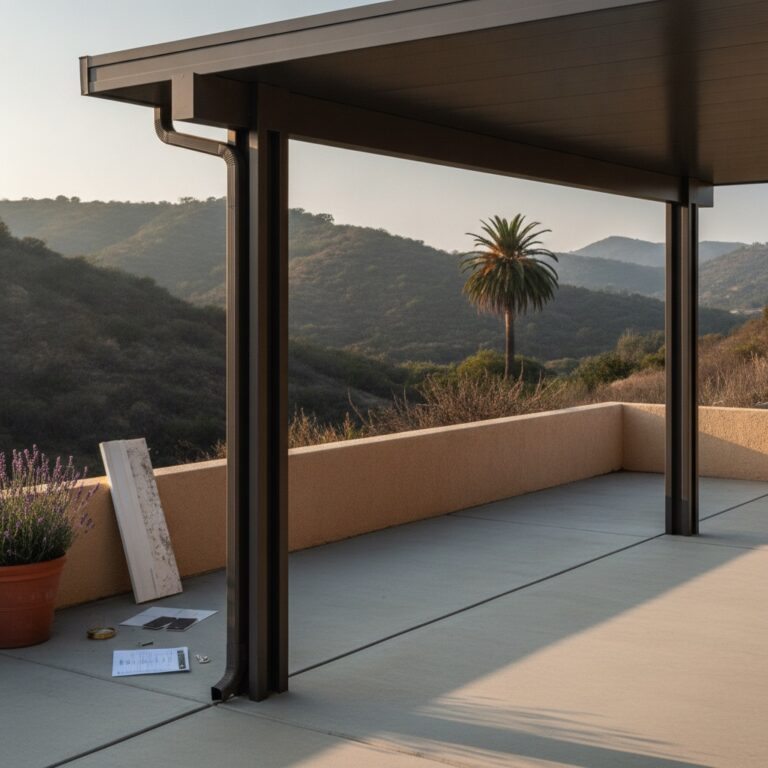
Quality aluminum patio systems build the gutter into the front fascia beam rather than hanging a separate trough off the edge. The beam is structural and the water channel lives inside it. That matters for three reasons in a SoCal winter.
- No separate fastener line to work loose in a 45 to 60 mph Santa Ana gust, which the Inland Empire sees several times between October and February.
- No dissimilar metal contact. A steel bracket holding an aluminum gutter is a corrosion cell waiting for coastal humidity or a wet January.
- The powder coat runs continuous across the beam face, so the water channel carries the same AAMA 2604 or 2605 finish as the rest of the cover instead of a thinner painted add-on.
Ask which AAMA tier the finish carries. AAMA 2604 covers most residential work with a five year color and chalk resistance standard. AAMA 2605 is the architectural tier, typically warranted around ten years, and it is worth the upcharge on a west or south elevation in Corona where afternoon sun is brutal from May through October.
One Downspout Is Almost Always the Wrong Answer
Here is where good installs and cheap installs part ways. A single 2 inch by 3 inch downspout at one end of a 20 foot beam is common because it is fast and it looks clean. It also asks that one opening to pass every gallon the cover collects, and it puts all of it at one corner of your slab.
Two outlets, one at each end, cut the load in half and give the system somewhere to go when a leaf mat forms over one of them. On covers over roughly 300 square feet, a 3 inch by 4 inch downspout is the better spec. It moves substantially more water and it is far harder to plug with jacaranda litter or the eucalyptus debris that blows through Chino Hills every fall.
Slope matters too. The cover itself should carry a minimum quarter inch per foot pitch away from the house so water actually travels. Inside the gutter channel, about a sixteenth of an inch per foot toward each outlet keeps standing water from sitting in the beam and breeding mosquitoes through a mild December. If an installer cannot tell you the pitch on the drawing, that is a real answer about how the job will go.
Where the Water Lands Is Half the Install
A downspout that dumps 150 gallons against a foundation has moved the problem twelve inches, not solved it. In flat backyards across Norco and Eastvale, the fix is a splash block plus a graded run that carries water at least four to six feet away from the house. On lots with any real slope, or where the discharge point sits uphill of a slider, the right answer is a 3 inch or 4 inch solid PVC line trenched to daylight or tied into an existing yard drain.
Expect the numbers to look roughly like this on a typical SoCal residential job. Integrated gutters with two downspouts on a 12 by 20 cover usually add somewhere in the $350 to $800 range over a bare fascia. A trenched underground tie-in runs $600 to $1,500 depending on how far the water has to travel and whether the crew is cutting through hardscape. Compare either figure to a slab that ponds under a slider for four months and the choice makes itself.
Foothill homeowners have a sharper version of this. Cal OES has been reminding residents near recent burn areas that scorched soil sheds water like pavement, so runoff that used to soak in now runs. If your lot sits below a hillside in Anaheim Hills, Chino Hills, or the Corona foothills, the cover’s discharge should never aim at the same low corner where hill runoff already collects. Put those two flows in the same place and a strong storm finds out for you.
Five Questions Worth Asking Before You Sign
Bring these to the estimate appointment. Any experienced installer answers all five without hedging.
- What is the square footage of the cover, and how many gallons does an inch of rain put through it?
- Are the gutters integrated into the fascia beam or bolted on separately?
- How many downspouts, what size, and at which posts?
- What pitch is the cover, and which direction does the gutter channel slope?
- Where does the water land, and how far is that from the foundation and the door track?
The wet season in Southern California effectively starts in late November and the strong El Nino pattern the forecasters are describing would push storm after storm through a jet stream aimed at Los Angeles and San Diego. Covers ordered now still land inside the install window ahead of it. Covers ordered in December get scheduled around storms.
JNL Aluminum builds drainage into the drawing rather than adding it later, and we walk the actual grade of the yard before quoting a downspout location. If you want the water math done on your specific slab and your specific slope, we will do a free in-home assessment and hand you the numbers in writing. Bring the questions above. We like the ones who ask.
Morning-context sources used: https://watchers.news/2026/09/03/atmospheric-river-targets-pacific-northwest-as-tropical-storm-marie-boosts-california-rainfall-risk/ , https://www.cbsnews.com/losangeles/news/hurricane-marie-rain-southern-california-september-6/ , https://www.techtimes.com/articles/325811/20260827/california-burn-scars-convert-el-nino-rains-debris-flows-flood-maps-understate-danger.htm , https://stormbag.co/blogs/news/noaas-new-winter-outlook-el-ninos-rain-arrives-late-hits-california-and-the-southeast-hardest , https://www.news.caloes.ca.gov/be-prepared-for-mudslides-and-debris-flows-in-burn-scar-areas/