

On August 19, 2026, the California Board of Forestry and Fire Protection approved the final draft of the state’s Zone 0 defensible space rules. If your backyard in Anaheim Hills or Yorba Linda backs to open chaparral, that vote changed the conversation about your patio cover. The first five feet around an occupied structure is now the state’s headline concern, and the rules name pergolas and the space beneath them directly. That puts a shade structure on the wildland edge squarely inside the hardening discussion.
What Zone 0 Asks of the First Five Feet
Zone 0 is the ember resistant zone: the first five feet measured out from the walls of the house. The approved draft phases in over roughly five years for existing homes. Phase one clears the combustible stuff most foothill homeowners already suspect is a problem. Firewood stacks, dead leaves, loose branches, bark mulch, and wood chips come out. Decomposed granite, gravel, and rock go in.
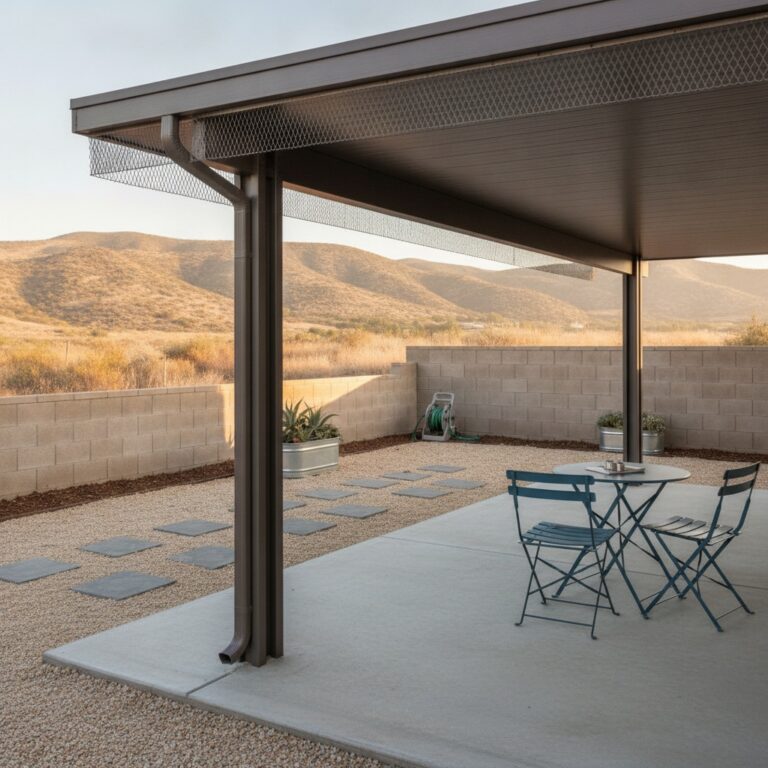
Later phases get more specific about structures. Vegetation is not allowed within five feet of an attached pergola. The area beneath decks, balconies, pergolas, and stairs has to stay free of plants and combustible material. Plants also come out from within two feet of windows, doors, and vents. Wood fences no longer get to touch the house. New accessory structures in Zone 0, including gazebos, pergolas, and sheds, must be noncombustible.
One clarification worth holding onto: the Board approved the final draft, but it is not enforceable yet. Office of Administrative Law review comes next, and no statewide effective date has been set. That gap is useful. A homeowner in Chino Hills or Corona who is already planning a cover this fall gets to build to the standard once instead of retrofitting to it later.
Why Aluminum Rates Where Wood Does Not
Extruded aluminum does not burn. It carries no fuel load, it does not feed a flame front, and it does not throw the airborne embers that drive house to house ignition in a wind event. A 6063-T5 extrusion melts somewhere around 1,220 degrees Fahrenheit, well above the radiant exposure a typical ember shower delivers to a shaded slab. A wood pergola on the same footprint is fuel bolted to the side of your house.
That distinction is what makes an aluminum cover the easy answer for a Zone 0 attached structure. A solid roof aluminum cover with a .050 to .070 inch wall extrusion, aluminum roof pans, and an aluminum fascia gives you a continuous noncombustible surface from the ledger board out to the drip edge. Nothing in the assembly needs an ignition test to pass a plan check, because there is nothing in it to ignite.
Chapter 7A of the California Building Code has treated attached structures as a studied ignition point for years. Walking surfaces on attached decks within 10 feet of a building carry material standards and testing requirements. Insurance underwriters have been reading those same studies. Aluminum sidesteps the whole test matrix by being the wrong material for a fire to work with.
Four Spec Choices That Matter on a Wildland Edge
Noncombustible framing is the floor, not the ceiling. Plenty of aluminum covers get installed on canyon lots every year with hardware and drainage details that were chosen for a flat tract lot in Fullerton. Four specifics separate a cover that holds up on the wildland edge from one that merely qualifies on paper. Ask about all four by name when you collect bids this fall.
- Fasteners. 300 series stainless hardware at every structural connection. Plated steel lags corrode, and a corroded lag on a Santa Ana night is a wind failure waiting for the right gust.
- Vent and cavity screening. Any ventilated cavity in the assembly gets noncombustible mesh between 1/16 and 1/8 inch. California requires OSFM listed vents tested to ASTM E2886 for ventilation openings in Fire Hazard Severity Zones. Ember intrusion through an oversized gap defeats an otherwise clean install.
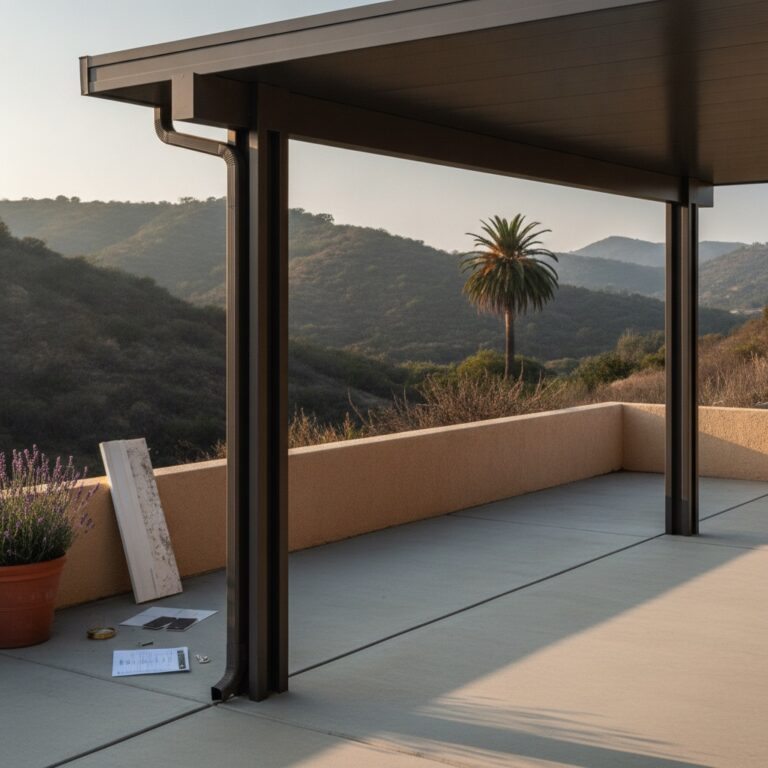
- Integrated gutters. An aluminum gutter tied into the cover with a downspout routed away from the wall keeps leaf litter out of the five foot band. An open fascia that dumps debris against your stucco creates the exact fuel bed Zone 0 exists to remove.
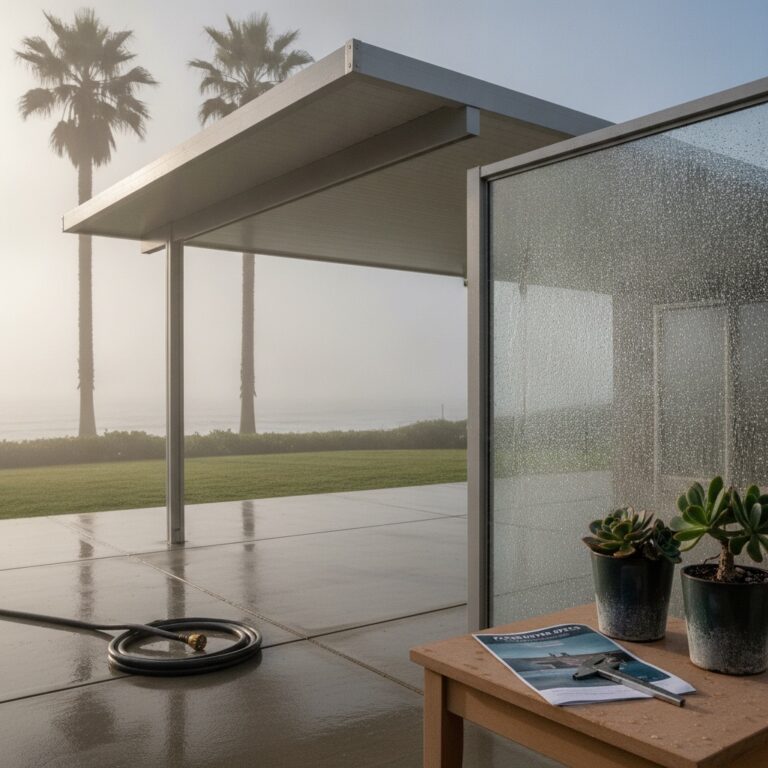
- Powder coat tier. AAMA 2604 is the working minimum inland. AAMA 2605 is the better call within a few miles of the coast or on a full sun west exposure. Neither tier changes the fire rating. Both change how the cover looks in year twelve.
What This Fall Looks Like on the Foothill Edge
The Southern Operations fire weather outlook for August through November 2026 reads a little kinder than last year. Santa Ana wind events are expected to run below normal through October and November, and a Gulf of Alaska storm is likely to arrive before the first real Santa Ana. Large fire potential still sits near normal across Southern California through November, which is the number that matters. Below normal wind frequency is not the same as no wind.
Precipitation is forecast near to below normal through September, then near to above normal in October and November, with warm storms and atmospheric rivers likely. That combination is a familiar one on a hillside lot. Dry fuel into late September, then heavy warm rain arriving on slopes that have not been graded for it. A cover with a real gutter tie and a downspout that carries water 10 feet off the foundation earns its keep in both halves of that pattern.
Homeowners in Yorba Linda, Anaheim Hills, Chino Hills, and Corona live at the intersection of both risks. Ember exposure from the canyon in October. Sheet flow off a slope in December. Aluminum handles the first by default and the second by design, provided the drainage was drawn before the posts went in.
The Paperwork Is Worth Asking About
Under the Safer from Wildfires framework, admitted California insurers must factor wildfire mitigation into underwriting and pricing. Documented Class A roof assemblies and hardened exterior work commonly move premiums in the range of 5 to 20 percent depending on the carrier. IBHS Wildfire Prepared Home designation has been associated with discounts running higher still. None of that is automatic. It requires documentation your carrier will accept.
So keep the paper. Material specs, the powder coat tier, the fastener schedule, the vent listings, the permit, and the warranty terms. A 20 year structural warranty and a 10 year finish warranty on a noncombustible assembly is a stronger file than a verbal assurance that the cover is fireproof. Ask for it in writing before the crew leaves.
If your slab sits within sight of open hillside, the honest starting point is a walk of the property with someone who reads the five foot band the way a plan checker will. We do that assessment in person, on your lot, with your exposure and your slope in front of us, and it costs nothing. Zone 0 is not enforceable yet. That makes right now the cheapest moment to build to it.
Morning-context sources used: https://www.pressdemocrat.com/2026/08/19/zone-0-regulations-passed-trees-plants-fences-californians-homes/ , https://www.wildfirela.org/2026/08/22/california-has-approved-zone-0-what-does-that-mean-for-los-angeles/ , https://timesofsandiego.com/california-fires/2026/08/19/wildfire-requirements-zone-0/ , https://gacc.nifc.gov/oscc/predictive/outlooks/myfiles/assessment.pdf , https://www.sandiego.gov/sites/default/files/2026-04/zone-0-guidelines-for-existing-structures.pdf , https://roofvista.com/resources/guides/california-wildfire-prepared-designation-guide