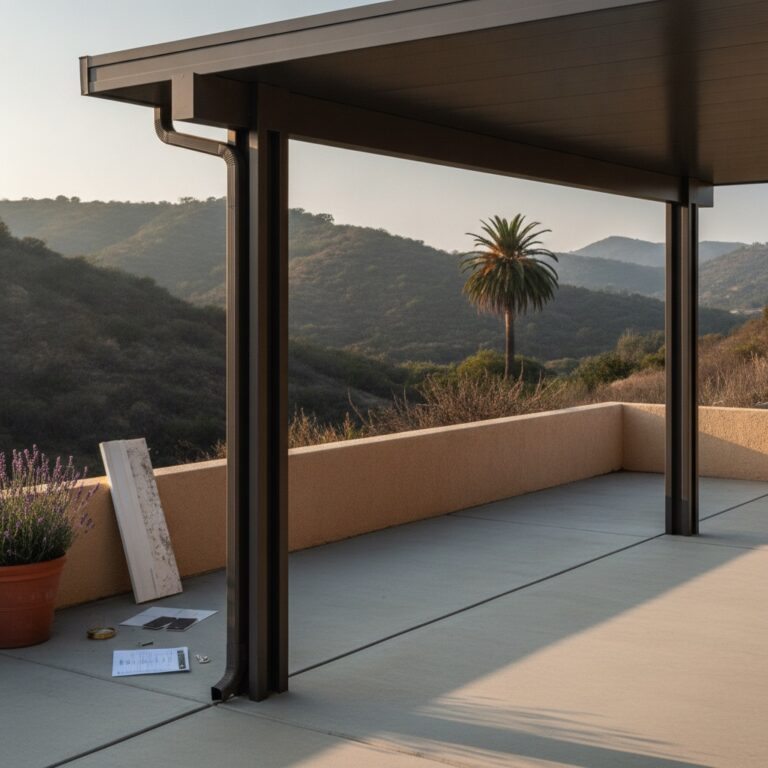


A homeowner on the east edge of Moreno Valley, backing up to the dry hills below Box Springs, got a notice this week from the city. Southern California Edison may cut power if the wind picks up. The National Weather Service has an extreme heat watch on Riverside and southwest Riverside County from Friday through at least Wednesday, Oct. 7, with highs at or above 100 degrees and easterly offshore gusts of 20 to 30 mph along the inland slopes. Her old wood lattice cover is 14 years old, gray, split, and bolted straight to the house.
That wood cover is now part of a conversation it was never built for. In August, the California Board of Forestry voted to adopt its “Zone 0” ember-resistant rules, and the clock on the first five feet around a home has started. Here is what that means for a patio cover in the Inland Empire foothills, and why the material under your roof matters more in October than in any other month.
Why October Is the Real Fire Month Inland
Summer gets the headlines, but the fall offshore season is when the Inland Empire burns. The federal South Ops fire outlook issued Sept. 30 puts it plainly: offshore winds become the main driver of fire activity heading into fall, and wind events before the first real rain can produce the region’s largest and most destructive fires. Medium-range models show much warmer than normal temperatures through the first half of October, with some potential for offshore wind.
There is good news in the same report. Labor Day rain tied to Hurricane Marie raised live fuel moisture across a big part of Southern California, and a strong El Nino is expected to bring a wetter than normal fall and winter. Forecasters expect fewer Santa Ana events than usual this season. Fewer is not zero, though. The South Ops outlook still keeps fire potential at near normal for October, and places that missed Marie’s rain are sitting at or near critical fuel moisture.
For a foothill home in Moreno Valley, Norco, Corona, or the hills above Temecula, the risk is rarely a wall of flame. It is embers. Wind lifts burning bits of brush and drops them a quarter mile ahead of the fire front, into gutters, under eaves, and onto anything dry and combustible next to the house. A patio cover sits right in that landing zone.
What Zone 0 Says About Your Patio Cover
Zone 0 is the strip within five feet of your home. According to a Sept. 9 legal alert from Best Best and Krieger, the zone is measured from the exterior wall, roof, attached deck, stairs, or pergola. That last word matters. An attached patio cover or pergola extends the line, so the five feet start at the outer edge of the cover, not the wall of the house.
The rules as adopted ask homeowners in covered areas to keep roofs and gutters clear, remove vegetation and combustible items from beneath decks, balconies, pergolas, and stairs, and stop storing firewood inside the zone. New combustible fencing is barred within the five feet, and fences that tie into the house generally need a five-foot noncombustible section. Some duties apply as soon as the rules take effect. Others phase in over three to five years, depending on where you live.
Where they apply depends on your map. In State Responsibility Areas, the rules reach structures across all hazard ratings. In cities, they cover occupied structures in locally designated Very High Fire Hazard Severity Zones. Plenty of foothill neighborhoods in Riverside County and north San Diego County fall into one of those buckets. Your city’s fire department or the CAL FIRE hazard map will tell you which one applies to your address.
What Aluminum Changes, and What It Does Not
An aluminum patio cover does not ignite. Aluminum is a noncombustible metal, so an ember landing on a 0.024-inch roof pan or a 3×8 extruded beam has nothing to feed on. Compare that to a wood lattice of 2×2 slats spaced two inches apart, which is close to a stack of kindling held sideways. Old, dried, split wood with years of UV checking catches faster than fresh lumber, and the cover is bolted to your fascia.
Honest limits matter here. Aluminum melts around 1,220 degrees Fahrenheit, and direct flame from a burning shrub or a neighbor’s fence can soften and sag a beam. Noncombustible does not mean fireproof. What it means is that the cover will not become the fuel that carries fire to your eaves. In an ember event, which is how most homes are lost, that is the difference that counts.
Ask about the roof panel itself too. Many insulated patio panels use a foam core between two aluminum skins. Some of those cores are combustible, and some assemblies carry a Class A fire rating while others do not. If you live in a Very High zone, ask your contractor for the panel’s fire rating in writing before you sign. A single-skin aluminum pan avoids the question entirely, at the cost of more heat underneath on a 104-degree afternoon.
Spec Choices That Matter in the Foothills
Material is only half the story. The details around the cover decide how it behaves when the wind is pushing embers sideways at 30 mph. For an Inland Empire foothill install, these are the line items worth asking about:
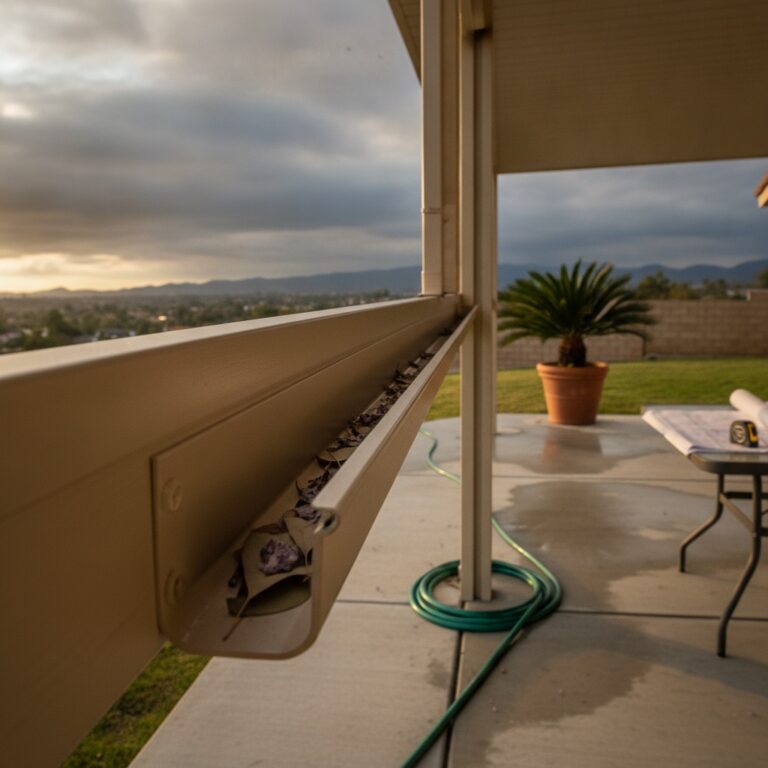
- Integrated aluminum gutter with a metal mesh guard. Dry leaves in a gutter are the classic ember bed. A metal guard keeps debris out without adding plastic to the roof line.
- Stainless or coated steel fasteners at the ledger and post bases. Offshore gusts load the cover upward and sideways, and the anchors hold that load for the cover’s full life.
- Post bases set in concrete footings, not surface-mounted on an old slab edge. Ask what footing depth the engineer specified for your local design wind speed.
- Powder coat to AAMA 2604 or better. Inland UV and 100-degree heat cook cheap paint. A strong finish keeps the metal sealed for 20 years.
- No combustible trim. Skip wood fascia boards or vinyl wraps on an aluminum frame. They undo the point.
Then plan the ground under and around the cover with Zone 0 in mind. Swap bark mulch for decomposed granite, gravel, or pavers in the first five feet. Choose metal or stone-topped furniture over wicker. Keep cushions in a closed bin indoors on red flag days. Move the firewood rack out past the five-foot line. None of this makes the patio less usable. It makes it a place embers have nothing to grab.
Replacing a Wood Cover Before the Next Wind Event
For a typical 12×20 attached cover in Riverside County, replacing tired wood with an aluminum solid or combination cover usually runs a few weeks from first visit to final inspection, depending on permit timing in your city. A cover built from noncombustible material also gives your insurance agent one less question at renewal, which carries real weight in the foothills right now.
If your cover backs onto open brush, or you are not sure whether your address falls inside a Very High zone, it is worth having someone walk the property with you. We do free in-home assessments across the Inland Empire, Orange County, and San Diego County. We will look at your current cover, the five feet around it, and your local wind exposure, then give you an itemized quote with the panel rating and finish spec written out, so you know exactly what you are getting before the next offshore wind arrives.
Morning-context sources used: South Ops Monthly/Seasonal Outlook, issued Sept. 30, 2026; MyNewsLA, Excessive Heat Across Region Expected into Next Week, Oct. 1, 2026; Best Best and Krieger, Board of Forestry Adopts Emergency Zone 0 Regulations, Sept. 9, 2026; KEYT, Tracking October Heat Wave, Sept. 30, 2026.