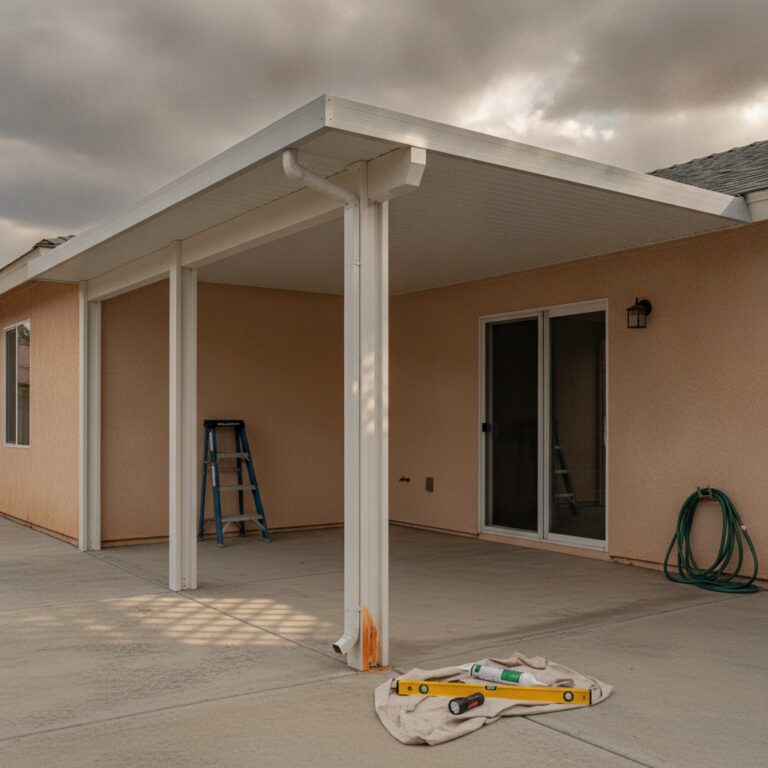


A homeowner in Fullerton called last spring with a folder on her kitchen table. Three quotes for a 16-by-20 attached cover, all within about $1,400 of each other. One said “limited lifetime warranty” in bold on the cover page. One said 10 years. One said nothing at all until page four, where it offered one year on labor. She wanted to know which one was actually the best deal. That is the right question, and the answer is not the biggest number.
Warranty language on a patio cover quote is doing three separate jobs at once, and most quotes blur them together on purpose. There is the finish warranty from the manufacturer, the structural warranty on the aluminum itself, and the labor warranty from the contractor who bolts it to your house. They cover different failures, they run for different lengths of time, and only one of them is worth anything if your installer closes shop in 2029.
The finish warranty is the one everybody advertises
When a brochure shouts “limited lifetime,” it almost always means the powder coat. Alumawood covers its finish for the life of the original retail purchaser against chipping, peeling, flaking, and blistering under normal wear. That coverage transfers to a new owner, but only for the first ten years, and after that the clock resets to a flat ten years from original install. Weatherwood puts a lifetime warranty on its wood-textured aluminum. Some extruded lines, like 4K Aluminum, publish a straight 20-year term instead.
The tier behind those numbers is what matters in Southern California. AAMA 2604 powder coatings typically carry a five-year finish warranty. AAMA 2605, the top architectural tier, doubles the testing requirements and usually carries ten years, with some coaters extending to 20 or even 30 years. The difference shows up on a south-facing Riverside patio around year seven, when a 2603-grade finish starts chalking and a 2605 finish still holds its color. If a quote will not name the AAMA tier, that silence is the answer.
Read what the finish warranty actually excludes, too. Most of them require reasonable cleaning. Coating manufacturers routinely make cleaning frequency a condition of coverage, which means a cover in Newport Beach that never gets rinsed of salt film can have a legitimate fade claim denied. Two rinses a year with a hose and mild soap protects a warranty worth thousands.
Structure and finish are not the same promise
A finish warranty says the paint will stay put. It says nothing about the beam. Aluminum patio covers generally last 20 to 30 years, and plenty of well-built ones run past 30 with very little deterioration. Wood covers, by comparison, last about 10 to 15 years with consistent maintenance and 10 to 20 depending on how faithfully somebody reseals them. That gap is the whole reason aluminum dominates SoCal patios.
But long material life does not automatically mean long structural coverage on paper. Ask specifically whether the warranty covers the extrusion against cracking, separation at the joinery, and deflection under load. On a 20-foot span carrying a solid insulated roof, deflection is the failure that shows up first, usually as a visible sag over the center of the span. A quote that specifies a .050 or heavier wall extrusion and names the beam size for your span is telling you something real. A quote that says “heavy-duty aluminum” is telling you nothing.
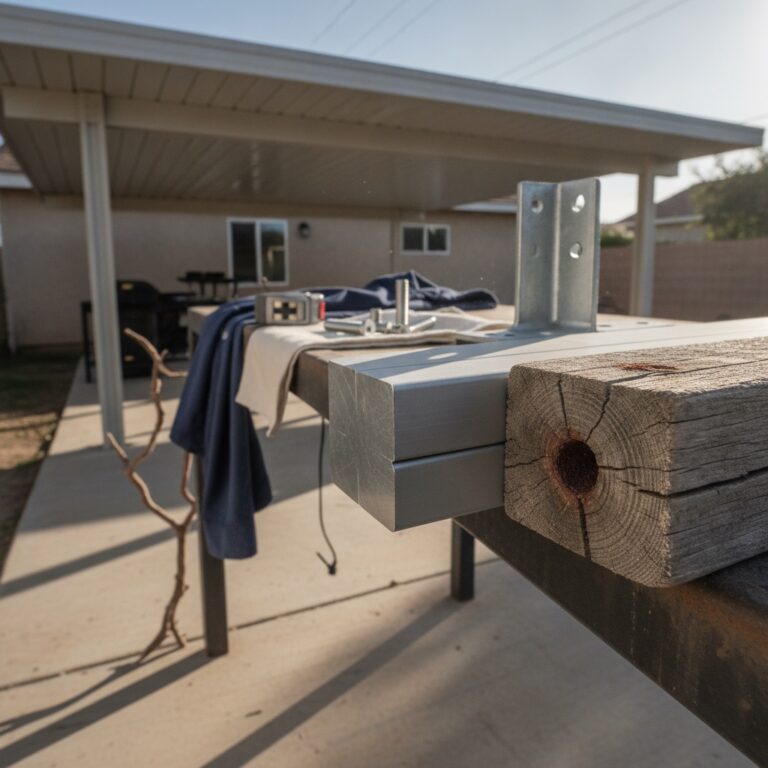
Here is the honest tradeoff. Wood genuinely wins on one point: a rotted 4×8 beam can be sistered or swapped by any decent carpenter for a few hundred dollars. A cracked proprietary aluminum extrusion has to come from the original manufacturer, and if that product line was discontinued, matching it gets awkward. That is a real argument for buying a system from a manufacturer with a long track record rather than the cheapest unbranded package on the lot.
The labor warranty is the one that pays your claim
Nearly every patio cover problem in the first five years is an installation problem, not a material problem. Flashing that was not tucked properly under the stucco. A ledger lagged into stucco instead of into framing. Posts set on a slab too thin to hold the anchor. Gutter tie-ins pitched the wrong way, which nobody discovers until the first real atmospheric river in January. None of that is covered by a finish warranty. All of it is covered by the labor warranty, which is exactly why one-year labor terms are so common and so weak.
California law sets a floor under this. There is a one-year implied warranty covering new construction and remodeling work, four-year coverage on major building systems, and ten-year coverage for major structural defects. If a contract offers less than the statutory minimum, the law overrides the contract. So a one-year labor warranty is not really one year. It is the legal minimum with nothing voluntarily added on top, and that tells you how much confidence the company has in its own crews.
A five-year or ten-year labor warranty is a company betting its own payroll that the flashing was done right. Ask for it in writing, ask what it covers specifically, and ask what voids it. Leaks, fastener backout, post settling, and finish damage caused during install should all be named.
How to compare three quotes in about ten minutes
Set the three quotes side by side and pull five numbers out of each one. The AAMA powder coat tier. The finish warranty term and whether it transfers. The extrusion wall thickness and beam size for your span. The labor warranty term. And the contractor’s license number, which you can check in about 90 seconds on the CSLB site along with the $25,000 bond every licensed California contractor is required to carry.
Then check two things nobody thinks to check. First, how long the installing company has actually been operating in your county. A limited lifetime warranty from a company founded 14 months ago is a marketing line, not an asset. Second, whether the warranty is administered by the manufacturer or only by the dealer. Manufacturer-backed finish coverage survives a dealer going under. Dealer-only coverage does not.
The Fullerton homeowner picked the middle quote, the 10-year one. It named AAMA 2605 on the finish, specified the beam for a 20-foot clear span with no center post, and carried five years on labor from a company that had been working Orange County since the nineties. The “limited lifetime” quote turned out to cover the finish only, with one year on labor, from a company with an eight-month-old license. The bold type was the cheapest thing in that folder.
Warranty language should be boring, specific, and readable in the quote itself, not in a brochure you get after signing. When JNL Aluminum writes a quote, the powder coat tier, the extrusion spec, the span, and both warranty terms are on the page you sign. If you are holding a folder of quotes right now and cannot tell which one actually protects you, a free in-home visit will get you a fourth quote that itemizes every one of those lines. Compare it against the other three and pick whichever holds up best.
Morning-context sources used: Patio Kits Direct warranty terms, Valley Patios material comparison, Aluminum vs Wood Patio Covers: Honest Comparison (2026), AMICO on specifying AAMA 2604 vs 2605, Colourific on AAMA standards and powder warranties, California construction warranty law overview.