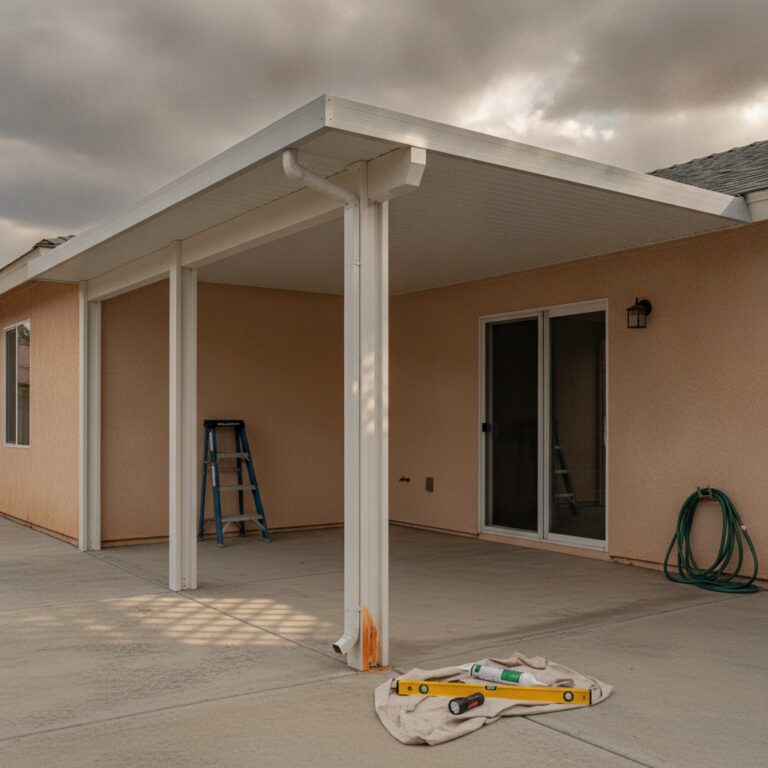


Drive the flats behind Seal Beach or the streets below Palos Verdes and count the patio covers with a rust stain weeping down a post. Steel starts doing that inside about eight years of ocean air, sometimes sooner once a ladder foot chips the coating. Aluminum covers on the same block look tired at worst, a little chalky on the south face, still sound where it counts. That difference is not marketing. It is chemistry, and it decides what the cover looks like at year fifteen.
Both metals build a fine patio cover on paper. Both carry a 20 psf live load without complaint, both take a 24-foot run with the right beam, both accept powder coat. The question worth answering before anyone signs is what each one looks like after 5,000 nights of marine layer, a few Santa Ana events, and roughly 3,000 hours of direct sun a year. Corrosion is the axis here. It is the failure mode that ends covers early in Southern California, well before anything sags.
What Salt Air Does to Steel and Does Not Do to Aluminum
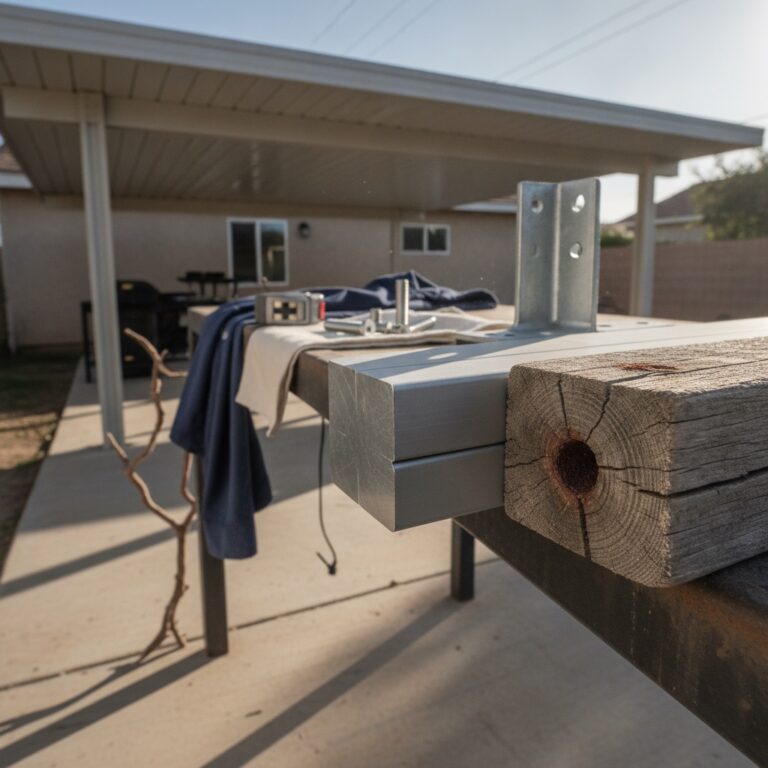
Steel rusts because it contains iron. Chloride ions ride in on marine air, land on the surface, wick into any scratch, and start pulling the iron apart. Once oxidation starts under a coating it spreads sideways and lifts the finish from below, which is why a rust bloom always looks worse the day you scrape it. Galvanizing buys time by putting a zinc layer between the steel and the air, and hot-dip galvanizing does that job well. The zinc still gets consumed. In a coastal exposure zone that sacrificial layer thins every year, and the countdown starts the moment a crew drills a mounting hole through it.
Aluminum carries no iron, so it cannot rust in the literal sense. It oxidizes instead, and the oxide film that forms is tight, clear, and self-repairing. That film is why a bare aluminum gutter in Newport Beach still sheds water after 30 years of salt fog. Aluminum does pit under constant spray within a few hundred feet of sand, and pitting is real. Pitting stays cosmetic for a long time before it becomes structural. Rust turns structural early, and it does it from the inside where nobody is looking.
Where Steel Genuinely Wins
Straight answer: steel is stronger per square inch. A36 structural steel yields around 36,000 psi. The 6063-T6 alloy in most patio extrusions yields closer to 25,000 psi, and 6005-T5 runs higher but still trails steel. On a long clear span, a 24-foot run with no intermediate post, a steel beam gets there in a shallower profile than aluminum needs. When headroom under the cover is already tight, or the slab sits low against a sliding door header, that shallower beam is worth something real.
Steel also takes a hit better. A falling eucalyptus limb dents an aluminum rafter and can crease it. The same limb bounces off a steel tube and leaves a scuff. Inland properties with mature trees, a basketball hoop, or a second story that drops things have an honest argument for steel. So does a homeowner attaching a cover under heavy clay tile where the ledger carries unusual load. Any contractor worth the deposit says this out loud rather than pretending one material wins every category.
The Finish Spec Decides the Warranty
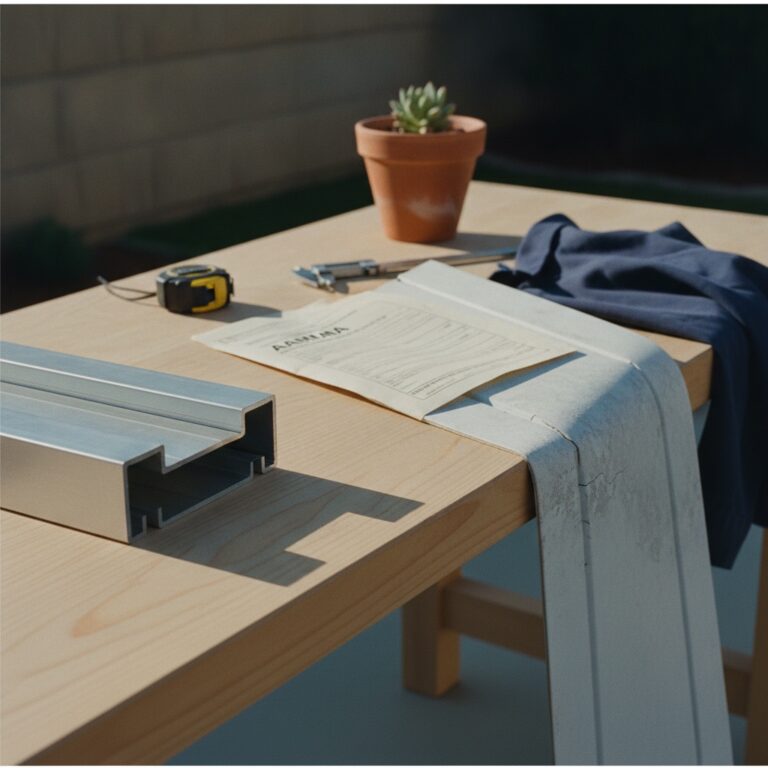
Both metals live or die by their coating, which is where the spec sheet earns its keep. AAMA 2604 asks a powder coat to survive five years of South Florida exposure testing with at least 30 percent of its gloss intact and a color shift under 5 delta E. AAMA 2605 raises that to ten years and 50 percent gloss retention. Most quality residential aluminum covers around Orange County ship with a 2604-class finish, and many carry a limited lifetime warranty against peel, blister, and chalk beyond spec.
Read the warranty page sitting next to that spec. Coastal coverage often shrinks. Plenty of manufacturers write an exclusion for installs within one mile of saltwater, or quietly cut the finish term to five years in that band. Steel covers usually carry a shorter finish warranty plus a separate structural warranty, because the coating is doing more of the work. Ask for both documents in writing before any deposit changes hands. A warranty that excludes the exact condition your house sits in is not coverage, it is paperwork.
What the Two Materials Cost Right Now
Metal pricing has been rough all year. The Associated General Contractors reported on August 17 that construction input costs ran 7.1 percent above July of last year, with aluminum mill shapes up 40.5 percent year over year under tariff pressure. Exchange aluminum settled near 3,237 dollars per metric ton on August 18. Steel has climbed on the same tariff schedule. Neither metal is cheap in 2026, which means the spread between them matters less to the decision than it did two years ago.
For a 16 by 20 attached cover in Corona or Riverside, budget roughly 22 to 32 dollars per square foot installed for a quality powder-coated aluminum system with the permit pulled. Custom steel over the same footprint typically lands 15 to 40 percent higher once fabrication, primer, topcoat, and the heavier crew and equipment get counted. Steel is welded and touched up in the field. Aluminum shows up finished from the factory and gets bolted together, and that single fact is why the labor line reads so differently.
How to Read the Bid
Three lines on a proposal settle the material question faster than any brochure. First, alloy and wall thickness stated in thousandths, not the phrase “heavy gauge.” Second, the finish named by standard, AAMA 2604 or 2605, with the warranty term and who backs it. Third, the fastener metal. Stainless 316 hardware belongs on a coastal job. Plain zinc-plated screws are fine three miles inland. Bare steel screws driven into aluminum near the ocean set up galvanic corrosion and stain the post inside two seasons.
Ask for the exposure assumption in writing too. A cover going up in Yorba Linda breathes different air than one four blocks off the sand in Sunset Beach, and the right specification changes with the zip code. Houzz found that 71 percent of homeowners hired at least one pro for their outdoor project this year, up from 65 percent, so most people are already having this conversation with somebody. Make sure it is a specific one.
JNL Aluminum builds across Orange County, the Inland Empire, Long Beach, and north San Diego County, and the free in-home quote itemizes alloy, wall thickness, finish standard, fastener metal, and warranty terms on a single page. Get that page from whoever bids the work, then compare the bids line for line. The material argument gets a lot simpler once the numbers are on paper.
Morning-context sources used: https://www.agcfla.com/2026/08/17/construction-input-costs-climb-7-1-percent-between-july-2025-and-july-2026-as-impacts-from-war-and-tariffs-spread-beyond-petroleum-and-metals/ | https://tradingeconomics.com/commodity/aluminum | https://www.constructiondive.com/news/construction-costs-producer-price-index-july/827933/ | https://mecktimes.com/news/2026/07/23/construction-input-costs-remain-sharply-higher-than-a-year-ago-despite-june-decline-as-aluminum-copper-and-steel-prices-continue-to-climb/ | https://amicoarchitectural.com/specifying-aama2604-vs-aama2605/ | https://pro.houzz.com/pro-learn/blog/2026-houzz-outdoor-trends-report