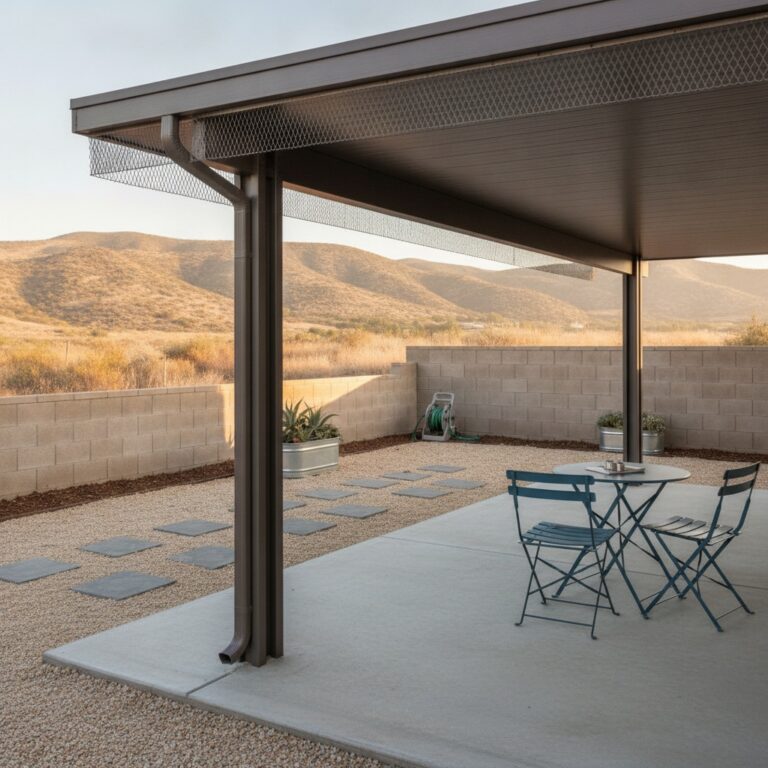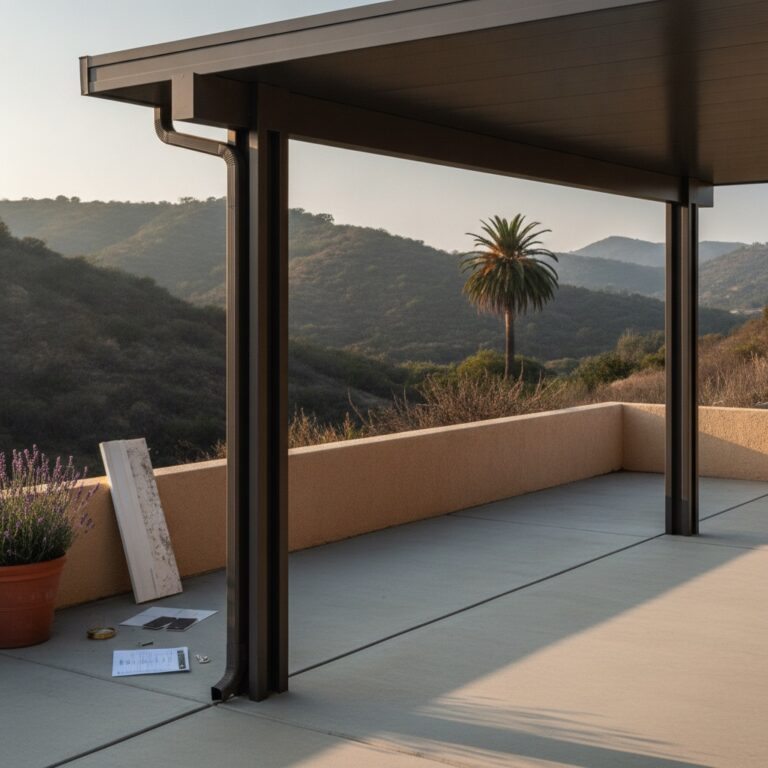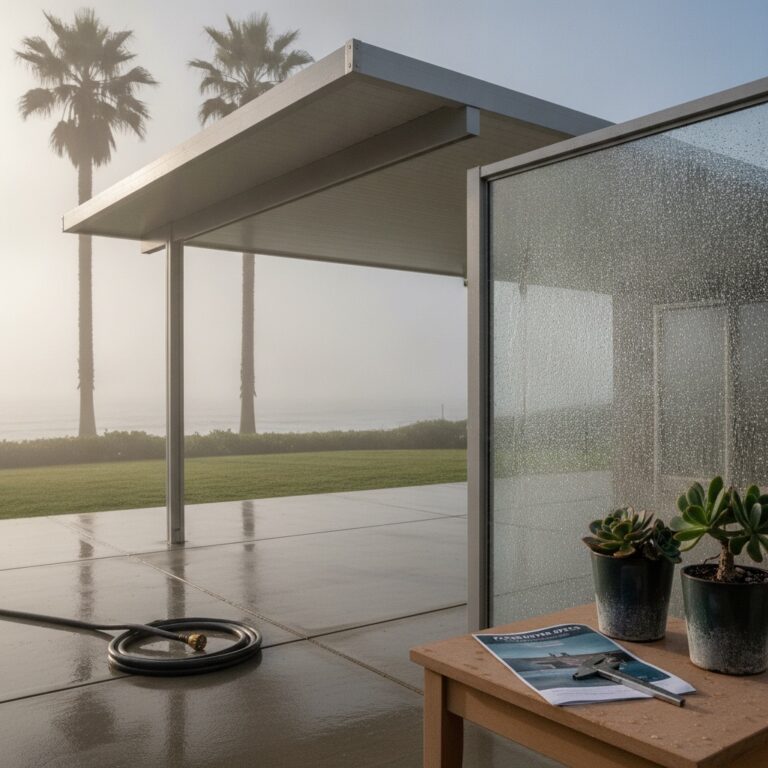


Lake Elsinore hit 110 degrees earlier this month and broke a record that had stood since 2012. San Jacinto climbed to 109 and knocked out a 2020 mark. Riverside sat at or just above 100 for four straight days, and forecasters called for another stretch of triple-digit heat across the Inland Empire this week. If you live in Corona, Moreno Valley, or Rancho Cucamonga, none of that is news. You already know your back slab is unusable from noon until dark.
What most homeowners do not know is how much of that heat a patio cover actually removes, and how much it just moves around. The answer depends almost entirely on what the roof panel is made of. A cover is not a cover. Two structures that look nearly identical from the kitchen window can read 15 degrees apart on a thermometer at 4 p.m. in August.
What 105 Degrees Does to an Uncovered Slab
Air temperature is the number the news reports. It is not the number your feet feel. A broom-finish concrete slab in direct Inland Empire sun runs 40 to 60 degrees above ambient air. On a 105 degree Riverside afternoon, that pad is sitting somewhere between 145 and 165 degrees. It absorbs solar energy all day and releases it back as radiant heat well past sunset, which is why your patio still feels like an oven at 8 p.m. when the air has dropped to 92.
That stored heat also pushes into the house. A west-facing slab with a sliding glass door radiates straight at your living room through the hottest four hours of the day. Homeowners in Eastvale and Jurupa Valley describe the same thing every summer: the AC runs without stopping from 2 p.m. onward and the room nearest the patio never gets comfortable.
Shade fixes the first half of the problem. Blocking direct sun keeps the slab from charging up in the first place. A shaded concrete pad in the Inland Empire typically runs 15 to 25 degrees above air temperature instead of 40 to 60. The surface still gets warm. It stops behaving like a stovetop.
Insulated Panel Versus Open Lattice: The 15 Degree Question
Here is where the spec sheet earns its keep. An open lattice cover blocks roughly 50 to 70 percent of direct sun depending on slat spacing. It looks great, it moves air, and on the coast it is often the right call. Twenty miles inland it leaves too much energy on the table.
A solid non-insulated cover uses a single aluminum W-pan, usually .019 to .024 gauge. It blocks 100 percent of direct sun, which is a real improvement. The catch is that the pan itself heats up. Aluminum conducts, so a bare pan sitting in 105 degree sun reaches 150 plus on the top skin and re-radiates a large share of that downward. You get shade and you still get a hot ceiling three inches above your head.
An insulated roof panel solves that. These are two aluminum skins with an EPS foam core sandwiched between them, and they are the reason a patio in Riverside can feel usable at 4 p.m. A 3 inch panel typically rates R-16 to R-18. A 4 inch panel runs R-20 to R-24. Field measurements put the space under an insulated panel 10 to 20 degrees cooler than the same space under a bare pan on a triple-digit day. That difference is the line between a patio you look at and a patio you sit on.
The panel also carries its own span. Insulated panels are structural, so a 3 inch panel can clear 12 to 14 feet without an intermediate beam, and a 4 inch panel can push toward 16 to 18 feet. Fewer posts in the middle of a Corona backyard means the shade is usable instead of chopped up.
The 4 to 9 p.m. Problem
Inland Empire heat is expensive in a way coastal heat is not. Southern California Edison summer rates run June 1 through October 1, and on most residential time-of-use plans the peak window falls between 4 p.m. and 9 p.m. Peak summer pricing sits near 49 cents per kWh on common plans, and some schedules run higher. That is roughly double what the same kilowatt costs in spring.
Your AC does its heaviest work in exactly that window, and a hot west-facing slab is one of the reasons. Cutting radiant load on that wall and door does not replace an air conditioner. It does shorten the run time during the most expensive five hours of the day. Homeowners who add a solid insulated cover over a west-facing slab commonly report the adjacent room holding setpoint an hour or two longer before the system kicks back on.
There is a second benefit that shows up on the calendar rather than the bill. A shaded, insulated patio in Rancho Cucamonga gives you 200 to 250 usable outdoor evenings a year instead of the 90 or so you get on bare concrete. That is the actual return. The energy savings are a bonus line item.
Specs That Matter in Riverside, Corona, and Fontana
Inland heat is hard on materials in ways coastal air is not. A few things to hold your contractor to:
- Thermal expansion allowance. Aluminum moves. A 20 foot beam swings roughly a quarter inch between a 45 degree January morning and a 110 degree August afternoon. Attachment points need slotted holes or an expansion joint. Rigid-pinned installs oil-can and pop fasteners within a few seasons.
- Powder coat tier. Inland UV is the enemy here, not salt. Ask for an AAMA 2604 finish at minimum. It carries a 10 year chalk and fade warranty. AAMA 2603 is a builder-grade finish and will show visible fade on a south or west exposure inside five years.
- Panel gauge and color. Lighter roof colors reflect more. A sandstone or white top skin measures cooler than a dark bronze by a meaningful margin. Keep the dark color for the fascia and posts where it looks sharp and does not sit over your head.
- Post footing depth. Riverside County inspectors generally want a 12 inch diameter footing at 18 to 24 inches deep for a standard attached cover. Skimping here is the most common thing found on a failed inspection.
- Fascia gutter integration. Inland yards get little rain and then get all of it at once. A cover that dumps sheet water at the edge of the slab will undercut it. Tie the gutter into an existing downspout run.
One more thing worth asking about is ceiling fan blocking. If you are building for August afternoons, plan the fan now. An insulated panel needs internal blocking and a conduit chase run before the panels close up. Adding it later means opening the roof.
Every Inland Empire backyard reads differently. A north-facing slab in Ontario with mature shade trees needs a different panel than a bare west-facing pad in Perris with nothing between it and the sun. That is the whole reason JNL does the assessment on site rather than over the phone. We measure the exposure, check the span, look at the existing fascia and drainage, and quote the panel that fits the yard you actually have. It is free, it takes about an hour, and it is the fastest way to find out whether your slab needs a 3 inch panel or a 4 inch one before next August arrives.
Morning-context sources used: https://mynewsla.com/weather/2026/08/03/heat-wave-lingers-for-inland-areas-2/ , https://www.cbsnews.com/losangeles/news/heat-wave-southern-california-record-temperatures , https://ktla.com/news/california/southern-california-heat-advisories-august/ , https://ktla.com/weather/socal-extreme-heat-ridge-breakdown-forecast/ , https://okanaganpatiocovers.ca/insulated-aluminum-patio-covers/ , https://www.solar.com/learn/sce-time-of-use-tou-rates-a-beginners-guide/