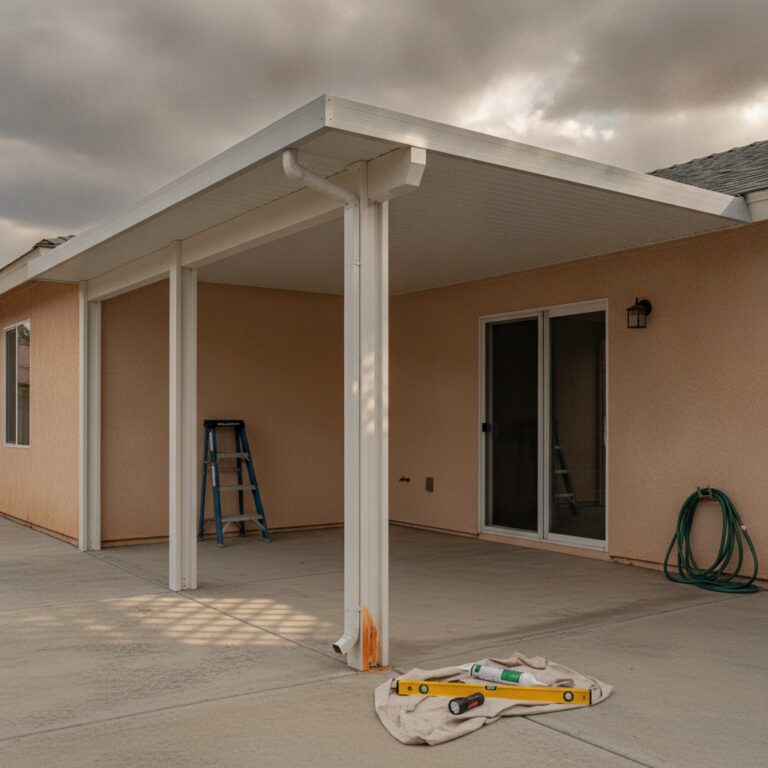


Palm Springs touched 119 degrees during this month’s heat wave, Thermal hit 117, and inland communities across Riverside and San Bernardino counties broke daily records on back-to-back afternoons. Homeowners felt every bit of it. Almost nobody thought about what that stretch did to the finish on their patio cover. A week of 108 to 112 degree air is exactly the exposure that separates a factory powder coat from a field-applied paint job, and the result shows up four or five summers from now, not this one.
The finish is the part of a patio cover most homeowners never ask about. They ask about span, post count, panel thickness, and color. Then in year six they wonder why the white reads gray, why there is a stripe down the fascia where water ran, and why the west-facing beam no longer matches the north one. That outcome was decided in a factory, before the extrusion ever left the plant.
What a 110-Degree Week Does to a Coating
Aluminum in direct SoCal sun does not sit at air temperature. A dark powder-coated beam under 110 degree air can read 150 to 165 degrees at the surface on an infrared thermometer. The metal expands, the coating expands with it, and the whole assembly sheds 50 to 60 degrees after sundown. That cycle repeats daily from June through September in Fontana, Hemet, Corona, and every other inland city where JNL Aluminum works.
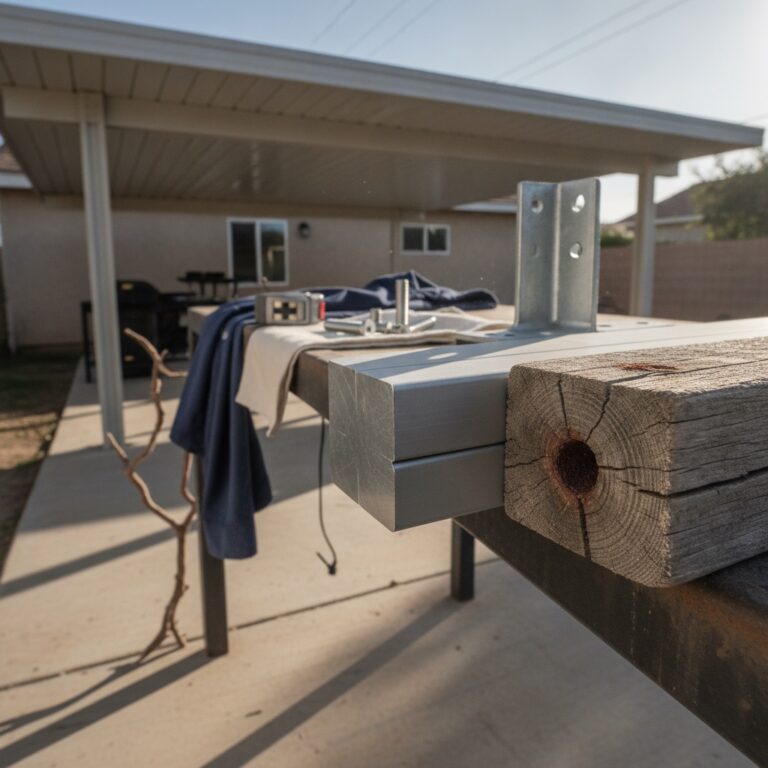
Paint fails that cycle in a predictable order. The binder breaks down under UV first. The pigment loses its grip on the surface. Then the coating starts releasing chalk. Rub a white painted wood beam after four inland summers and your palm comes back gray. Next comes hairline checking along the grain, and after that the water intrusion that follows any crack in a coating over wood.
A fluoropolymer powder coat behaves differently because the resin itself resists UV rather than relying on a sacrificial topcoat. The powder is electrostatically applied to bare aluminum and cured in an oven at roughly 400 degrees. Nothing about a 112-degree August afternoon in Riverside is new information to a film that was formed at nearly four times that temperature.
AAMA 2604 and AAMA 2605 in Plain Numbers
Two specifications matter when you read a patio cover proposal. AAMA 2604 is the intermediate architectural standard. It calls for five years of South Florida outdoor exposure with at least 30 percent gloss retention at the end, and chalking held within a rating of 8 on the ASTM D4214 scale. That is a real standard and a real test. It is not the top tier.
AAMA 2605 is the high-performance tier. It requires ten years of that same South Florida exposure, at least 50 percent gloss retention, and no more than trace chalking after the full run. Resin content explains the gap. A 2604 powder typically carries around 50 percent fluoropolymer resin. A 2605 powder carries around 70 percent. That resin difference accounts for most of the price difference between the two finishes.
South Florida is the industry proving ground because of its UV load and humidity. Inland Southern California is a different kind of punishment. Less humidity, more annual sun hours, and a much wider daily temperature swing. Coastal Long Beach and north San Diego add salt to the mix. A 2605 finish is not overkill on a west-facing cover in Menifee. It is the spec that actually matches the exposure.
There is a third tier worth knowing. AAMA 2603 is the entry level, meant for interior or lightly exposed metal. It has a place on garage door track and interior trim. It does not belong on a beam that faces sun across a Riverside backyard for twenty years. If a proposal says only “powder coated, choose from five colors,” it has told you nothing about which of the three tiers you are buying.
Where Paint on Wood Still Wins
Two honest points for the other side. Paint gives you any color, mixed today, matched to trim you already own. Powder coat gives you the manufacturer’s chart, and a true custom color usually means a minimum order plus a four to six week lead time. If an HOA committee specifies a color that is not on the chart, a painter solves that problem in an afternoon and a coater does not.
Paint is also repairable in place. Scratch a powder-coated beam during installation and the fix is a touch-up pen that will never quite match a baked finish under raking late-afternoon light. Gouge a painted wood beam and a brush and thirty minutes erase it. Wood also takes stain, and a stained cedar cover over a 1920s craftsman in Orange can look like it belongs there in a way that a bright white aluminum cover sometimes does not.
The tradeoff arrives later. Painted wood asks for a wash and an inspection every year, plus a full sand and recoat every five to seven years in inland heat. Budget roughly 900 to 1,800 dollars per cycle if someone else does the work on an average 20 by 12 cover. Across twenty years that is two or three recoats and one or two rot repairs. A 2605 powder coat over the same twenty years asks for a garden hose, a soft brush, and mild soap twice a year.
How to Read Your Own Cover Right Now
The chalk test costs nothing. On a cool morning, take a dark cloth and wipe a two-foot stretch of the sunniest beam. Heavy powder on the cloth means the binder has given up and the color will keep drifting. Light residue on a ten-year-old cover is normal aging. Chalk on a four-year-old cover means the finish was never rated for what your yard delivers in August.
Next, compare the south and west faces against the north face of the same beam. Real fade shows up as a visible split between those sides, not as an overall softening you talk yourself out of seeing. Then check the bottom edge of the fascia and the base of each post, where water sits longest and coatings surrender first. Bubbling, a lifted edge, or hairline cracking at those points is the signal to stop patching and start pricing.
Timing deserves a mention. Aluminum mill shapes climbed roughly 33 percent from January 2025 to January 2026 under 50 percent Section 232 tariffs, and construction input prices have been rising at their fastest pace since 2022. None of that changes the material case for aluminum over painted wood. It does mean the number you were quoted two years ago is not the number you will see in October, and that waiting has a cost of its own.
When you collect bids, put the finish in writing. Ask for the AAMA number, ask how many years the warranty covers the finish as opposed to the structure, and ask specifically whether fade and chalk are covered or only structural failure. Those three questions separate serious proposals from brochures. JNL Aluminum itemizes the finish spec on every quote, and a free in-home visit is where you get to hold the actual sample cards in your own backyard light rather than judging a color on a phone screen. Fifteen minutes on your slab tells you more than an hour of reading ever will.
Morning-context sources used: FOX 11 Los Angeles, dangerous late-August 2026 Southern California heat wave; CBS News Los Angeles, record temperatures in inland communities; AMICO Architectural Metals, AAMA 2604 vs AAMA 2605; Linetec, AAMA paint and powder specifications; Associated General Contractors of America, January 30 2026 producer price index update; Duralum, 2026 outdoor living trends.