

Wednesday afternoon in Carlsbad the thermometer read 83 degrees. That sounds like a nice day. The dew point read 69 and relative humidity sat at 74 percent, and twenty miles south the San Diego airport reported 86 degrees that felt like 99. The gap between the number on your phone and the number your skin reports is the entire story of a North County patio right now. Shade by itself does not close that gap. Moving air does, and the cover you pick either helps or gets in the way.
Why a 70-Degree Dew Point Changes the Patio Math
Coastal San Diego County normally runs dry. Marine air comes in cool, the dew point sits in the high 50s, and sweat evaporates fast enough that 85 degrees under a lattice feels fine. Monsoon flow rewrote that this month. San Diego forecasters have been calling out building humidity since the first week of August, with the stretch starting August 24 flagged for extreme heat, high moisture, and possible record highs.
Above roughly a 65-degree dew point, evaporative cooling starts to stall. Your body keeps producing sweat and the air stops accepting it. That is why 83 in Carlsbad this week feels worse than 95 in Temecula in a dry June. It also explains the part homeowners notice most: the patio does not cool off after sunset. Warm, wet air holds heat overnight, so the slab that used to be comfortable at 8 p.m. stays sticky until 10.
For a patio cover, that shifts the design target. Blocking sun is still job one, because a shaded concrete slab runs 25 to 35 degrees cooler at the surface than one baking in full sun. But in humid heat, a cover that traps a pocket of still air underneath can feel worse than no cover at all. The fix is not more roof. The fix is roof plus a deliberate path for air to leave.
Shade Is Only Half the Fix on a Humid Slab
An insulated aluminum roof panel stops radiant load cold. A 3-inch foam-core panel runs roughly R-13 to R-15, and a 6-inch panel gets close to R-25. Stand under one at 2 p.m. in Escondido and the difference against an open pergola is obvious in about four seconds. That is the right call for a west-facing slab in inland North County, where the afternoon sun is the dominant problem.
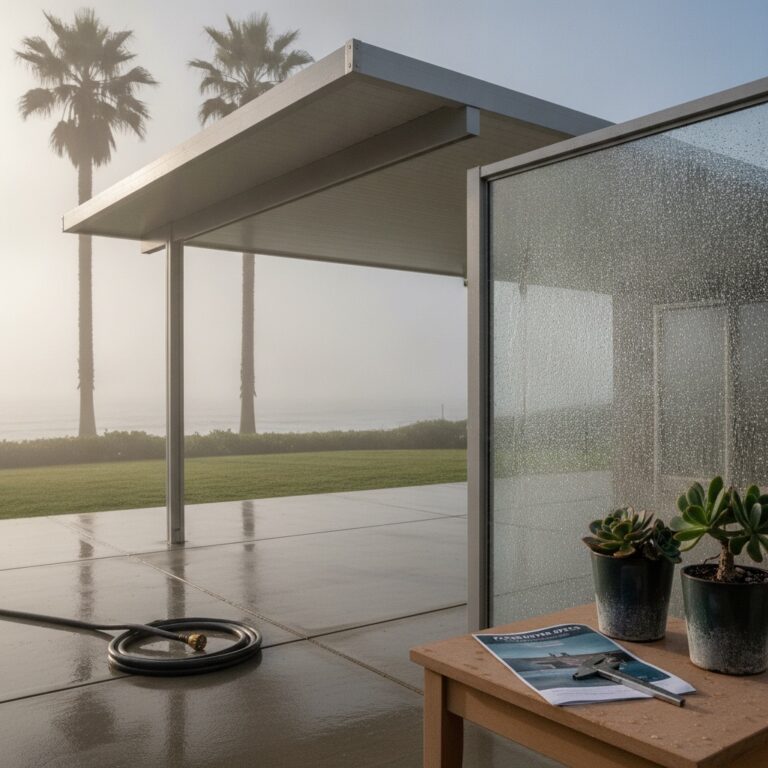
Closer to the coast, in Carlsbad, Encinitas, and Oceanside, a fully solid cover with three enclosed sides can turn into a warm-air pocket on a 70-degree dew point day. The panels do their job and the air underneath just sits. Homeowners describe it as stuffy, and they blame the cover when the real culprit is the missing exit path for hot air.
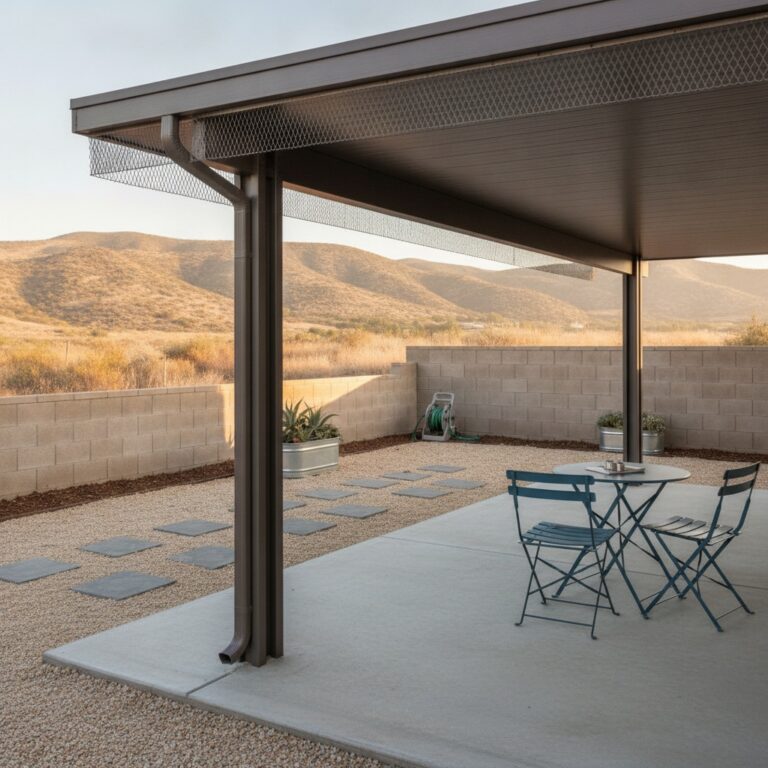
Two layouts solve it. The first is a solid center bay with lattice wings, so the seating area stays fully shaded while the outer four to six feet breathe. The second is a full solid roof with both ends left open and the outer beam raised. Neither costs much more than a standard build. Installed pricing in San Diego County this year generally lands around $45 to $65 per square foot for insulated roof systems and $25 to $40 for open lattice, so a mixed 16 by 20 design often prices out below a full insulated span of the same footprint.
Post Height, Slope, and Fans on a North County Build
Standard patio cover post height is 8 feet. On a humid coastal slab, 9 feet at the house wall and 10 feet at the outer beam buys real comfort. The taller air column gives heat somewhere to rise to, and the extra pitch pulls a light onshore breeze straight through instead of stalling it against the fascia. Most North County lots handle that height without a variance, though a few HOA design guidelines cap it at 10 feet total, so it is worth checking before the drawings go in.
Slope matters twice. Anything less than a quarter inch of fall per foot of run is asking for standing water on the panels during a monsoon burst. A quarter to three-eighths per foot drains clean and still looks flat from the yard. On a 20-foot projection that is five to seven and a half inches of drop, which is easy to hide with a taller outer beam rather than a low house-side connection that cuts your headroom.
If you want a ceiling fan, say so before fabrication. Insulated panels need a factory-installed fan beam or an internal mounting block, and retrofitting one into a foam-core panel later is messy and rarely watertight. Spec a fan rated for damp or wet locations with a 52-inch or larger blade span. A slow-moving 52-inch fan pushing air across a seating area is worth several degrees of perceived temperature on a sticky evening, which is more relief than any additional inch of insulation will give you.
Salt Air Plus Humidity Is a Corrosion Multiplier
Within about two miles of the surf line, airborne chloride is a constant. Add 74 percent relative humidity and you get a thin, persistent film of salty moisture sitting on hardware for weeks at a time. Aluminum extrusion handles that well because it forms its own oxide layer. The fasteners are where coastal jobs fail.
Ask what the installer is putting through the beams. Zinc-plated screws will bleed rust streaks down a white beam within two summers in Leucadia. Type 304 stainless is the working minimum near the coast, and 316 stainless is the honest answer inside a mile of the water. Where stainless meets aluminum, a nylon or neoprene isolation washer stops the galvanic reaction that eats the softer metal at the contact point. It costs pennies per fastener and it is the single cheapest longevity upgrade on a coastal build.
The same logic applies at the ledger. A patio cover attached to a stucco wall needs a properly flashed connection with the ledger standing off the wall surface, not caulked flat against it. Trapped moisture behind a ledger is how a good aluminum cover ends up damaging good framing. Reputable SoCal manufacturers back their extrusions and finishes with limited lifetime coverage on the aluminum and 10 to 20 years on the coating, and none of that helps if the connection detail is wrong.
Monsoon Downpours and the September Wildcard
Humid air is not just uncomfortable. It is also the fuel for the mountain and desert thunderstorms that have popped all month, and occasionally those cells drift west. Forecasters are also watching a modest but real chance, somewhere in the 5 to 20 percent range, that a weakening tropical system turns toward California in early September. That is not a prediction of disaster. It is a reason to size your drainage for more than a typical San Diego drizzle.
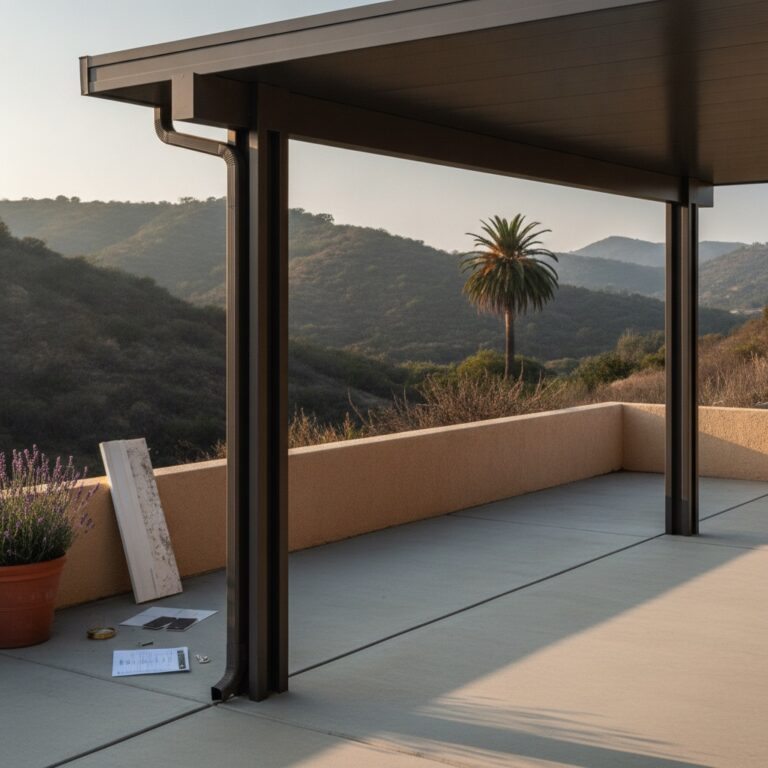
Run the numbers on a 16 by 20 cover. That is 320 square feet. One inch of rain across it is about 199 gallons. A short 2-inch-per-hour monsoon burst is roughly 400 gallons an hour coming off your roof, and a single 2 by 3 downspout is not the right tool for that. An integrated gutter beam with 3 by 4 downspouts at both ends, discharging to a solid pipe that carries water away from the foundation, handles it without a puddle at the back door.
Skip the splash block. On a flat coastal lot, water dumped at the base of a post finds its way under the slab edge. Twenty feet of buried 4-inch solid pipe to a pop-up emitter in the lawn costs a few hundred dollars during the build and is a headache to add later.
Every microclimate in San Diego County argues for a slightly different build. A yard in Rancho Santa Fe wants radiant control and headroom. A yard six blocks off the sand in Oceanside wants airflow, 316 stainless, and a drainage plan. Getting it right means standing on the actual slab and reading the sun angle, the breeze, and the wall condition. JNL Aluminum does that in person at no charge, and the quote reflects your lot rather than a generic square-foot number. If this week convinced you the patio is unusable from July through September, now is the time to ask.
Morning-context sources used: ABC 10News San Diego forecast, August 24, 2026; Weather Underground Carlsbad and San Diego conditions, August 26, 2026; Weather West, late-August SoCal heatwave and September tropical remnant odds; FOX 11 Los Angeles, Southern California heat wave coverage, August 2026; MyNewsLA, Southland temperatures and fire danger, August 26, 2026.