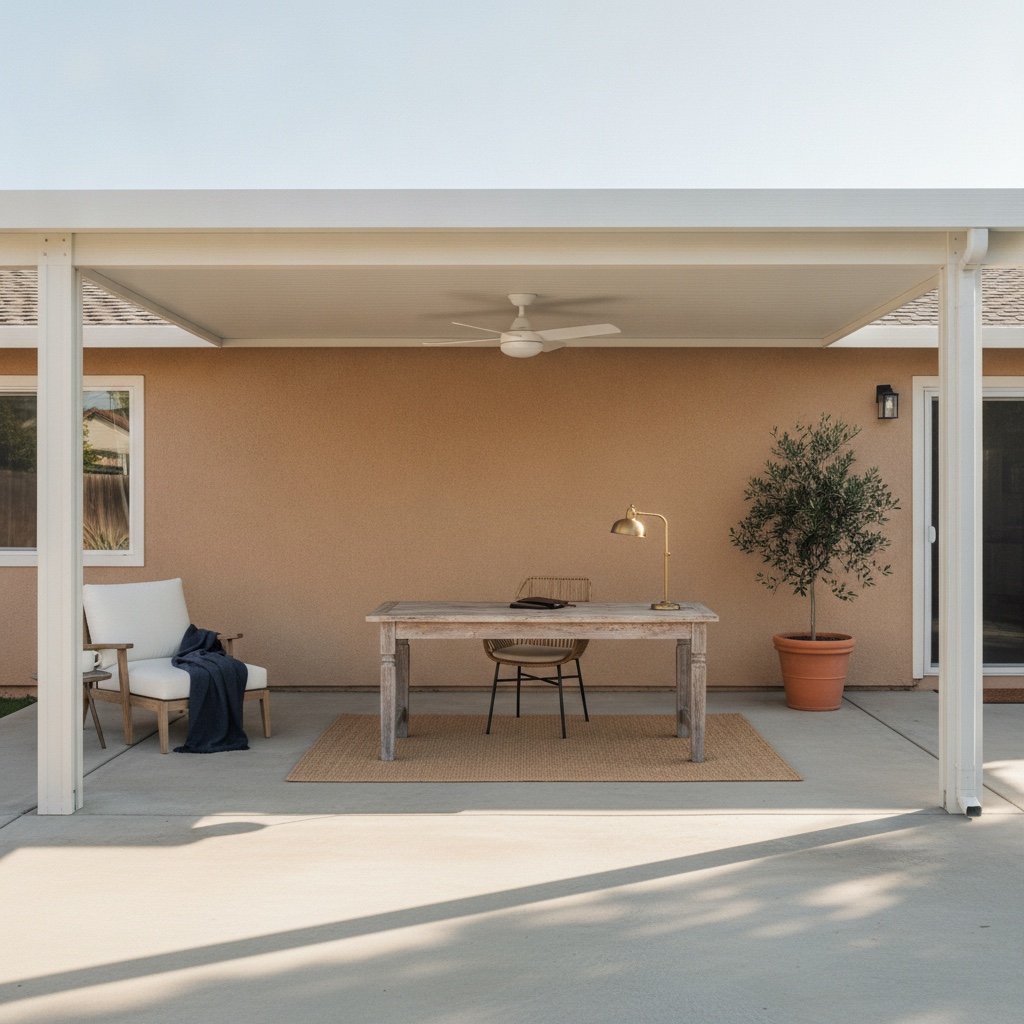

In August, a Fullerton homeowner set a 48 by 24 inch desk right at the front edge of her new patio cover. The light was perfect, the yard was green, and the shade line sat about 9 feet out from the back wall. By the first week of October, the same desk was in full sun by 11:30 a.m. Nothing about the cover changed. The sun did. Fall is when a work-from-home patio either proves itself or gets abandoned, and the difference comes down to a few decisions made on paper before the posts go in.
She is not unusual. Gallup’s 2026 numbers put roughly half of remote-capable workers on a hybrid schedule and about a quarter fully remote. That is a lot of Southern California homeowners looking at the back slab and wondering if it could be the office two or three days a week. This post walks one real workday under a cover in October and shows what makes the setup hold up after summer ends.
Why October Moves the Shade Line
At solar noon in mid-August, the sun over Orange County sits about 71 degrees above the horizon. By October 6, it drops to roughly 51 degrees. By the winter solstice, it bottoms out near 33 degrees. Every week of fall, the light reaches farther under any roof. For a cover with a 9 foot front beam, the shadow line moves from about 3 feet behind the beam in August to more than 7 feet behind it in early October. On a 12 foot projection, that leaves under 5 feet of true midday shade against the house.
That shift matters more this year than most. Forecasters called for an extended early October heat wave, with downtown Los Angeles and Pasadena near 100 degrees and an extreme heat watch running through at least October 8. Coachella Valley highs have been sitting above 100 every day, against a normal of the mid 90s. Low-angle sun plus triple-digit heat is the worst combination for a laptop, a dark screen, and anyone trying to focus on a spreadsheet.
A Real Workday Under the Cover
Here is how her Tuesday actually runs once the layout is right. At 7:00 a.m. the slab is around 68 degrees and the sun has just cleared the neighbor’s roofline to the east. Coffee goes on a small cedar side table next to a lounge chair in the southeast corner. The cover blocks the direct glare. A 5 by 8 foot outdoor rug keeps the concrete chill off her feet, which matters more in late October than people expect.
At 8:30 she moves to the desk, which now sits 3 feet off the back wall instead of at the front beam. An ergonomic task chair needs about 26 inches of depth plus 30 inches of roll-back room, so the desk zone takes roughly 5 by 7 feet. A weather-resistant GFCI outlet with an in-use cover sits on the wall right behind it. A mesh Wi-Fi node just inside the slider keeps video calls stable. A 2700K wet-rated LED fixture on a dimmer handles cloudy mornings and the darker afternoons that arrive once daylight saving ends on November 1.
By 2:00 p.m., during a heat event, the slab can push past 95 degrees in the sun. Under a solid insulated roof, the air directly beneath stays noticeably cooler and the underside of the panel does not radiate heat down onto her shoulders. A 52 inch wet-rated ceiling fan mounted at the center beam turns on at 1:00 and runs until 5:00. At 5:30 the laptop closes, the desk lamp goes off, and the same corner becomes the spot for a glass of wine while the sun drops behind the garage.
The Spec Choices That Make It Work
Most of the comfort in that day comes from four choices made during design. None of them are exotic, and all of them are easier to plan before the cover goes up than to retrofit afterward. If you are picturing a covered work zone, bring this short list to the consultation and ask the designer to mark each item on the site drawing.
- Solid insulated panels over the desk zone. A 3 inch insulated aluminum roof panel blocks direct sun and cuts radiant heat. Lattice looks beautiful but throws striped light across a laptop screen all day.
- Projection sized for fall, not summer. Adding 2 to 3 feet of projection, or lowering the front beam from 10 feet to 8 feet 6 inches, buys back October shade where the desk actually sits.
- A drop shade on the sun side. An exterior solar screen on the south or west opening handles the low-angle months. Many SoCal homeowners add one per opening rather than trying to oversize the whole roof.
- Power and fan blocking in the beam. Running conduit and a fan-rated mounting point during install keeps wiring hidden and avoids drilling through a finished panel later.
The aluminum itself does the quiet work. A powder-coated frame does not warp in a 100 degree afternoon, does not need sealing every spring, and holds its color under coastal and inland UV. That means the office corner looks the same in its fifth October as it does in its first, with nothing to sand or restain before the cooler months.
Laying Out a Two-Use Corner
The smartest work-from-home patios do double duty. The desk zone faces the yard, not the house, so the camera shows plants instead of the kitchen. The lounge chair and side table sit in the corner that gets morning sun, since a few minutes of 7:00 a.m. light feels good in October and the cover cuts it off before it turns harsh. Potted rosemary, lavender, or a dwarf olive along the perimeter handle low water and full sun while softening the edge of the slab.
Keep the work gear modest. A folding teak or powder-coated aluminum desk is easier to move than a heavy indoor piece, and it handles a damp marine-layer morning without swelling. A lidded storage bench holds cushions, a laptop stand, and an extension cord overnight. When the weekend comes, the desk slides against the wall and the whole 12 by 16 foot cover goes back to being a place for Sunday lunch and a long afternoon in the lounge chair.
For homeowners in Riverside, Corona, or Temecula, where fall afternoons stay hotter longer, consider pairing the solid roof with a second fan over the lounge side. Near the coast in Huntington Beach or Long Beach, the bigger concern is morning dew, so a slightly deeper projection and outdoor-rated fabrics on the chair matter more than extra airflow.
Planning Your Own Covered Workspace
A patio office does not need a sunroom budget. It needs the right roof over the right 5 by 7 feet, sized for the October sun angle and wired for the gear you actually use. The homeowners who get it right usually decide where the desk goes first and let the cover follow. The ones who struggle tend to pick a standard size, then discover in fall that their favorite spot sits outside the shade.
If you are thinking about a covered patio that works as an office during the week and a hangout on weekends, a free in-home design walkthrough is the easiest place to start. We will measure your slab, check the sun path for your lot, and sketch where the desk, fan, and outlet should land before anything gets ordered. It takes about an hour, and you will see your fall shade line on paper before the first post goes in.
Morning-context sources used: “Extreme heat in Los Angeles area expected to last at least a week,” October 2, 2026; “Extra-long fall heat wave could last to mid-October: what to expect,” October 1, 2026; NBC Palm Springs, “Jerry’s SoCal Weather Briefing,” October 2, 2026; SurveyMonkey, “Remote and hybrid work statistics and return-to-office trends in 2026,” 2026; Brookfield Residential, “Outdoor Living Trends for 2026,” 2026.