
Start with the number most Orange County homeowners actually pay in 2026: $20 to $30 per square foot for a solid-roof aluminum patio cover, installed. A 10 by 20 cover, the most common size on quotes from Anaheim to Mission Viejo, lands between $4,000 and $8,000 depending on spec. That range is real, but it hides a lot. Here is how to read it the way a contractor reads it at your kitchen table.
The broad market backs those figures. Current Orange County pricing guides put installed covers anywhere from $12 to $35 per square foot, with light lattice kits at the bottom and thick insulated-panel roofs at the top. National 2026 data for embossed aluminum runs $18 to $55 per square foot. SoCal labor costs more than the national average, but our mild climate keeps the engineering simpler than snow country, so the local bands mostly line up with the national ones.
The 2026 price bands, spelled out
Open lattice is the entry point at $18 to $22 per square foot installed. You get shade stripes, not rain protection, and the extrusions are usually lighter. A 10 by 14 lattice over a side patio in Orange runs about $2,500 to $3,100. It is the right call when you want dappled light over a garden bed and a place for string lights, not a dry dining table in January.
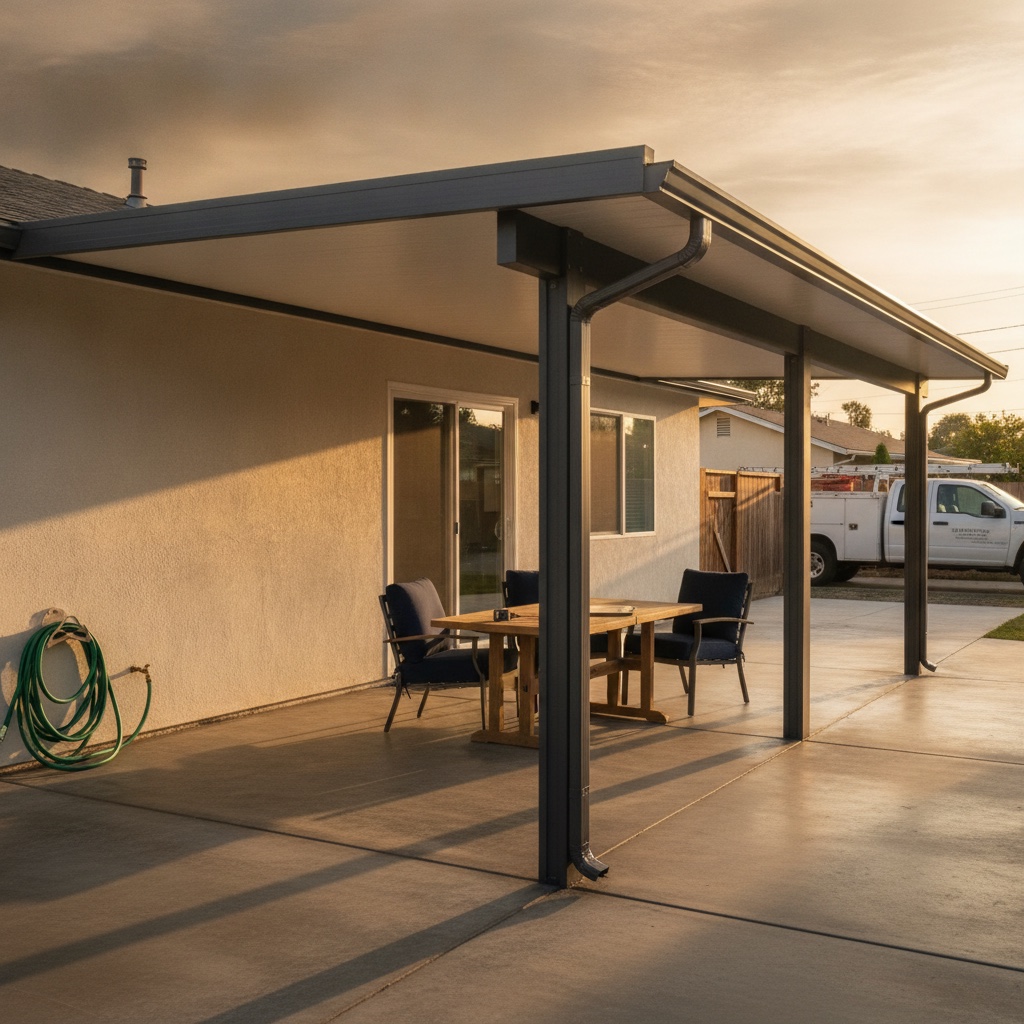
Solid non-insulated roofs are the workhorse of OC backyards at $20 to $30 per square foot. That buys .032 gauge embossed aluminum roof pans, a powder-coat finish in the AAMA 2604 tier, an attached ledger flashed into the stucco, and a gutter along the front edge. You get full shade, real rain protection, and a slab that reads 15 to 20 degrees cooler at 3pm in July than open concrete.
Insulated roof panels push the band to $30 to $55 per square foot. A 3-inch foam-core panel deadens heat and rain noise and carries ceiling fans and recessed lights without extra framing. If you plan to use the patio as a year-round room, this is where the budget should go. If you only need shade over a barbecue, it is often more panel than the yard requires.
A named-spec example you can hold a quote against
Price out a real job: a 10 by 20 attached solid cover in Tustin. The spec sheet reads .032 gauge embossed aluminum pans, an 8-inch front beam on two 3 by 3 inch posts set in concrete footings, AAMA 2604 powder coat in adobe cream, a ledger attachment flashed at the stucco line, and a front gutter with two downspouts. At $24 per square foot, the cover itself prices at $4,800.
Then come the adders. A Tustin permit with plan check runs $300 to $600, and OC cities as a group charge anywhere from $200 to $800. An electrical run for one ceiling fan and a switch adds $400 to $700. Footings in expansive clay can add about $250 per post when the inspector wants 24-inch depth. The delivered project lands between roughly $5,800 and $6,600. A bid far below that is usually missing something, and the missing line is almost always the permit.
What actually moves your number
Square footage moves the total but barely moves the rate. The items below move the rate itself, and they are the ones worth asking about before you sign anything. Each one should appear as its own line on the quote, priced in plain dollars, so you can compare bids without guessing at what got bundled where.
- Beam span. A clear 20-foot opening with no center post needs a heavier beam, which can add $600 to $1,000 over a two-post layout.
- Freestanding vs attached. A freestanding cover adds two posts, two footings, and knee bracing, typically $800 to $1,200 over an attached design.
- Insulated panel upgrade. Moving from pan roof to 3-inch foam core adds $8 to $20 per square foot, and it is the single biggest lever on any quote.
- Electrical. One fan and a light on a switch runs $400 to $700. A sub-panel feed for a full outdoor kitchen is a different project entirely.
- Demolition. Tearing off a failing wood cover and hauling it away runs $500 to $900 in most OC cities.
Color matters less than people expect. Standard white, adobe, and desert sand price the same. Two-coat designer colors in the AAMA 2604 tier add roughly 5 to 8 percent, and for a coastal address the upgrade earns its keep in color hold, since the marine air works on cheap finishes first. Ask which tier the quote carries. If the salesperson cannot name AAMA 2603, 2604, or 2605, keep shopping.
Paying for it at July 2026 rates
Cash is still the cheapest money, and a patio cover is small enough that many households simply write the check. For financed jobs, the national average HELOC rate sits at 7.43 percent as of July 22, 2026, with fixed home equity loans close behind at 7.36 percent. On a $6,500 cover paid over five years at those rates, the payment works out to about $130 a month.
Manufacturer and dealer promos are the other lane. Twelve-month same-as-cash offers are common in summer, and they are fine tools if you read the deferred-interest clause and clear the balance before the clock runs out. In-house financing tends to price above a credit union HELOC, so treat it as a convenience, not a deal. Whatever the lane, get the cash price first and negotiate from there.
The honest way to pin down your own number is to measure at the house, not over the phone. A free in-home quote from JNL takes about an hour, itemizes the spec down to gauge and powder-coat tier, and hands you a per-square-foot figure you can hold against every other bid in Orange County. If 2026 is the year the slab finally becomes a room, that hour is the cheapest part of the whole project.
Morning-context sources used: patiowarehouseinc.com (How Much Does a Patio Cover Cost in OC, 2026 guide), visionsunrooms.com (How Much Does a Patio Cover Cost in Southern California, 2026), homeguide.com (Alumawood Patio Cover Cost, 2026), bankrate.com (Current HELOC Rates, July 2026), finance.yahoo.com (HELOC and home equity loan rates, July 23, 2026).