
Stand on a patio in Corona del Mar on a July morning and you can taste the ocean in the air. The marine layer has been parked over the Orange County coast all week, holding beach towns in the low 70s while inland neighborhoods bake. That damp, salty blanket feels great on your skin. It is quietly brutal on metal. Salt-laden moisture settles on every beam, panel, and screw in your backyard, and it does not rinse itself off.
This is why the single most important line item on a coastal OC patio cover quote is not the color or the panel style. It is the powder-coat tier. Two covers can look identical on install day, one finished to AAMA 2603 and one to AAMA 2605, and ten years later only one of them still looks like it belongs in Newport Beach. Here is how to read that spec before you sign anything.
What salt air actually does to a patio cover
Salt does not attack aluminum the way it attacks steel. Bare aluminum forms its own oxide layer and resists red rust entirely, which is one reason it beats steel near the water. The real fight happens at the finish. Salt crystals land on the coating, pull moisture out of the marine layer, and hold a corrosive film against the surface through the wet mornings and dry afternoons that define coastal OC summers.
The failure mode to know by name is filiform corrosion. It shows up as thin, thread-like trails creeping under the coating, usually starting at a scratch, a cut edge, or a fastener hole. Testing bodies consider it the dominant failure mode on powder-coated aluminum near the coast, which is exactly why the top coating standard switched from a static salt-spray test to a cyclic wet-dry test that mimics real beach-town weather. Wet mornings, dry afternoons, repeat for twenty years. That is the test your finish needs to pass.
The three powder-coat tiers, in plain English
AAMA specs sound like alphabet soup, so here is the kitchen-table version. AAMA 2603 is the entry tier. It is fine for interior work and forgiving inland climates, and it typically carries about one year of real fade resistance in aggressive exposure. On a coastal lot it chalks and dulls fast. If a low bid will not name its coating spec, this tier is usually why.
AAMA 2604 is the solid middle. It is tested against five years of South Florida sun and roughly 3,000 hours of salt spray, and it holds color well for most SoCal neighborhoods. For a homeowner in Tustin or Anaheim Hills, 2604 is a smart, honest spec. We install a lot of it inland and it earns its keep.
AAMA 2605 is the coastal tier. These finishes, built on 70 percent PVDF or FEVE resins, are rated for ten years of aggressive exposure and are qualified under the cyclic salt-fog test designed around coastal corrosion. This is the tier written into specs for oceanfront buildings, and it is what belongs on a cover in Huntington Beach, Laguna, Seal Beach, or Dana Point. Expect it to add roughly 10 to 20 percent to the finish cost. Spread over a cover that should last 20 years or more, that premium is small.
The two-mile rule for Orange County streets
Salt exposure drops fast as you move inland, so your street address does a lot of the spec work. Within about a half mile of the sand, in places like Balboa Peninsula, Sunset Beach, or south Laguna, treat the site as a marine environment, full stop. That means 2605, stainless fasteners, and a rinse habit. The marine layer sits on these blocks most summer mornings at 1,000 to 1,500 feet thick, and evening humidity regularly runs above 80 percent.
From a half mile to about two miles inland, Costa Mesa, most of Huntington Beach, Fountain Valley west of the 405, the salt load is lighter but real. Fog still reaches you, and onshore wind still carries spray-borne chloride. Here 2605 is the recommendation and 2604 is the defensible budget call, provided you commit to rinsing the cover a few times a year. Past two miles, in Irvine, Orange, or Yorba Linda, ordinary coastal caution applies and 2604 performs well.
Fasteners and flashing are part of the finish spec
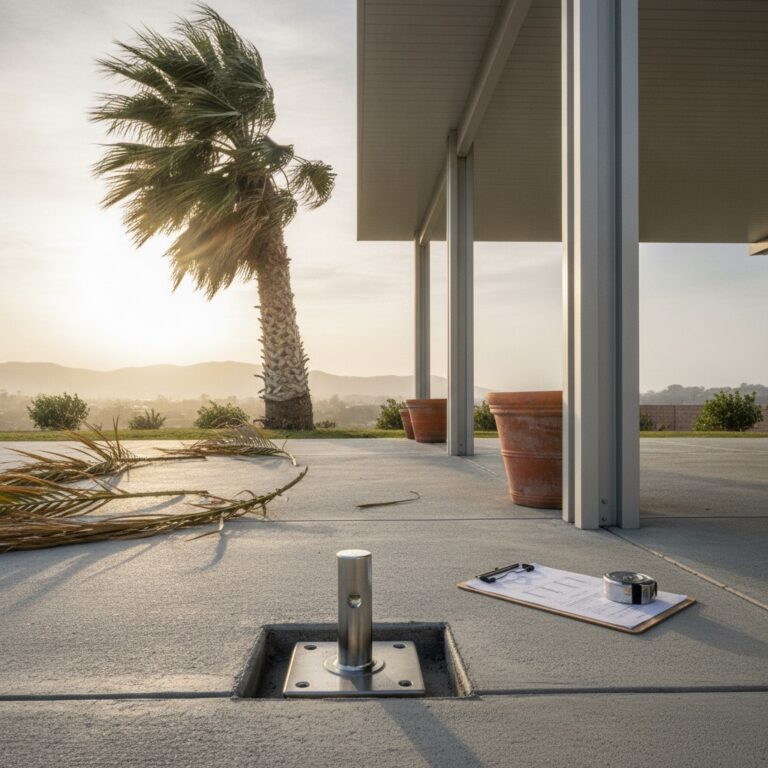
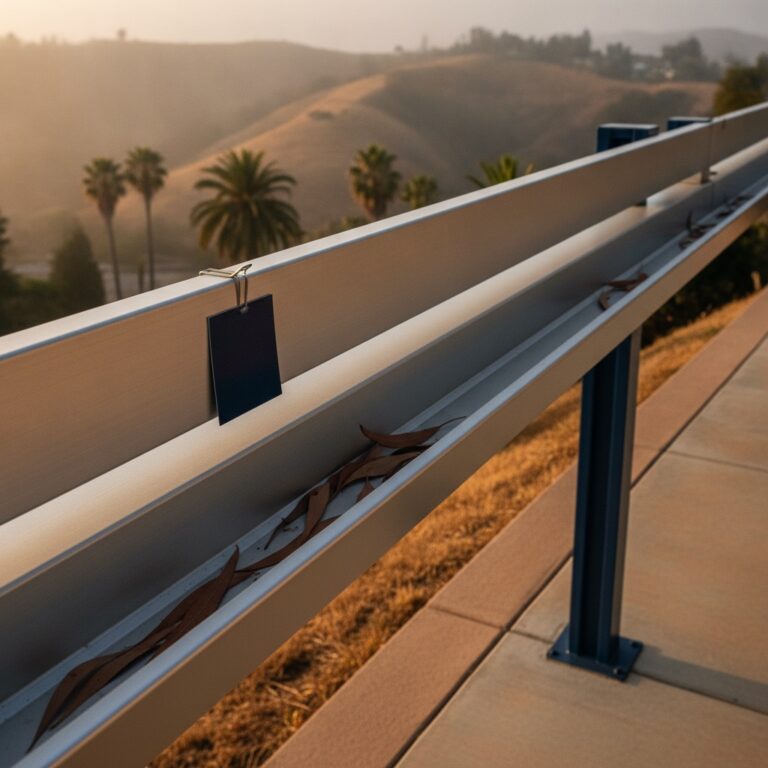
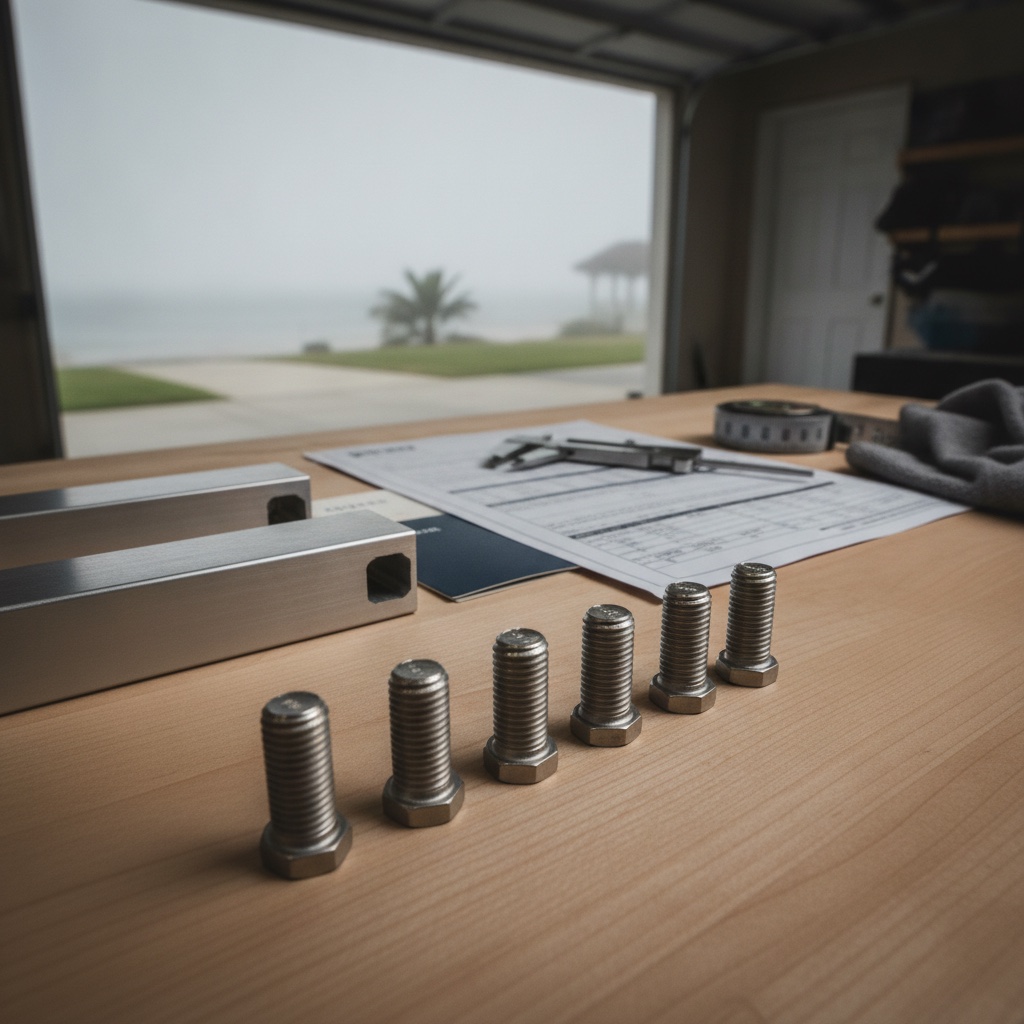
A 2605 finish with the wrong hardware is a spec with a hole in it. Every fastener penetration is a cut edge where filiform corrosion wants to start. On coastal installs the fasteners should be stainless steel, and the attachment points at the house wall need clean flashing so salty runoff never sits trapped against the header. Gutter integration matters here too. A gutter that drains fully after the marine layer burns off dries the whole edge of the cover instead of leaving a damp salt line.
Then there is the cheapest insurance in this whole article: a hose. Aluminum covers near the coast should get a plain-water rinse every month or two, more often on front-row lots. Rinsing removes the salt film before it concentrates, and most manufacturer warranties at the 2605 tier quietly assume you are doing it. Ask your installer to show you the warranty language on finish care. A good quote names the coating spec, the fastener metal, and the care schedule on one page.
One more spec note worth the ink: color choice interacts with tier. Darker powder coats absorb more heat and show chalking sooner when the resin gives up, so a charcoal or bronze cover two blocks from the pier has the most to gain from 2605 chemistry. Lighter tones like soft white or sandstone are more forgiving at 2604. If your heart is set on a dark finish near the water, budget for the top tier and consider it settled.
If you live anywhere from Seal Beach down to San Clemente and you are weighing a new cover, have someone stand in your actual yard before you pick a finish tier. JNL Aluminum builds for coastal Orange County every week, and a free in-home assessment will match the powder-coat tier, fasteners, and drainage details to your distance from the water, not to a brochure average. Request a quote and get the spec that fits your block.
Morning-context sources used: LAist on the marine layer cooling the SoCal coast this week; Orange County Patch coastal forecast for late July 2026; AMICO Architectural Metals on specifying AAMA 2604 vs 2605; Sundial Powder Coating (Los Angeles) on the AAMA 2605 specification; Duralum on 2026 outdoor living trends.