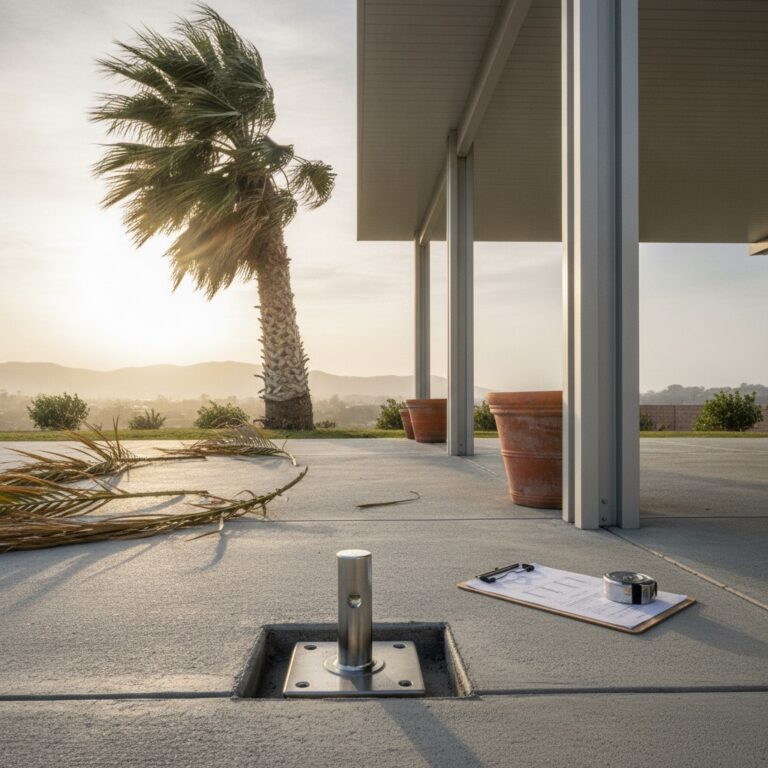

Christmas week of 2025 dropped more than a foot of rain on parts of the Southern California foothills. Downtown Los Angeles logged its wettest Christmas Eve and Christmas Day in more than 50 years. In Yorba Linda and Anaheim Hills, homeowners watched water sheet off the front edge of their patio covers and trench the planting beds below. The cover did its job. The drainage did not.
Now look ahead. NOAA’s July updates point to a strong El Nino peaking this fall, with serious odds it reaches the top tier of intensity. Strong El Nino winters tilt Southern California wet. Nobody can promise you a February storm total. But if you own a patio cover in the north Orange County foothills, August is the month to ask one question: where does the water actually go?
What a strong El Nino means for a foothill patio
The signal is unusually loud this year. NOAA’s Climate Prediction Center carried its El Nino advisory through July and gives the event a 97 percent chance of persisting through winter. The mid-July model ensembles overwhelmingly favor a strong event, and forecasters put real odds on a very strong one. That does not guarantee rain. It loads the dice toward a wet Southern California, the same way the big El Nino years of the past did.
Foothill neighborhoods feel it more than the flats. When a storm presses against the Chino Hills and the Puente Hills, the terrain wrings extra water out of it. That is why the December 2025 storms put over 12 inches on some foothill stations while coastal gauges recorded far less. Yorba Linda, Anaheim Hills, Brea, and the canyon streets above them sit in exactly that squeeze zone.
California logged 69 flooding reports and 31 landslide reports during that Christmas-week stretch. Most aluminum patio covers came through fine as structures. Aluminum does not rot, and a properly anchored cover carries a rain load without complaint. The failures showed up a foot lower, where water left the roof and went wherever gravity took it.
Your solid cover is a rain collector, planned or not
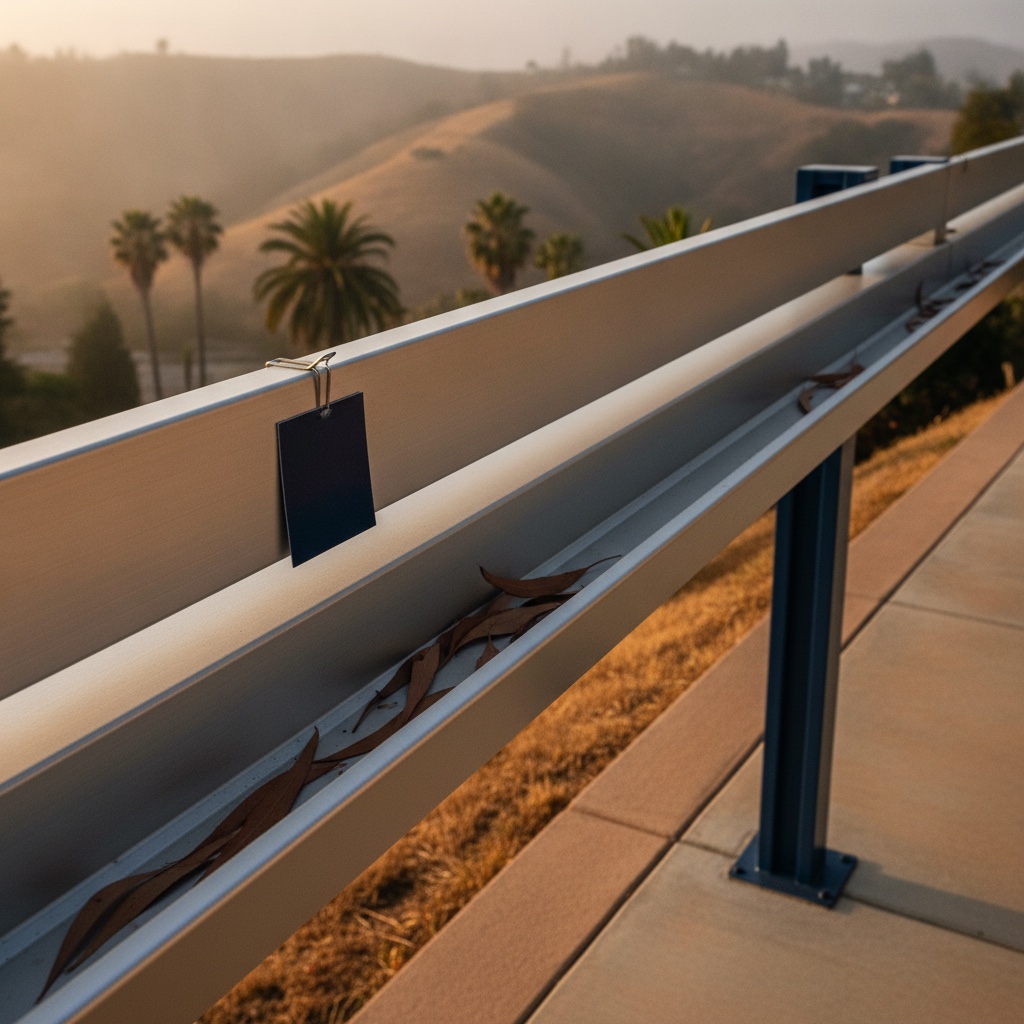
A solid-roof aluminum cover gathers every drop that lands on it. The W-pan roof panels shed water forward into the gutter channel built into the front fascia beam. A modest 10 by 20 foot cover carries 200 square feet of catchment. One inch of rain per hour sends roughly 125 gallons per hour into that single channel. The December storms delivered bursts well past that rate for hours at a time.
The first common failure is too few outlets. A 20-foot fascia gutter with one downspout at a far corner backs up in heavy rain. Water stacks in the channel, finds the low spot in the middle of the run, and pours over the lip in a sheet. From the kitchen window it looks like the cover is leaking. It is not. It is overflowing.
The second failure is the dump at the post base. Plenty of older installs run the downspout straight down a post and stop at the slab. In a light rain that is harmless. In a December cloudburst it concentrates hundreds of gallons against a post footing, undermines the slab edge, and sends a stream toward the house foundation. Foothill lots with any slope turn that stream into a channel cut through the yard.
The third failure is debris. Foothill streets carry eucalyptus, pepper trees, and palms, and Santa Ana season strips them out every fall. The first real storm in November lands on a gutter channel that has been collecting leaf litter since September. A clogged 2 by 3 inch downspout outlet turns a well-designed gutter into a bathtub with no drain.
The drainage spec worth asking for by name
When you get a cover quoted, or a drainage retrofit on an existing one, the fix is a short list of specifics. Ask for a downspout at each end of any gutter run over 14 feet, not one corner outlet serving the whole span. Ask for the gutter channel pitched toward the outlets, about an inch of fall over a 20-foot run. Flat channels hold standing water and debris all winter.
Ask where each downspout terminates. The right answer on a foothill lot is a splash block aimed away from footings at minimum, and a tie-in to a yard drain or a buried 3-inch line daylighting at the curb where the grade allows it. The wrong answer is bare slab. On attached covers, ask about the flashing detail where the cover meets the house wall, because wind-driven rain exploits a caulk-only joint within a season or two.
Materials matter in the wet season too. A gutter channel in an AAMA 2604 powder coat holds its finish through years of standing moisture and sun. Stainless fasteners at the gutter and downspout connections keep rust streaks off a light-colored fascia. None of these line items add much to a quote. All of them are cheaper than regrading a yard in March.
Why August beats November for this work
Every wet-winter forecast follows the same social pattern. The news covers it in October, the first storm hits in November, and the quote queue at every patio contractor in Orange County fills up overnight. Homeowners who call in August get install dates in September, dry weather for the crew, and a finished drainage path months before the first atmospheric river shows up on a 10-day forecast.
A drainage retrofit on an existing aluminum cover is usually a half-day job: added downspouts, re-pitched channel, terminations routed away from the slab. A new cover designed around drainage from day one costs nothing extra beyond the downspout hardware. Either way, the work is easier, faster, and better done on a dry 85-degree week than between storms in December.
If your cover survived last Christmas but your yard did not, this is the season to fix it. We offer a free in-home assessment across Yorba Linda, Anaheim Hills, Brea, and the surrounding foothill neighborhoods, and it takes about an hour to walk the cover, trace the water path, and put the right drainage spec in writing before El Nino makes the argument for us. Request a quote and pick a morning that works.
Morning-context sources used: NOAA winter 2026-2027 outlook coverage (Unofficial Networks, July 19, 2026); Weather West special update on rising odds of a strong-to-historic El Nino (July 2026); IRI/CPC July 2026 ENSO Quick Look; CalMatters reporting on December 2025 Southern California debris flows; LAist coverage of the December 2025 holiday atmospheric river.