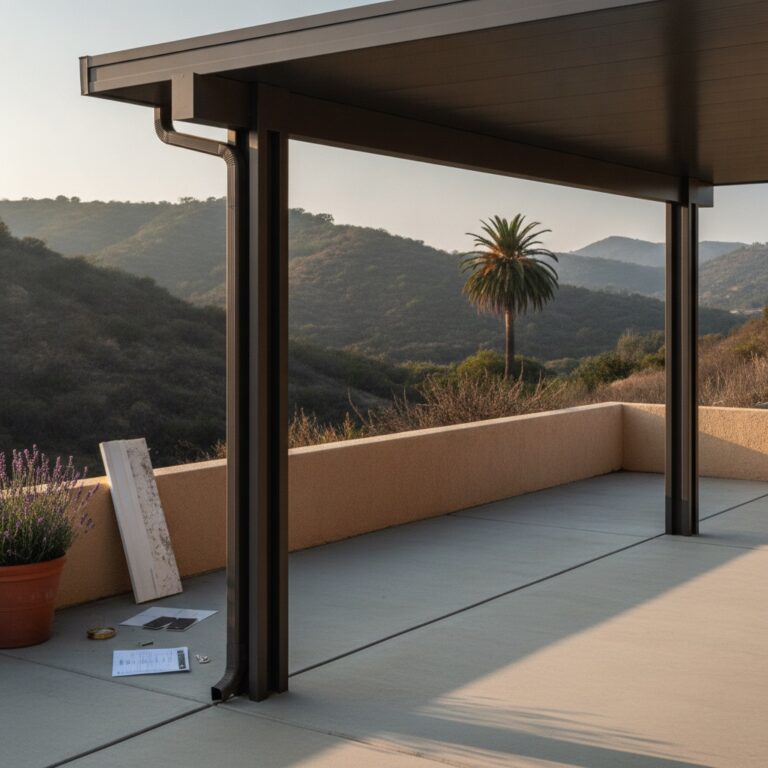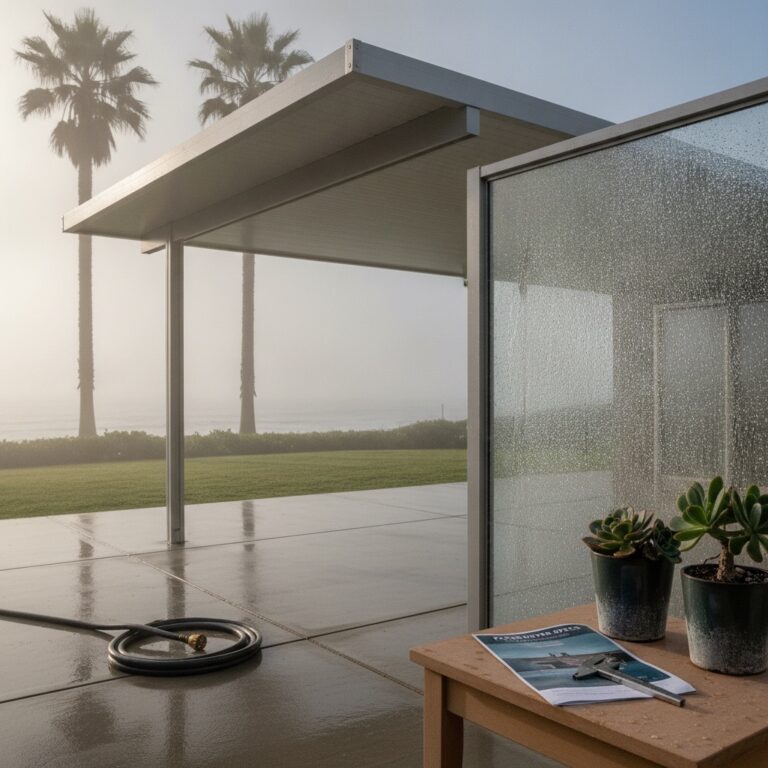

In Corona del Mar, a patio cover sits about 1,200 feet from the surf line. The owner washes salt film off the windows every week and never thinks twice about the aluminum overhead. That is the coastal Orange County trade. The ocean keeps your July highs near 69 degrees while the rest of the county bakes, and in exchange it coats everything you own in a fine salt mist that hunts for cheap finishes. A patio cover built for an Inland Empire yard will not hold up the same way half a mile from the water. The finish spec is the whole ballgame.
The coastal microclimate your cover actually lives in
Coastal OC runs its own weather. Through late June 2026 the marine layer has stayed thick and stubborn, with forecasters calling for June gloom to persist unusually deep into the month and onshore flow pushing low cloud and drizzle into the valleys overnight. Humidity in the county runs 60 to 73 percent across June, and along the beaches highs sit near 69 while homes a few miles inland climb into the mid 70s. Salt rides in on that same onshore flow. Newport, Huntington Beach, Laguna, Dana Point, and Seal Beach all live inside the band where airborne chloride settles on metal every single night. The cover never fully dries between the dew at dawn and the drizzle after dark. Constant moisture plus salt is the exact recipe that pits the wrong aluminum finish.
Distance from the water changes the math fast. Salt deposition drops off sharply as you move inland, so a cover three blocks from the sand in Seal Beach takes a far heavier chloride load than one two miles back in Costa Mesa. Wind direction matters too. The same onshore flow that builds the marine layer carries salt straight at west-facing and south-facing yards, while a protected courtyard sees less. None of that means an inland-grade finish is fine at the beach. It means a contractor who knows coastal OC should be matching the spec to your exact block, not handing every address the same cut sheet.
What salt air does to the wrong finish
Bare or under-coated aluminum does not rust the way steel does, but it corrodes. Salt sets up a slow electrochemical reaction at any scratch, cut edge, or thin spot in the coating. You see it first as white powdery blooms near fastener heads and beam ends. Then the powder coat starts to lift at the edges, and once moisture gets under the film it spreads sideways from the defect. A finish that looks flawless on the truck can show chalking and edge creep within a couple of seasons this close to the water. Vinyl covers fare worse here, going brittle and hairline-cracking under the same salt-and-UV load, which is why a lot of coastal homeowners replacing an old vinyl unit are surprised how fast it failed. The metal underneath is rarely the problem. The coating and the prep are.
AAMA 2605 vs 2604: the tier that matters near the water
Powder coat is graded against AAMA performance specs, and the gap between the two common tiers is real. AAMA 2604 is a solid mid-grade finish backed by roughly five years of Florida exposure data. AAMA 2605 is the top architectural tier, validated against ten years of South Florida outdoor testing with strict limits on gloss loss, color shift, chalking, and film erosion. South Florida is the benchmark on purpose. It stacks intense UV, high humidity, salt air, and frequent rain, so ten years there maps to twenty or thirty in a milder climate. For a yard within a mile of the OC coast, that 2605 tier is the one worth paying for. The corrosion test behind it matters too. Coastal-rated coatings get checked under cyclic salt exposure, and salt-spray resistance runs out to 4,000 hours per ASTM B117 with tight limits on how far corrosion creeps from a scribed line. That number is the difference between a finish that shrugs off Newport mist and one that blooms by year three.
Fasteners, pretreatment, and the details installers skip
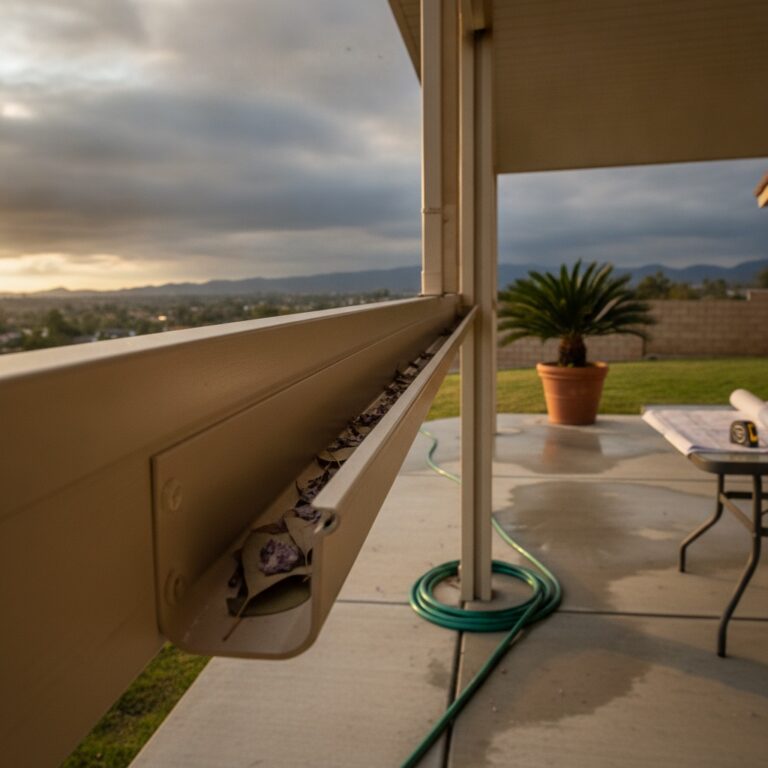
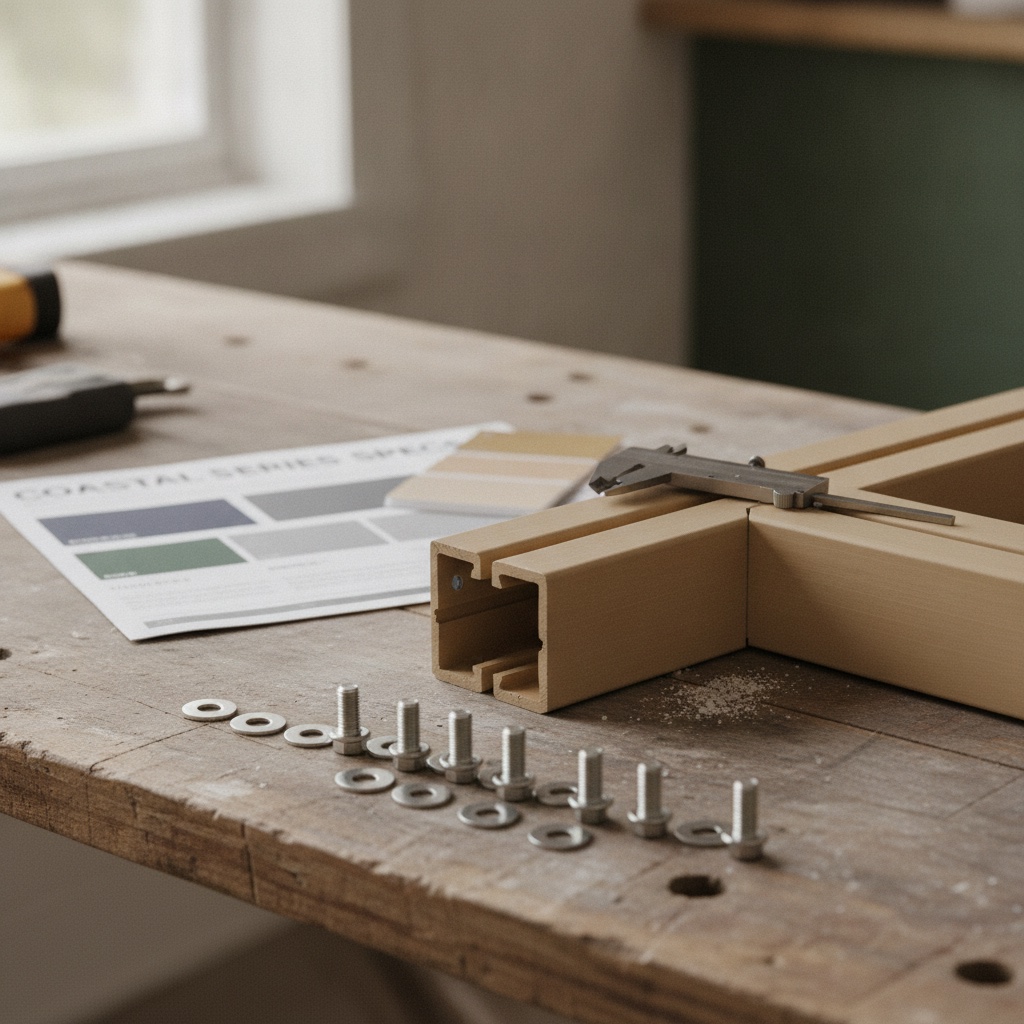
The finish tier means little if the prep underneath it is wrong. The step that decides long-term corrosion resistance is the pretreatment, a chrome phosphate conversion coating applied to the aluminum before any powder goes on. That layer locks the film to the metal and stops moisture from undercutting the coating at every scratch and cut edge. Skip it or rush it and even a 2605 finish lifts early. Fasteners are the other quiet failure point. Standard zinc-plated screws will weep rust streaks down a coastal cover within a year, so the hardware needs to be stainless steel, ideally 316 grade near the beach. Cut ends of beams and rafters should be sealed, not left raw, because bare aluminum at a saw cut is exactly where salt starts its work. Gutter integration matters here too, since standing water in a poorly pitched gutter holds salt against the metal for days. A built-in gutter wants enough fall toward the downspout that nothing pools after the marine-layer drizzle clears. None of this shows up in a glossy brochure photo, and all of it shows up in year four.
Gauge plays a quieter role. A heavier extruded aluminum beam, in the .040 to .050 range for pans and a thicker wall on the structural members, gives the powder coat more metal to protect and more margin before any pitting reaches something that matters. Thin imported pan stock corrodes through faster at the coastal edge cities precisely because there is less material between the salt and the open air. When a quote lists the finish tier but stays vague on gauge and fastener grade, that is the moment to ask. Those three numbers, the AAMA tier, the metal thickness, and the stainless grade, decide whether a coastal cover looks new at year ten or chalky at year three.
Spec it for your block, not a brochure
A cover a mile inland in Tustin and a cover three blocks off the sand in Seal Beach are not the same job, even if the brochure shows the same beam. The coastal one wants AAMA 2605 powder coat, 316 stainless fasteners, sealed cut ends, and a gutter that actually drains. We build to the address, not the catalog, and a free in-home assessment is where that gets sorted. We will walk your yard, check how much salt your specific block really sees, and write a quote that names the finish tier and fastener grade in plain language so you know exactly what is protecting your patio. If you are coastal OC and weighing a new cover or replacing one that is already blooming, ask for the in-home visit and we will spec it for where you actually live.
Morning-context sources used: AccuWeather June Gloom forecast (https://www.accuweather.com/en/weather-forecasts/june-gloom-to-persist-in-southern-california-unusually-deep-into-the-month/1537607); 10News San Diego forecast June 24 2026 (https://www.10news.com/weather/san-diegos-weather-forecast-for-june-24-2026-cooling-off-with-a-return-of-june-gloom); climate-data.org Orange County June climate (https://en.climate-data.org/north-america/united-states-of-america/orange-county-california-10312/r/june-6/); AMICO AAMA 2604 vs 2605 guide (https://amicoarchitectural.com/specifying-aama2604-vs-aama2605/); Today Windows and Doors coastal-grade aluminum salt spray (https://todaywindowsdoors.com/blogs/news/coastal-grade-aluminum-salt-spray-resistance-for-marine-environments).