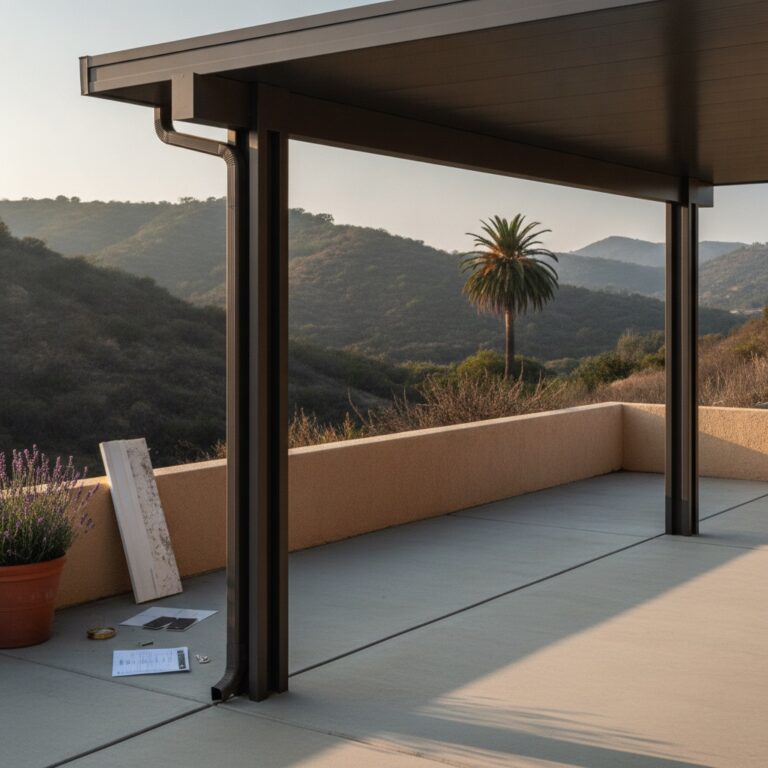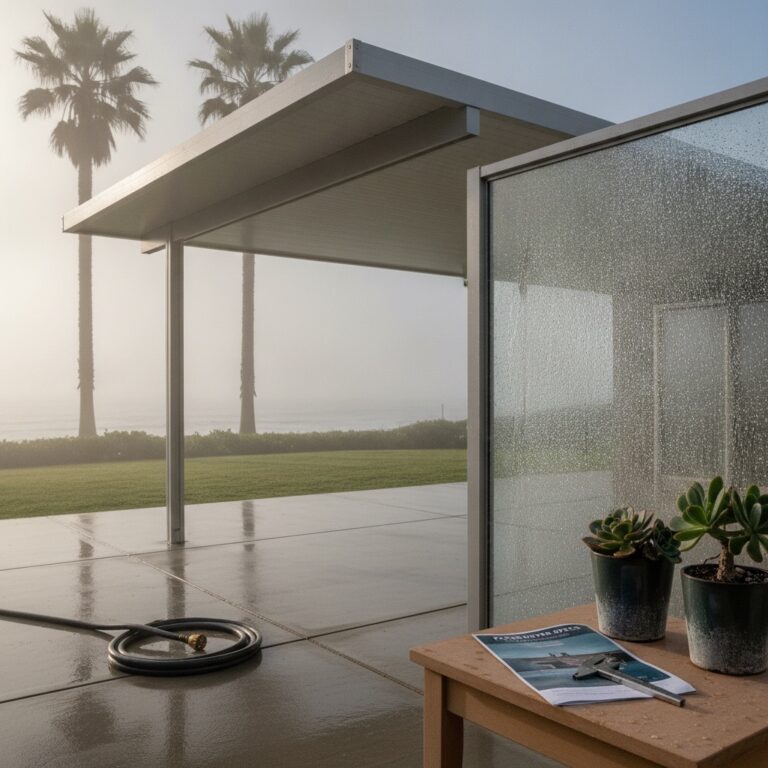
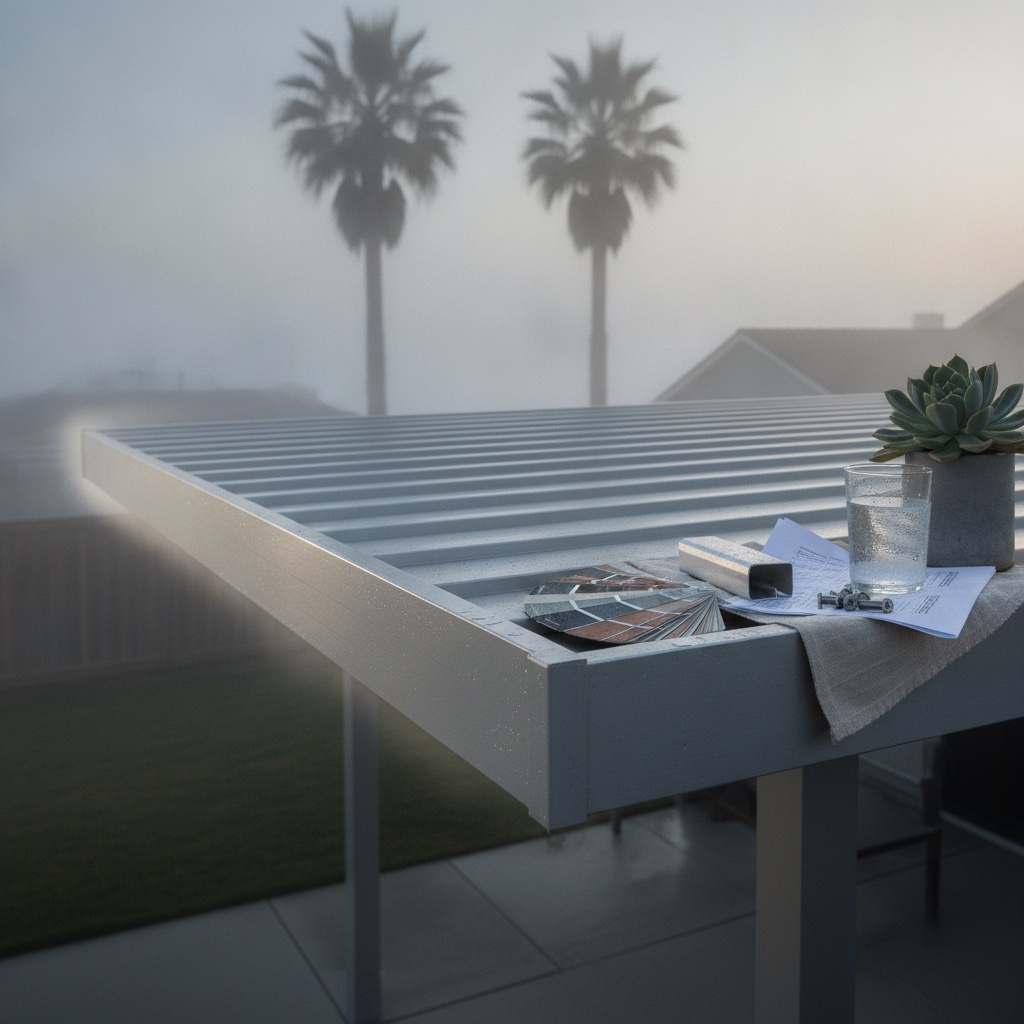

A Long Beach patio lives two climates before lunch. The morning starts under a gray marine layer thick enough to bead water on a car hood, and by early afternoon the same slab bakes under a clear sky and a UV index near 9. This June the gloom has held unusually deep into the month, with low clouds and patchy drizzle most mornings and a warming ridge building behind it. Forecasters expect that on-and-off pattern to run for weeks before steady summer sun arrives. For a patio cover, that daily swing matters more than any single hot afternoon.
The reason is simple. Salt-laden fog settles on every horizontal surface overnight, sits there through the cool morning, then flashes off when the sun breaks through. What it leaves behind is a thin film of marine salt that the next day’s UV bakes onto the finish. Repeat that 120 or more times a summer and a cheap coating starts to chalk, fade, and pit at the edges. The fix is not a bigger cover. It is the right finish spec for a coastal microclimate that most brochures gloss over.
A Long Beach Patio Lives Two Climates a Day
Coastal Long Beach rarely sees the inland heat that Riverside or Chino Hills fights in July. Summer highs near the water tend to land in the upper 70s to low 80s, while the marine inversion this month has been running around 1,900 feet deep. That keeps mornings cool and damp. The catch is humidity. A patio that stays under 80 percent relative humidity until 11 a.m., then sits under a high-UV sky by 1 p.m., gets the worst of both worlds: moisture to carry salt, and radiation to drive corrosion and color loss.
Wood covers hate this cycle. The daily wet-then-dry swing swells and shrinks the grain until joints loosen and paint flakes at the fastener heads. Vinyl handles the moisture but goes brittle and yellow under repeated UV near the coast. Aluminum is the material that shrugs off both, but only when its finish and fasteners are specified for salt air. A bare or builder-grade aluminum cover in Long Beach will outlast wood and still disappoint you in year six.
What the Fog-Then-Sun Cycle Does to a Cheap Finish
Most patio covers sold in SoCal carry an AAMA 2603 finish. That is the entry tier, fine for a dry inland yard, weak at the coast. It is a basic polyester coating with no real salt-spray pedigree, and it chalks fast where marine air meets strong UV. Homeowners in Belmont Shore and Naples Island see it first as a dull haze on the south-facing beams, then as a color that no longer matches the stucco it was ordered to complement.
The damage starts at the edges and fastener holes. Salt finds the cut ends of an extrusion and the spots where a screw breaks the coating. Once moisture wicks under the film, it lifts the finish from the metal and corrosion creeps inward. Cyclic salt-and-UV exposure, the kind a Long Beach summer delivers daily, is harder on a coating than steady heat alone. That is why coastal finish standards test with cycling salt fog, not just a hot oven.
The Powder-Coat Tier That Holds Up
For a Long Beach cover, specify an AAMA 2605 finish. That is the top architectural tier, the same standard written for high-rise curtain walls and marine-environment projects. It requires 10 years of South Florida outdoor exposure to pass, and the salt-spray testing runs cyclic per ASTM G85 rather than the gentler continuous test used for lower tiers. Compliant fluoropolymer coatings document 4,000 or more hours of salt-spray resistance. In plain terms, this is the finish built for exactly the fog-and-sun beating your slab takes.
The reason it survives is chemistry. Only 70/30 PVDF fluoropolymer coatings reliably meet AAMA 2605. They hold color and gloss where standard polyester gives up. A chrome-phosphate pretreatment locks the film to the aluminum so salt cannot undercut it at scratches and edges. For coastal work, a coating thickness around 50 to 60 microns is the target, thicker than the 40 microns that passes inland. The step up from a 2604 finish to a true 2605 finish on a 14 by 20 foot cover usually adds only a few hundred dollars, and it is the single best dollar you spend near the water.
Fasteners, Gauge, and Gutters for the Coast
The finish is half the battle. Hardware is the other half. Specify 316 stainless fasteners, not zinc-plated or standard galvanized. Marine-grade 316 resists the chloride pitting that turns ordinary screws into rust streaks down a white beam within two summers. Where the cover attaches to the house, the ledger fasteners and flashing should be stainless too, because that joint stays damp longest each morning.
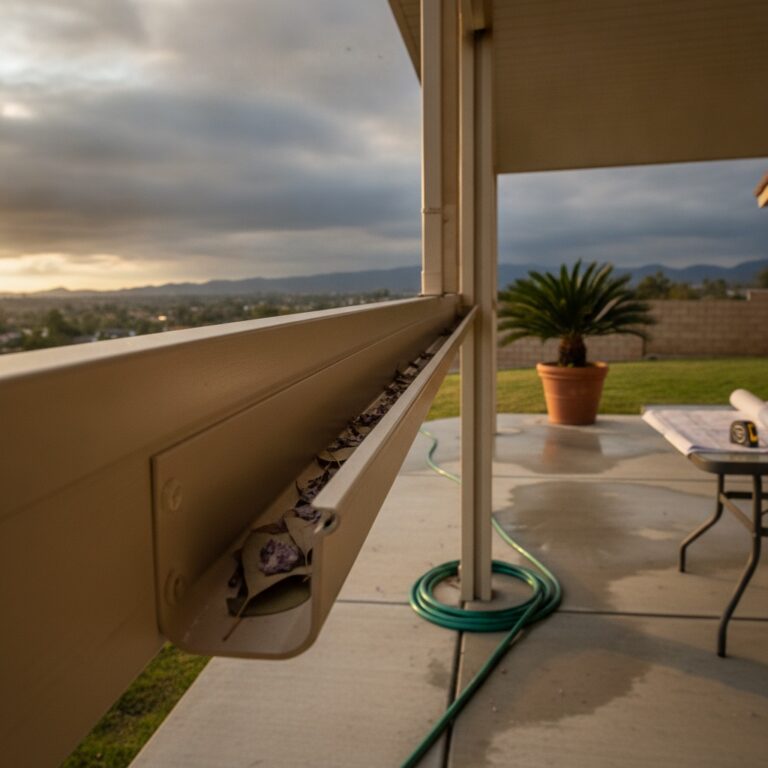
Gauge matters less for corrosion and more for the wind that often follows a marine morning. Roof pans in the 0.024 to 0.032 inch range and structural beams in 6005-T5 alloy give a Long Beach cover the stiffness to handle a gusty onshore afternoon without oil-canning. Pair that with a built-in gutter sized for real runoff. Coastal SoCal does not see much summer rain, but when an atmospheric river lands in winter, an integrated gutter on an aluminum cover sheds it cleanly while drizzle and condensation drain off instead of pooling on the panels.
One more coastal note: ask where the extrusions are cut and sealed. A good installer seals cut ends and touches up any field-drilled holes with matching coating so bare aluminum never faces the salt directly. That detail does not show up on a spec sheet, but it decides whether your beam ends look clean at year 10 or weep a white powder long before.
Spec the Cover for the Cycle, Not the Brochure
A Long Beach patio cover priced at $20 to $40 per square foot is a fair range for quality aluminum, and the coastal finish upgrade fits inside that without drama. What separates a cover that still looks sharp in 2036 from one that chalks by 2031 is not the headline price. It is the AAMA 2605 powder coat, the 316 stainless hardware, and an installer who seals the cuts. Those three choices answer the fog-then-UV cycle your yard runs every single summer day.
If you are weighing a cover anywhere from Belmont Shore to Bixby Knolls, we will come measure your slab, read your exposure, and write a quote that names the finish tier and fastener grade in plain language. The in-home assessment is free, and it is the fastest way to see what a coastal-spec cover actually costs for your yard. Book the visit and we will bring the powder-coat samples so you can hold the difference in your hand.
Morning-context sources used: AccuWeather, “June gloom to persist in Southern California unusually deep into the month” (https://www.accuweather.com/en/weather-forecasts/june-gloom-to-persist-in-southern-california-unusually-deep-into-the-month/1537607); NWS Los Angeles Area Forecast Discussion (https://forecast.weather.gov/product.php?site=LOX&issuedby=LOX&product=AFD&format=ci&version=1&glossary=1); Weather West, mid-June ridge and warming-trend outlook (https://weatherwest.com/archives/43869); Linetec, “How does salt spray affect finished aluminum? 6 considerations for finishes in coastal conditions” (https://linetec.com/2022/09/29/how-does-salt-spray-affect-finished-aluminum-6-considerations-for-finishes-in-coastal-conditions/); Sundial Powder Coating, “What Is AAMA 2605 Specification?” (https://sundialpowdercoating.com/articles/what-is-aama-2605-specification).