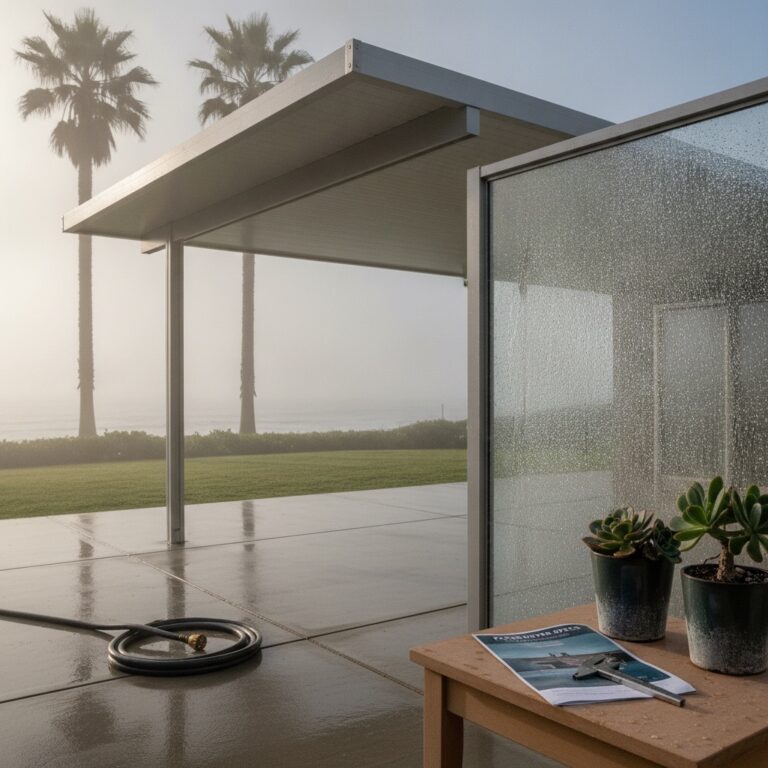
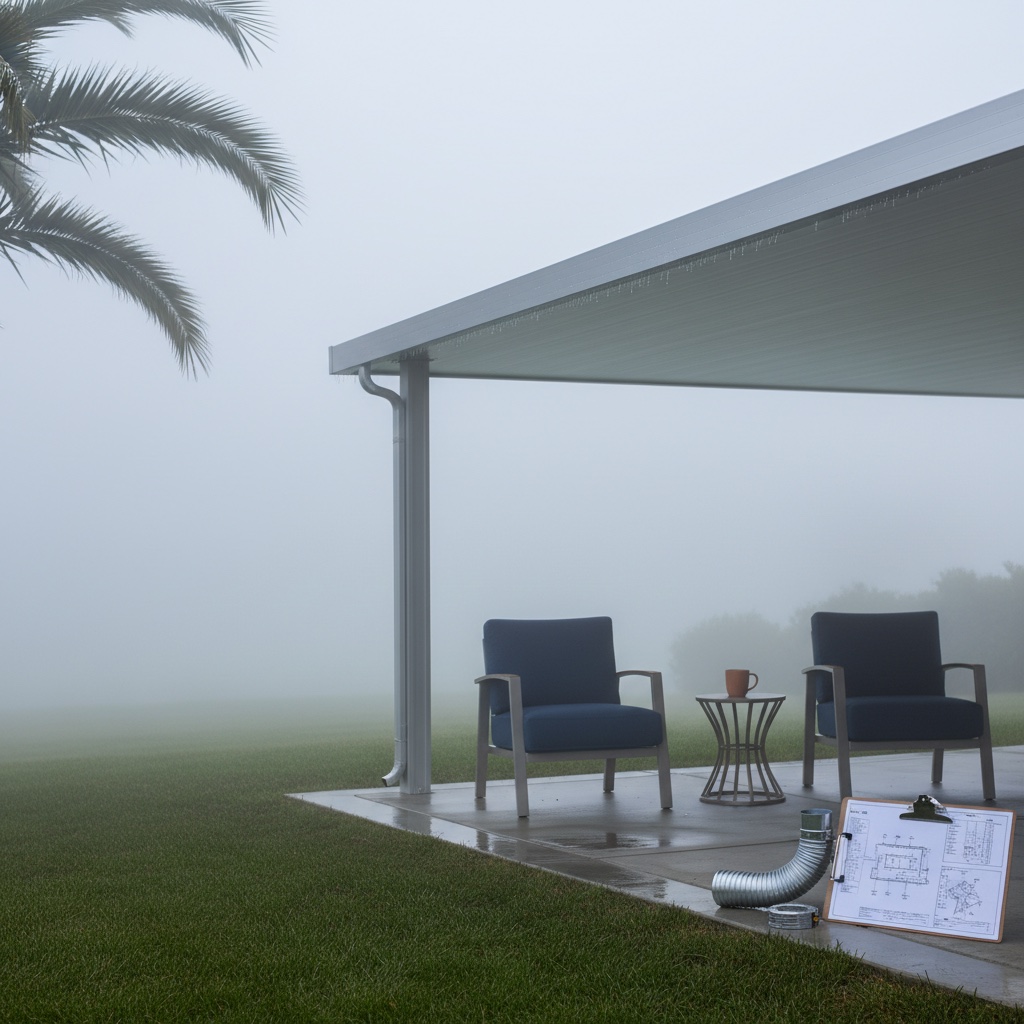

The Carlsbad slab woke up Tuesday morning with a fine sheen of water across it. Not rain. Dew. The marine layer had pushed in low and thick the night before, and by 6 a.m. the homeowner’s outdoor cushions were damp, the patio table felt slick, and a string of glass-bead pendant lights wore a fogged halo at each bulb. By 2 p.m. the gray finally peeled back and the slab went usable again. That is May Gray in coastal San Diego, and it is not new. The pattern shows up nearly every year from late April through early July, and 2026 is running right on script.
The National Weather Service forecast discussion this week called for onshore flow holding through Saturday, with a warming trend starting Sunday as the pattern flips offshore. Translation: the marine layer wins three more mornings before high pressure muscles back. For a SoCal homeowner planning a covered patio, that pattern is the whole ballgame. Material choice, finish tier, fastener spec, and drainage detail all answer one question. How do you keep a covered slab dry, mildew free, and usable when the morning air sits at 80 percent humidity until lunch?
What the marine layer actually does to a coastal patio
The marine layer forms when warm, moist Pacific air slides over cooler ocean water and condenses into a low cloud deck. In San Diego the deck routinely sits between 1,000 and 2,500 feet, holds along the coast until early afternoon, and burns off inland first. May and June average only 58 to 59 percent sunny days at the coast. The rest of the time, your patio is sitting under a damp lid.
That damp lid does three measurable things to an outdoor room. It coats every horizontal surface with condensation overnight. It keeps relative humidity in shaded areas above 70 percent well into late morning. And it traps that moisture against any material that absorbs water, which is where wood and certain vinyl panels start losing the fight by year three. Indoor air-quality research is clear that sustained relative humidity above 60 percent grows mildew on organic surfaces. A covered patio is not indoors, but it is shaded, often furnished with fabric cushions, and bordered by stucco walls that hold moisture too.
Why aluminum still wins the coastal humidity test
Aluminum has no iron in it, so it does not rust. That single material fact is why coastal SoCal contractors keep specifying aluminum over steel, even where steel could span a longer beam. What aluminum can do, and what wood and vinyl cannot, is pair a non-corroding base material with a powder-coat finish rated for salt-spray exposure.
The right finish standard for a San Diego coastal install is AAMA 2604 at minimum, with AAMA 2605 for homes within roughly 1,000 feet of the Pacific. AAMA 2605 is the highest-performance architectural finish standard, and it is what holds color and gloss against the combination of UV and salt mist that hits a Del Mar or La Jolla yard year round. A 2604 finish protects against blistering and color shift through year 10. A 2605 finish is rated to hold through year 20 in salt-spray testing.
The other quiet hero is fastener choice. A coastal-grade install does not use plain galvanized lag bolts. It uses stainless steel, type 304 at minimum and type 316 for the closest oceanfront homes. Hardware corrodes faster than the cover itself, and a streaking rust line down a powder-coated post is almost always a fastener problem, not a finish problem. The honest tradeoff: stainless adds cost. A typical 14-foot by 20-foot attached cover sees roughly 40 to 60 fasteners in the structural connection points. Going from galvanized to 316 stainless adds maybe 80 to 140 dollars in hardware. Against a 12 to 18 thousand dollar install, that is rounding error, and it is the line item that decides whether your cover looks new at year 10.
The drainage detail that separates a dry patio from a wet one
Marine-layer moisture is not a single soaking rain event. It is a slow, repeated wetting cycle that runs every overnight for two to three months a year. The covered patio that stays dry handles two paths for that water: the dew that lands on the cover, and the dew that lands on the slab beyond the cover.
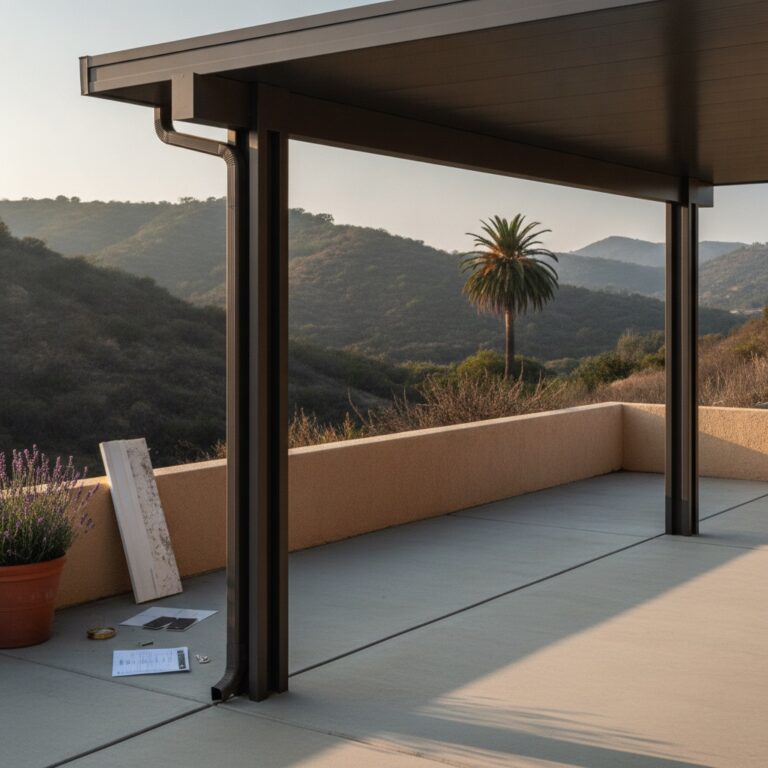
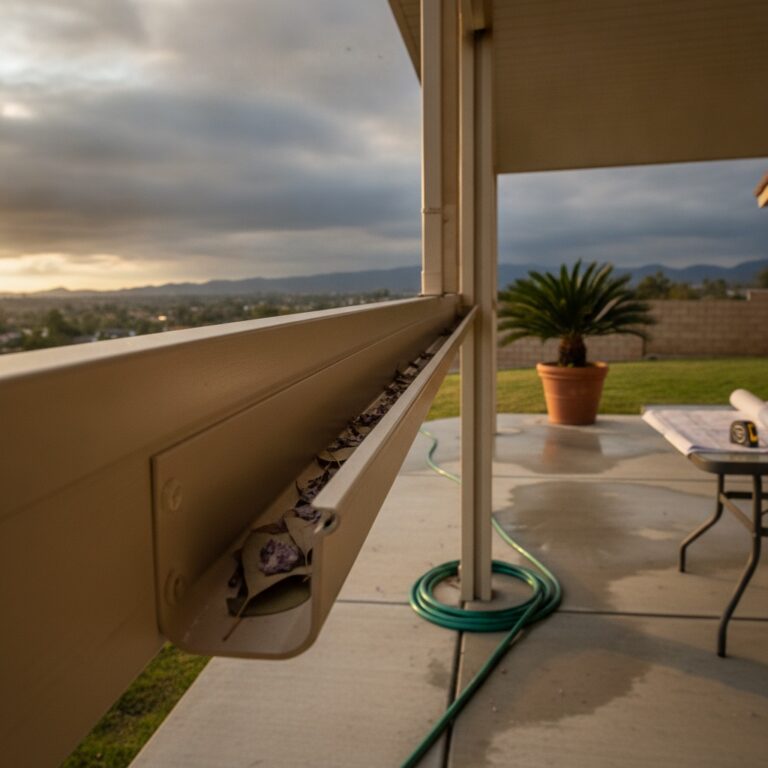
Water on the cover goes to the gutters. A properly integrated aluminum cover has its gutter built into the front fascia, sloped a quarter inch per foot toward a downspout that ties into the existing yard drainage. On a 14-foot run, that is a 3.5 inch fall, plenty to move the volume that even an atmospheric river drops. Cheaper installs skip the integrated gutter and let water sheet off the front edge. That works for two seasons. By season three, the front edge of the slab has a green algae stripe and the soil at the dripline is permanently mud. The fix is rarely retrofittable without disassembly.
The other path is the air gap between the cover and the house. A proper attached install uses a flashed ledger board, a backed pan flashing at the wall, and a sealed bead at the stucco. Marine-layer drip rolls right off the flashing instead of pooling at the wall plate. Skip that detail and you get the slow stucco staining and wood-trim damage that ages a house faster than the actual rain does.
Mildew, cushions, and the practical homeowner side
The cover itself does not grow mildew. Aluminum and powder coat are both inorganic and food-free for fungus. What does grow mildew under a coastal cover is anything organic that lives under it: outdoor cushions, jute rugs, untreated wood furniture, and the leaves that drift in and stay shaded.
Three practical moves keep a covered patio mildew free through May Gray and June Gloom. Specify solution-dyed acrylic cushion fabric, not olefin or polyester blends. Pull rugs and store cushions if a 5-day marine-layer stretch is forecast. Sweep leaves out weekly between April and July. None of those are dramatic, and all three matter more once the structure is right.
One more local note. A solid-roof cover keeps the slab dry under it but does not stop the dew that lands outside its footprint. A lattice cover lets some dew reach the slab below, which dries faster once the gray breaks. Coastal homeowners who want a fully dry slab in the worst of June Gloom should size the solid cover to extend at least 2 feet past the usable footprint at the drip edge. Inland homeowners can run a tighter footprint because the marine layer thins fast going east of Interstate 5.
What this means if you are quoting a coastal-grade cover this summer
A San Diego coastal homeowner asking for a new aluminum patio cover should see these line items on the quote. AAMA 2604 powder coat as a floor, with 2605 if the home sits within 1,000 feet of the Pacific. Type 304 stainless fasteners minimum, type 316 within sight of the water. An integrated gutter with a real downspout tied into existing drainage. Flashed ledger and pan flashing at any wall connection. Solution-dyed acrylic recommended for any cushions sold or specified with the install. None of those are upgrades. On a coastal install they are the spec.
The cover that holds up against five years of May Gray, June Gloom, Santa Ana wind, and the occasional atmospheric river is the one that was specified for those conditions on day one. We walk every coastal quote through this list at the kitchen table, line by line, before pricing. If you are weighing a new cover for a Carlsbad, Encinitas, Del Mar, La Jolla, or Coronado home, book a free in-home assessment and stand with us in the corner of the yard that gets the worst of the marine layer. The right spec falls out of the site walk, not a brochure.
Morning-context sources used: Times of San Diego coverage of May Gray history (2026-05-06); ABC7 Los Angeles May Gray and onshore-flow forecast for late May 2026; NWS Los Angeles area forecast discussion for the week of May 26-28, 2026; Vision Sunrooms 2026 coastal patio cost guide; INSTALL-IT-DIRECT 2026 coastal-grade outdoor-living spec guide; RKC Construction coastal patio cover materials guide for San Diego; AM Response San Diego mold season timing reference.