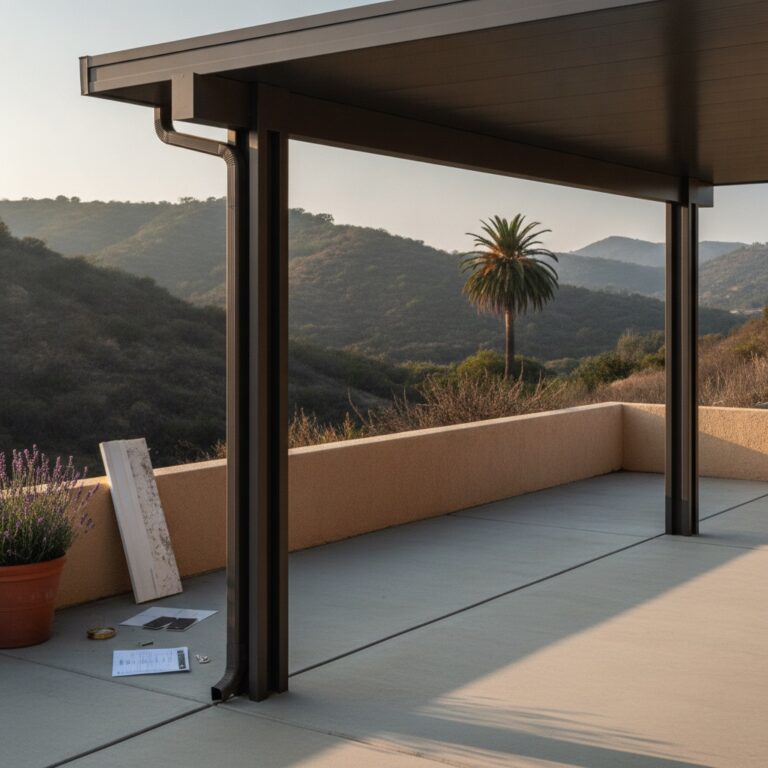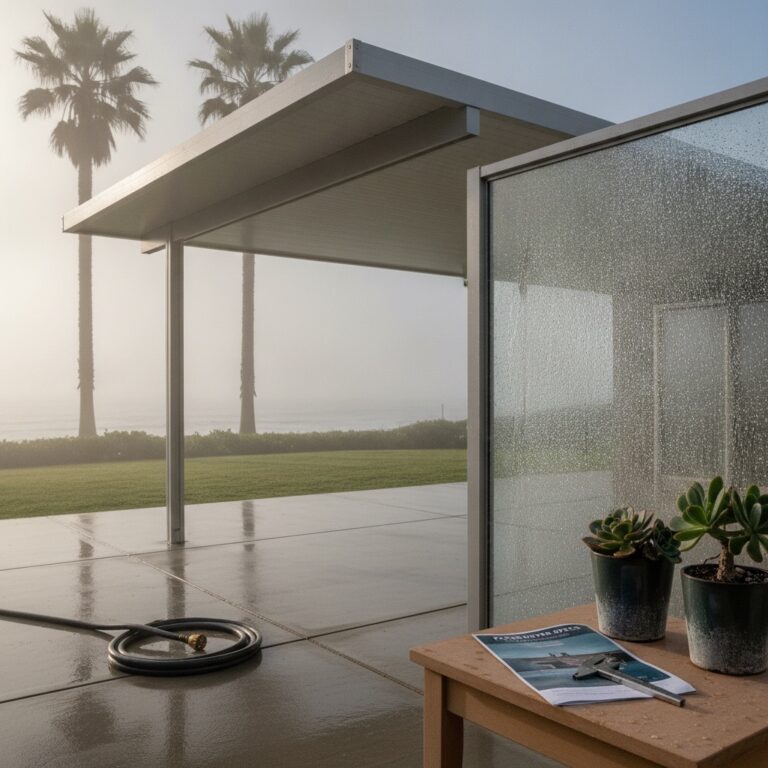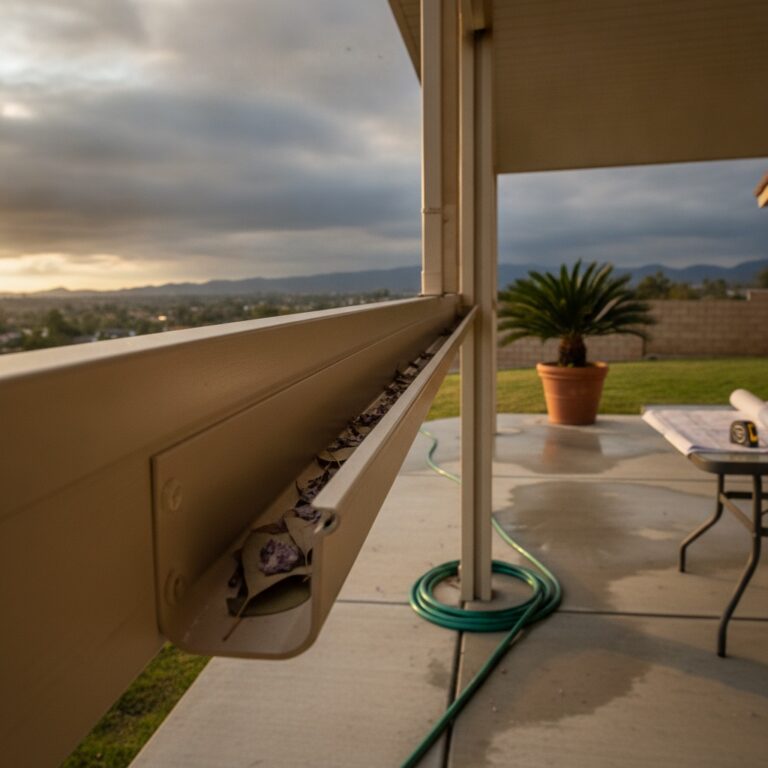
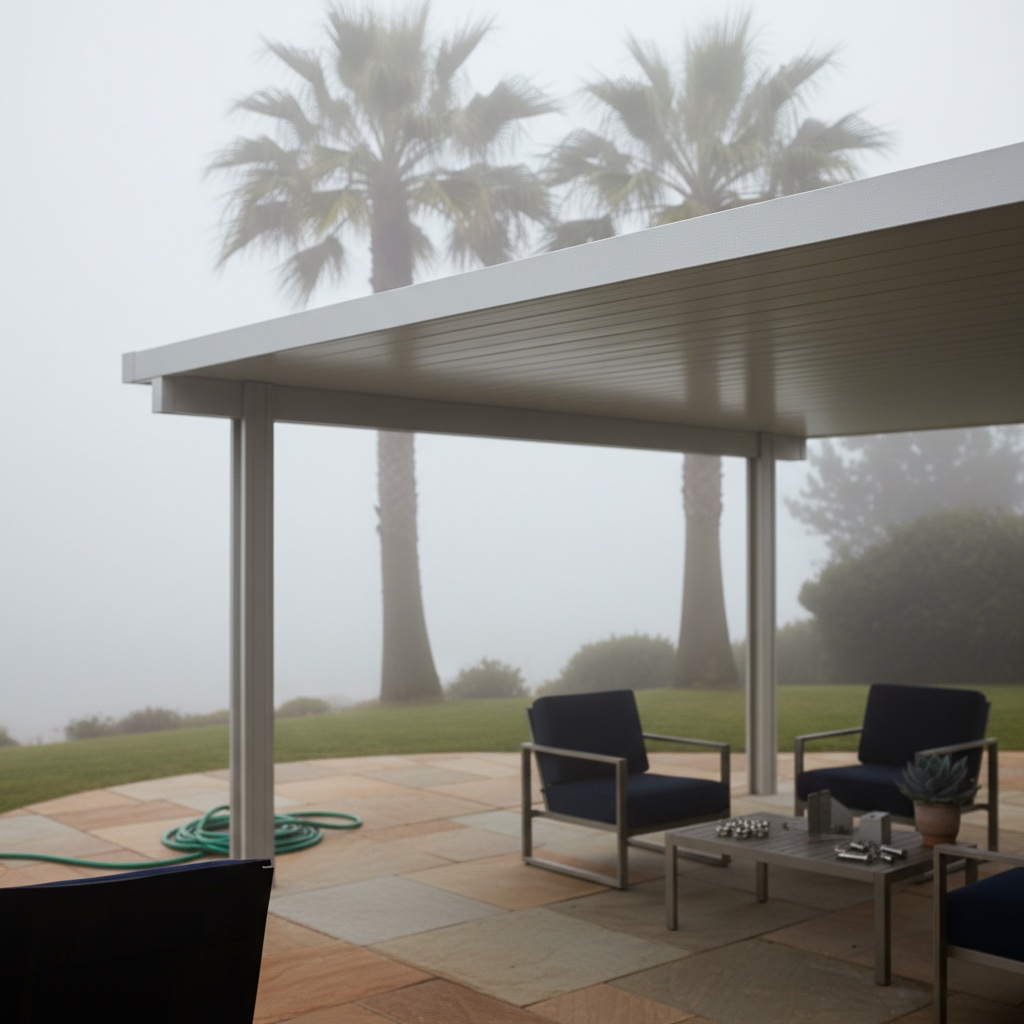

Stand in a backyard three blocks from the water in Corona del Mar on a May morning and you can feel the problem before you see it. The marine layer has not burned off yet. Every horizontal surface holds a film of damp, and that damp carries chloride blown in off the Pacific. A patio cover in that yard works a longer shift than the same cover in Riverside. Salt is patient, and it goes after the finish first.
Coastal Orange County is its own microclimate. Newport Beach, Huntington Beach, Seal Beach, Laguna, and Dana Point all sit close enough to the ocean that salt deposition is a daily event, not a storm event. The good news for homeowners here is that aluminum is the right base material. The detail that decides how long your cover looks new is the powder-coat tier and the hardware behind it.
What Salt Air Actually Does to a Patio Cover
Aluminum does not rust the way steel does. It forms a thin oxide layer the moment it meets air, and that layer seals the metal underneath. In salt air that oxide layer holds up better than most homeowners expect. So the structural beams and posts of an aluminum cover are rarely the part that fails near the coast.
The finish is a different story. Salt is hygroscopic, which means it pulls moisture out of the air and keeps the surface wet longer than plain dew would. A wet, salty film sitting on a powder coat all morning is a slow chemical attack. On a cheap finish you see it as chalking first, a dull white haze when you run a hand across the top of a beam. Then color fade, then pinholes where the coating lifts. Within a mile of the water that timeline can run years faster than it would inland.
Salt also speeds up galvanic corrosion. When two dissimilar metals touch and a salty film bridges them, the more reactive metal corrodes. That is why fasteners and brackets matter as much as the panels. A coastal cover does not usually fail at the big obvious parts. It fails at a screw head, a bracket edge, or a cut beam end that never got sealed.
The Powder-Coat Tier That Matters Within a Mile of the Water
Architectural finishes are graded by AAMA standards, and the three tiers a homeowner should know are 2603, 2604, and 2605. AAMA 2603 is the entry grade. It is fine for a garage door in a dry inland tract, and it is the wrong call for a coastal patio. AAMA 2604 is the mid tier. It passes a 3,000-hour salt spray test under ASTM B117 and carries roughly five years of weathering without serious gloss or color loss.
AAMA 2605 is the tier built for the coast. It uses a cyclic corrosion test, ASTM G85 Annex A5, that wets and dries the sample in stages instead of soaking it. That cycle mirrors what a real Newport Beach beam goes through every May morning far better than a constant fog does. A 2605 finish is usually a fluoropolymer, and it is rated for about ten years of weathering with the color and gloss still intact.
For any home within 1,000 feet of the Pacific, ask for AAMA 2605. Between roughly 1,000 feet and a mile inland, 2604 is a defensible choice when the budget is tight, though 2605 still buys margin. Past a mile, 2604 is genuinely fine. One more number is worth asking about: coating thickness. A coastal finish should land at 2.5 mils or thicker, because a thin coat fails at the edges no matter what tier is printed on the spec sheet.
Fasteners and Hardware: Where Coastal Covers Quietly Fail
A patio cover is held together by parts most homeowners never look at. Near the coast those parts decide the outcome. Plain zinc-plated or galvanized screws will streak rust down a beam within a couple of seasons in Huntington Beach. The fix is stainless steel, and the grade matters. Type 304 stainless is acceptable a few blocks back from the sand. Type 316, the marine grade, holds up best for the first row of homes facing the water.
Brackets, post bases, and gutter straps follow the same rule. Anywhere two metals meet, a good installer isolates them or matches them so a salty film cannot start a galvanic cell. Cut ends of beams need to be sealed, because a bare aluminum edge is the one spot the powder coat never covered. These are small line items on a quote. They are also the difference between a cover that looks the same in year eight and one that shows its age by year three.
When you compare quotes, the spec sheet tells the truth. A vague quote that says “aluminum cover, white” is hiding the tier. A quote that names AAMA 2605, Type 316 stainless fasteners, and sealed beam ends comes from a contractor who has worked coastal yards before.
Living With a Coastal Cover: The May-Gray Maintenance Routine
May and June are the cloudiest months on the SoCal coast. San Diego averages only about 59 percent sunny days in May, and Orange County beaches sit under the same marine layer, with morning highs holding in the low 70s while the gray lingers past 10 a.m. That damp morning pattern is exactly when salt settles onto your cover and stays.
The maintenance answer is refreshingly simple. Rinse the cover with a garden hose two or three times a year, more often in the first block off the sand. Plain water lifts the salt film before it can sit and work. No special cleaner, no wax, no ladder-bound scrubbing. A coastal-grade finish asks for a rinse, and that is close to all it asks. Skip the rinse for years and even a 2605 coat will dull sooner than it should.
Pay attention after a Santa Ana event too. Offshore wind pushes dust and grit onto the cover, and when the marine layer returns the next morning that grit traps moisture against the finish. A rinse once the wind settles keeps the surface clean. None of this is hard. It is just worth knowing before you assume a coastal cover is maintenance-free.
Coastal Orange County rewards homeowners who spec the cover for where they actually live. The base aluminum is the easy part. The powder-coat tier, the fastener grade, and the sealed edges are what carry a cover through a decade of salt mornings looking close to new. If you are within a mile of the water and weighing a new cover, JNL Aluminum offers a free in-home assessment that measures your exact distance from the coast and matches the spec to your microclimate. A quote that names the tier is the one worth signing.
Morning-context sources used: Times of San Diego, “May Gray isn’t new: San Diego’s century of coastal cloud cover” (timesofsandiego.com, May 6 2026); UCLA Atmospheric and Oceanic Sciences weather synopsis (atmos.ucla.edu, May 15 2026); Powder Coat It, “The Ultimate Guide to Monterey Coastal Metal Protection” (powdercoatitsc.com, May 14 2026); AMICO Architectural Metals, “Understanding AAMA 2604 vs. AAMA 2605” (amicoarchitectural.com); Winona Powder, “AAMA Specifications Explained” (winonapowder.com); ABC7 Los Angeles, Southern California weather (abc7.com, May 2026).