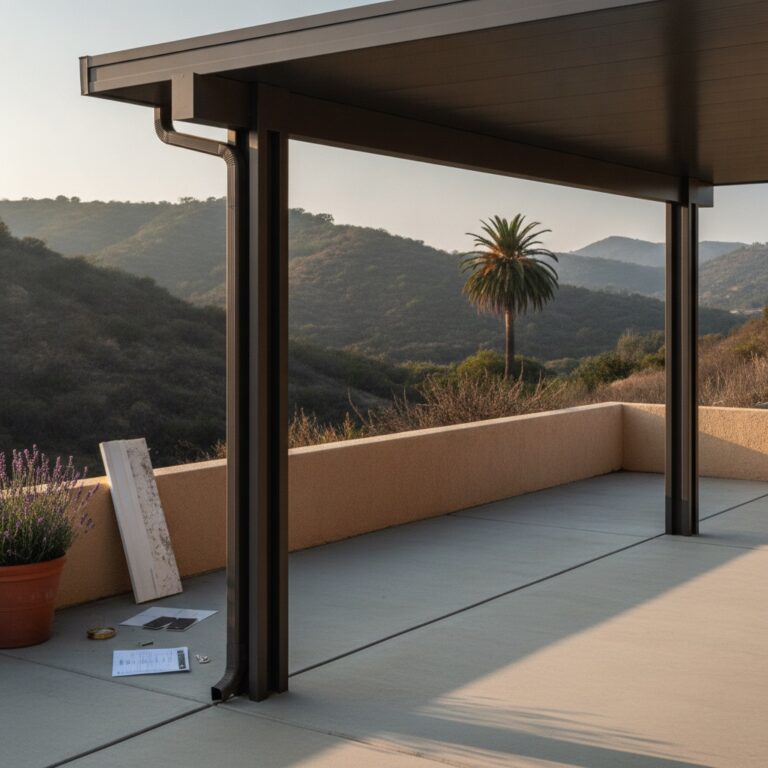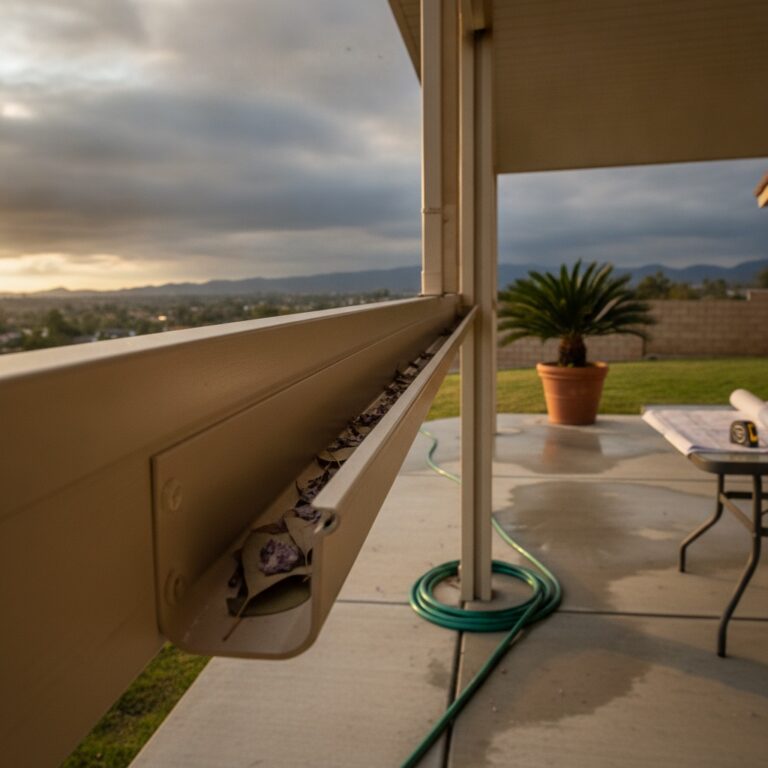


Last March a heat dome parked over the Southwest and broke 7,000 daily temperature records in a single week. Riverside hit 101 on a day that should have topped out at 78. The old record fell by three degrees. The Inland Empire is now four months into a year that opened with that pattern, and the NOAA Climate Prediction Center put 36 states on the above-normal side of the summer 2026 outlook. For a homeowner in Eastvale, Corona, or Moreno Valley with a west-facing slab, that is not a weather story. It is a patio story.
What a Heat Dome Actually Does to a Riverside Backyard
A heat dome is a stationary high-pressure ridge that compresses and warms the air column under it for days at a stretch. The March 2026 event held over the Southwest for nearly a full week and dropped temperatures 20 to 30 degrees above the climate average. When that same pattern parks itself over the Inland Empire in July or August, a bare concrete patio slab acts like a thermal battery. Exposed concrete in full sun reaches surface temps of 140 to 160 degrees by 2 p.m.
That stored heat radiates back upward well past sunset. The slab that should be the family room from May through October is the slab nobody wants to walk on from 11 a.m. to 9 p.m. Shade is what changes the math. The kind of shade matters more than people realize.
Lattice vs Insulated Solid Roof When the High Pressure Sits On You
A lattice cover filters sun. On a 95-degree day with a high sun angle, a 50 percent lattice cuts surface temps under the cover by maybe 8 to 10 degrees. That works in coastal Long Beach or Carlsbad, where a marine layer still rolls in by evening and the ambient air starts low. In Eastvale or Menifee during a dome event, 10 degrees off 105 still leaves a homeowner sitting in 95-degree shade. The cover is helping. The patio is still off-limits.
A solid aluminum roof blocks direct sun outright. The skin reflects most of the visible spectrum, and a standard non-insulated solid panel knocks another 12 to 15 degrees off the slab temperature. An insulated panel goes further. The construction is two aluminum skins sandwiched around an expanded polystyrene foam core. A 3-inch panel rates at R-12. A 4-inch panel hits R-16. A 6-inch panel reaches R-24, which is the same insulation value as a code-minimum 2×6 exterior wall in California.
Manufacturer field data from Duralum and Valley Patios shows the slab under an R-16 or R-24 insulated cover running 15 to 20 degrees cooler than the open yard during a 105-degree afternoon. That is the difference between a patio you abandon at noon and one a family of five can eat lunch on.
The Spec Numbers That Matter at 105 Degrees
Three numbers separate a cover that holds up through a heat dome from one that bows or fades by year three. The first is aluminum gauge. Look for a top-skin thickness of at least 0.024 inch and an underside skin no thinner than 0.019 inch. Lighter gauges are common in big-box kits and start to oil-can in direct heat cycling.
The second is powder coat tier. AAMA 2604 is the SoCal minimum and carries roughly a 10-year industry warranty against fade past 5 Delta-E units. AAMA 2605 is the next tier up and runs 20 to 30 years on chalk and fade in the most demanding installs. For an Inland Empire yard that absorbs UV index 11 readings from June through September, the 2605 tier is the smart upgrade. The cost premium runs 8 to 12 percent of the build total and typically pays back inside the warranty window.
The third is beam span. A 6-inch deep aluminum beam can clear-span 18 feet without a center post. That matters in Corona, Eastvale, and Wildomar where many newer tract homes have 16 to 18 foot slab pads behind the great room, and a center post would land in the middle of the dining table footprint.
The Math on Cooling Costs for the House Behind the Slab
An attached insulated cover does more than shade the patio. It creates a thermal buffer along the south or west wall of the home. Field data from Duralum shows interior temps in adjacent rooms running 4 to 7 degrees cooler when a 14 by 24 insulated cover shields a west elevation through a heat dome day.
That has a number attached to it. Southern California Edison summer rates went into effect June 1, and Tier 2 residential pricing now sits at 42 cents per kWh once a household exceeds its baseline. The average residential rate as of June 2026 reads 34.4 cents per kWh. A typical 3-ton central AC pulling that elevation drops 1.5 to 2 hours of runtime per day during a 7-day dome event. The straight math lands at 8 to 12 dollars saved per day, or 60 to 80 dollars across a single dome week. Two dome events per summer cover the AAMA 2605 powder coat upgrade in the first year.
The other line item is the patio itself. A patio used 80 days more per year is a patio that justifies the build. Quote requests in Riverside County tend to spike the second week of every heat advisory, which is also when fabrication queues lock up.
Booking the Build Before the First July Dome Lands
The Inland Empire install calendar tightens fast in June. Permit timelines in Riverside County are running 18 to 22 business days on residential patio cover submissions as of last month. Add a 7 to 10 day fabrication window for an insulated solid roof in custom dimensions, plus the install week itself. A homeowner who books the in-home consult the first week of June lands a finished build in mid to late July, before the August dome window the seasonal outlooks are already flagging.
We run a free in-home assessment that walks the slab orientation, the west-wall heat load, the beam-span options, and a printed quote with three roof choices on it. Pulling the tape on a 14 by 22 slab in Eastvale takes about 40 minutes. We bring AAMA 2604 and AAMA 2605 sample blocks so the color decision happens in your own sunlight, not under a showroom fluorescent. If the slab faces west and the high pressure starts building Tuesday, the cover should be on it.
Morning-context sources used: ABC7 Los Angeles current SoCal heat forecast (https://abc7.com/post/los-angeles-weather-temperatures-southern-california/58983/); Weather On This Day Summer 2026 outlook (https://weatheronthisday.com/trends/summer-2026-outlook); NRG Clean Power SCE 2026 rate changes (https://nrgcleanpower.com/learning-center/sce-rate-changes/); EcoFlow SCE 2026 rate guide (https://energy.ecoflow.com/us/blog/southern-california-edison-rates); Duralum insulated patio cover heat data (https://duralum.com/volume-5-issue-6/); Valley Patios insulated roof aluminum covers (https://www.valleypatios.com/insulated-roof-aluminum-patio-covers); AMICO AAMA 2604 vs 2605 architectural standards (https://amicoarchitectural.com/specifying-aama2604-vs-aama2605/).