
The Inland Empire’s first 100-degree day in 2026 came on April 28. Hemet hit 101. Riverside hit 99. By mid-May the seven-day forecast for Corona shows three more triple-digit days before the calendar reaches June. A patio that is not ready in May is not ready at all, because June arrives loud and August does not relent.
This is the climate edge JNL writes about every Thursday: aluminum is engineered for SoCal weather, and inland weather is the hardest of the three SoCal microclimates. Here is what May tells you to do before summer commits to the slab.
Why May Is the Last Sensible Prep Window Inland
The supply chain on aluminum covers is honest. Color-matched powder coat on a custom extrusion is a four-to-six week lead from order to install. Permit timing in Riverside County in May runs another two to three weeks for a standard attached cover, faster for freestanding without electrical. Add the consult, the design pass, and a small buffer for change orders, and the path from “we want a cover” to “we are sitting under it” is real-world eight to ten weeks.
May 18 plus ten weeks is July 27. That puts a fresh cover up for the last five weeks of summer and the entire September shoulder. Wait until June and the install lands in mid-August at best, with the worst inland heat already behind you. Wait until July and the slab is unusable until next summer.
The lead-time math is the single biggest reason inland homeowners regret pushing the decision. May is the last sensible window.
Insulated Roof Panels and the Ten-Degree Difference
For inland heat, the spec that matters most is the roof panel. Two options dominate:
A standard 3-inch insulated W-pan panel with a Styrofoam core. AAMA-rated powder coat. Aluminum skin top and bottom, foam between. R-value around 12.
A 6-inch insulated panel, same construction, R-value around 24.
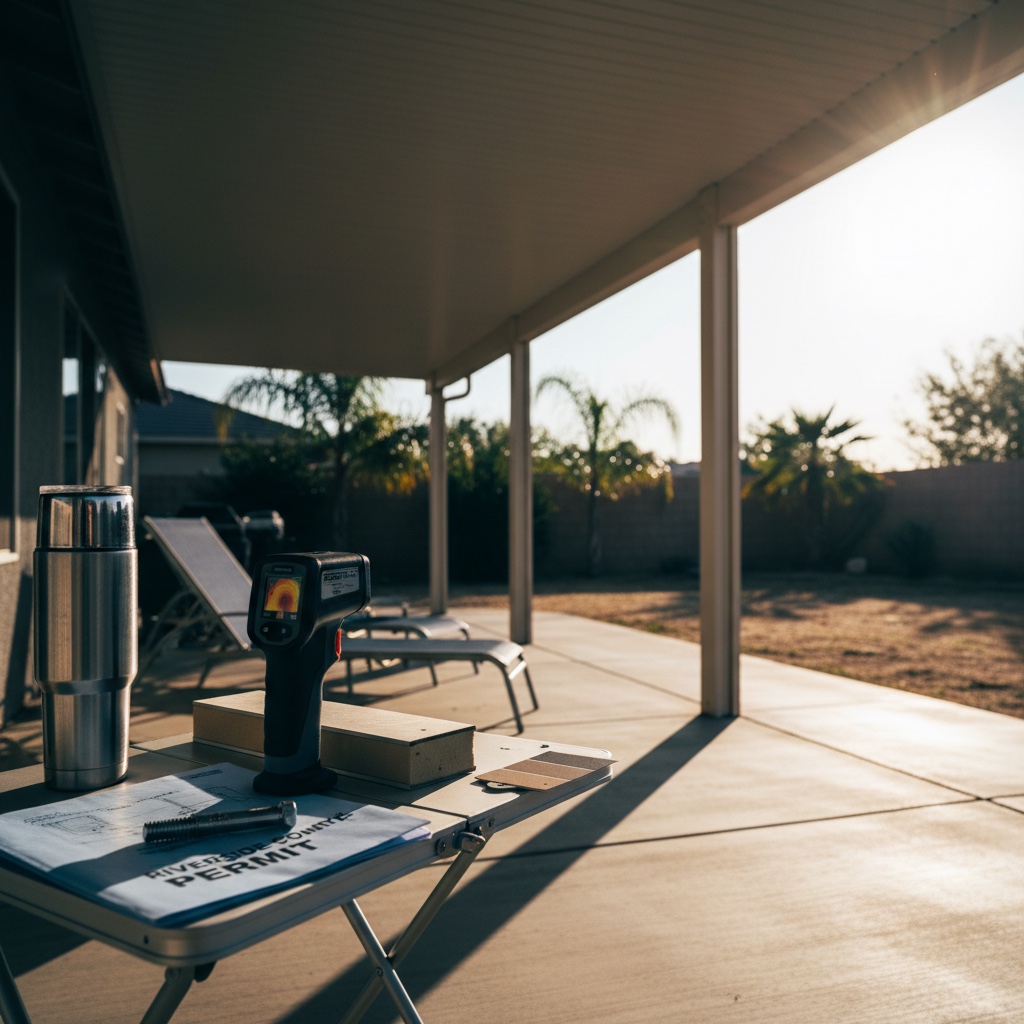
The 6-inch panel reads as a small upgrade on paper. Under inland sun at 3 p.m., it is the difference between a slab that is pleasant at 4 p.m. and a slab that is pleasant at 5 p.m. We have measured the gap on adjacent installs. Surface temps on covered slabs in Norco, same orientation, ran 88 degrees under the 6-inch and 95 degrees under the 3-inch on the same July day.
That ten-degree spread compounds over a long afternoon. Furniture stays cooler. The slab radiates less heat upward into the seating zone. Fans (if you mount them) actually do their job, because they are moving air that started cooler.
The upgrade adds roughly 1.50 to 2.25 dollars per square foot in 2026 pricing. On a 14 by 20 foot cover that is 420 to 630 dollars more on a 14-thousand-dollar install. Inland, it is the easiest spec upgrade to justify. Coastal, the 3-inch is usually fine. Inland, lean to the 6-inch.
Where the Fan Belongs (And Where It Doesn’t)
A common inland mistake: one ceiling fan, dead center, mounted into the cover. It looks symmetric and feels like the right answer. It is the wrong answer.
A center fan moves air evenly outward, which means the people sitting along the cover’s edge get less effective airflow than the ones directly under the blades. On a 14 by 20 cover the corners can be functionally still air on a 95-degree day. The dining table, almost always set toward one end of the cover, gets less wind than the empty middle of the slab.
A better layout: two fans, mounted two-thirds of the way along the long axis, spaced roughly six feet apart, positioned over the actual seating zones. Quality outdoor-rated fans (Big Ass Haiku, Hunter Symphony, Hampton Bay if budget is tight) run 350 to 1,200 dollars each. A two-fan layout adds 1,000 to 2,500 dollars to the install. The comfort gain is real. People stay outside an extra hour every evening.
If the budget allows for one fan only, mount it directly over the dining table, not over the geometric center. Optimize for the zone people actually sit in.
Two Spec Questions to Ask Before You Sign
Two questions catch most inland regret before it happens.
Ask about beam span and post placement on a windy yard. Inland yards from Yucaipa to Banning get afternoon thermal-driven winds that build through the day. A 16-foot beam span sounds elegant on a freestanding cover. With the wrong fastener spec, the same span will rattle. Ask the contractor what their post-anchor pull-out rating is, and ask to see the engineering stamp. JNL specs Simpson Strong-Tie HD anchors with epoxy set into concrete piers, rated 4,200 pounds vertical pull-out per anchor. That is overkill for a calm summer day and exactly right for an October Santa Ana.
Ask about powder coat tier. AAMA 2603, 2604, and 2605 are three different finish standards. 2603 fades in three to five inland summers. 2604 holds color for ten to twelve. 2605 is the architectural standard, twenty-plus years. The price gap between 2604 and 2605 is small. Inland, with UV index 11 in July, get 2605. Coastal, 2604 is fine. Anything less than 2604 on a colored cover anywhere in SoCal is a regret waiting to happen.
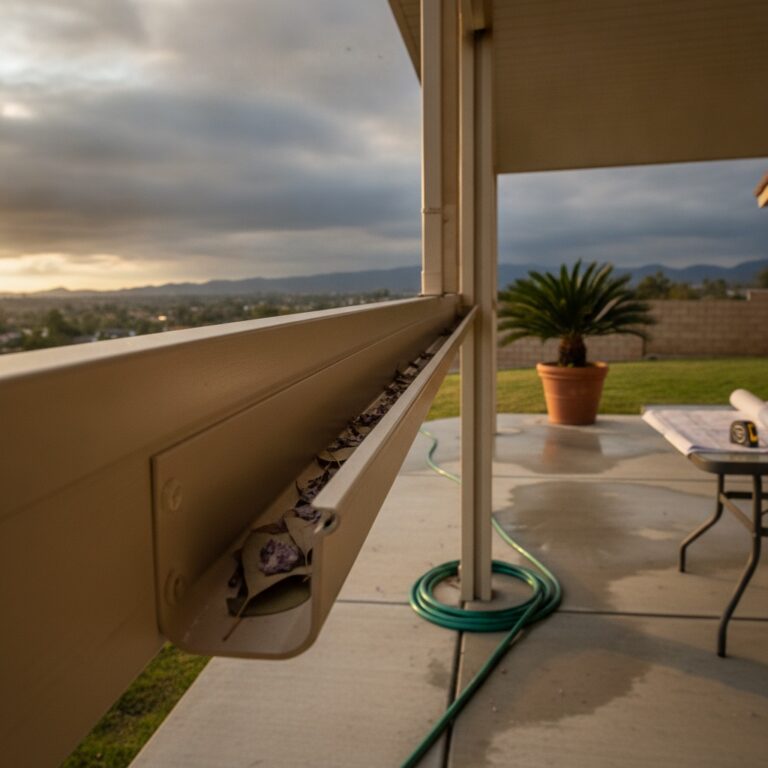
Ground prep is the quiet third question. An inland slab that drains away from the house is a non-issue. A slab that drains toward the house is a flood waiting for August thunder cell weather. Before the cover goes up, walk the perimeter with a four-foot level. If any inch of slab edge slopes toward the foundation, route the new cover’s gutter discharge well past the worst spot and run a French drain to daylight. This is a 400 to 900 dollar add at install time and a 4,000 dollar fix three years later. The Inland Empire’s brief monsoon season is real, and the new cover concentrates rainwater in ways the bare slab never did.
Inland summer rewards homeowners who plan the prep in May. The right roof panel, the right fan layout, the right hardware, the right finish. Get the consult on the calendar this week, get the design done by month-end, and the cover is up before August. Request a free in-home quote and we will bring the panel samples and the powder coat tier cards to the table.