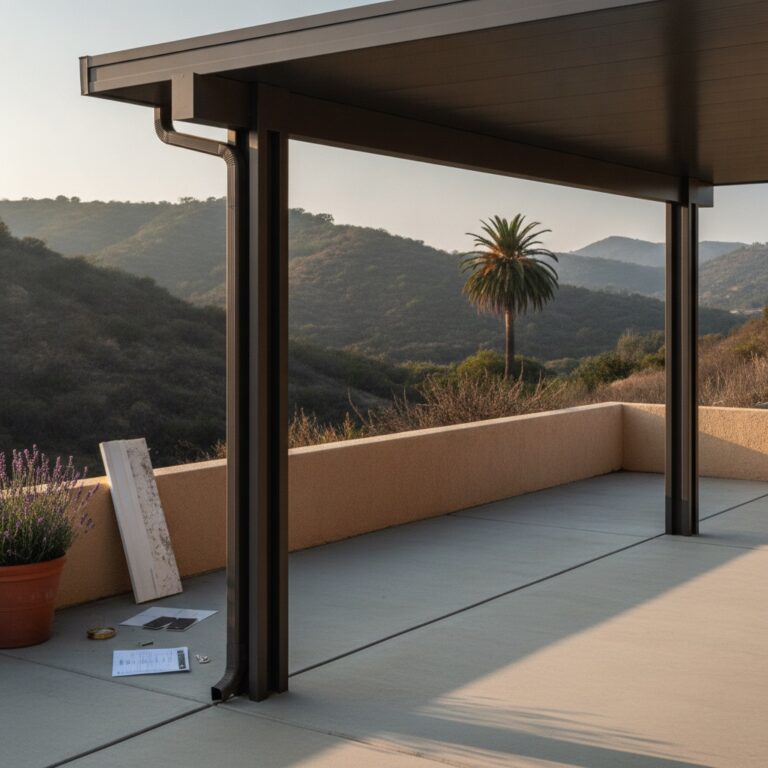
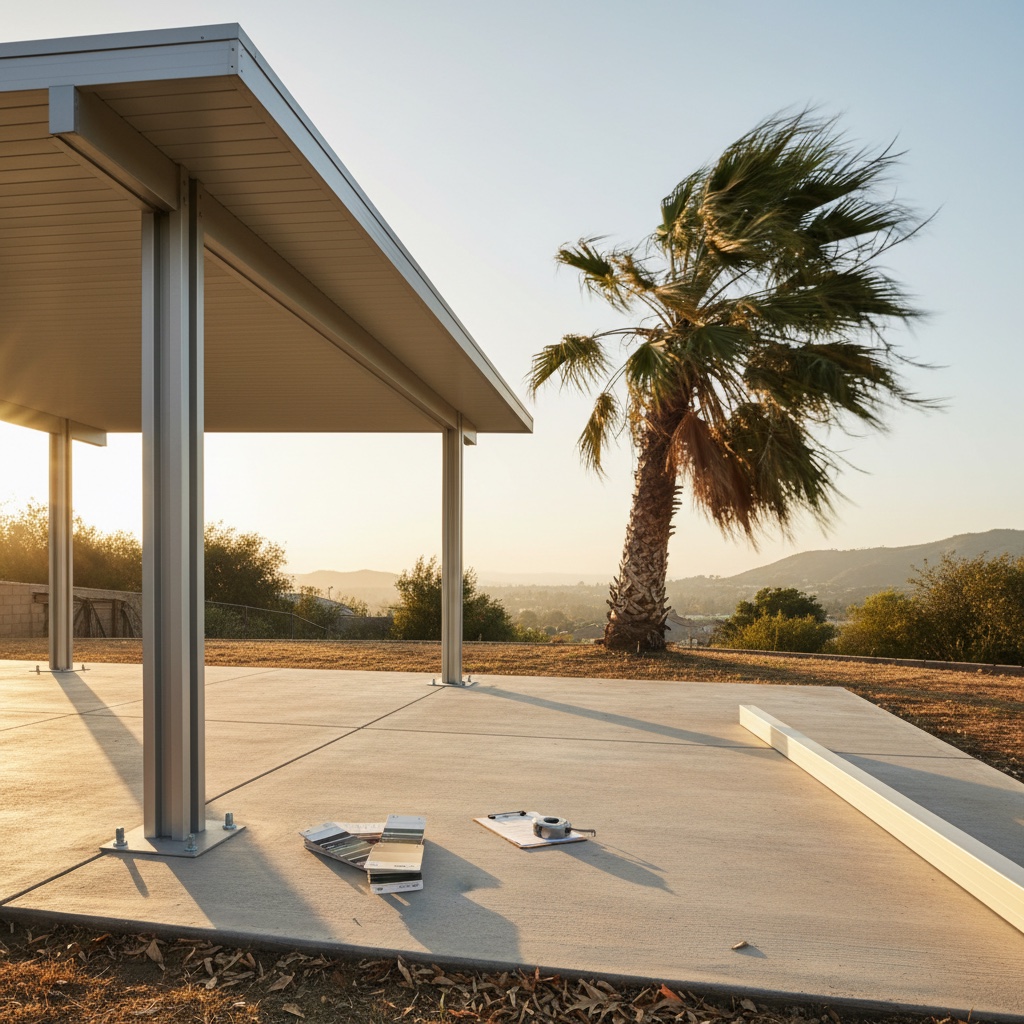

Drive Carbon Canyon Road between Chino Hills and Brea on a calm June morning and the trees barely move. That stillness is misleading. The same corridor funnels offshore gusts past 50 mph when the pressure gradient flips in the fall. The Santa Ana Canyon along the 91, the foothill edges of Yorba Linda, and the passes above the Inland Empire all do the same thing. A patio cover that feels solid in June gets tested hard in October. The smart fix starts now, while the air is quiet.
Why June Is the Quiet Window Before the Wind
June in Southern California runs warm and dry. The seasonal outlook from federal fire forecasters calls for above normal temperatures and below normal rain across the region into September, with the strongest offshore north wind events holding off until later in the year. Forecasters are also watching a possible strong El Nino building for the next wet season. None of that brings Santa Ana gusts in June. That is the point. The calm stretch is the right time to inspect anchors and order an upgrade before the fall wind season arrives.
Think of it like servicing a roof before the rains, not during them. A cover bolted down in June sits through the summer heat, then meets its first real wind load in autumn already hardened. Crews also book faster in early summer than they do once the first red flag warning hits the news and every homeowner calls at once. A look at the slab in June costs nothing and locks in a calmer install window.
What the Wind Map Says About Your Address
Wind design in California runs through the building code, which points to the ASCE 7 standard for the actual numbers. Most valley neighborhoods in Orange County and the Inland Empire sit in a basic design wind speed band near 95 mph, measured as a 3-second gust at 33 feet in open terrain. That is the load your cover should be engineered to meet. The figure climbs inside mapped special wind regions, which in Riverside County include pass communities like Banning and the high desert around Palm Springs.
Two terms decide your real number. Exposure category describes how open your lot is, and most SoCal tract yards fall in Exposure C, meaning open terrain with few windbreaks. A foothill lot above Fontana with nothing upwind catches more load than a sheltered interior block in Anaheim. The county building department confirms which category and wind speed apply to your parcel. A reputable installer pulls that figure before drawing a single beam, because it sets the post spacing and the anchor schedule.
The Post Anchors That Keep a Cover Standing
Wind does not push a patio cover over so much as lift it. The roof acts like a wing, and uplift wants to pull the posts out of the slab. That is why the anchor at the base of each post matters more than almost any other detail. A surface-mounted post base set with wedge anchors into a thin slab is the weak link crews see fail first. Four inches of slab with nothing under it does not hold against real uplift in a 50 mph gust.
The stronger detail is a post base bolted to a dedicated concrete footing, typically 12 inches square and 12 to 18 inches deep, tied to the slab or poured fresh. Anchors should be stainless or hot-dip galvanized, set with epoxy rather than a quick expansion plug where the engineer calls for it. For an attached cover, the ledger board bolting into the house framing carries half the load, so the lag bolts need to hit solid structure, not just stucco. Specifics like these belong on a stamped plan, not a guess.
Fasteners and Connections That Beat Uplift
The metal between the posts has to move the wind load down to those anchors without flexing apart. The California code limits total-load deflection on a patio cover roof to a span-over-60 ratio, so a 16-foot beam can sag no more than about three inches under full load. Meeting that on a windy lot means heavier extrusions, tighter post spacing, and real connections at every joint. Thin pan roofs that rely on a handful of screws are the ones that peel back in a gust and end up in the neighbor’s pool.
Knee braces and gusset plates at the post-to-beam joint resist the racking that wind creates. Stainless steel fasteners matter here too, both for strength and because coastal Orange County salt air chews through zinc-plated hardware in a few seasons. Ask whether the powder coat meets the AAMA 2604 tier, which holds color and film through years of UV, and whether the structural screws are rated rather than hardware-store generic. These are the line items that separate a cover carrying a limited lifetime warranty from one that voids in the first windstorm.
Spec the Cover Once, Ride Out Every Season
A wind-ready aluminum cover does not cost dramatically more than a basic one. In SoCal, installed covers run roughly 20 to 45 dollars per square foot depending on style and span, and the wind upgrades, deeper footings, stainless anchors, and a heavier beam, add a modest amount to that range rather than doubling it. The payoff is a structure that meets the 95 mph design load on paper and shrugs off the 50 mph Carbon Canyon gust in practice. Spending it once beats rebuilding after the first Santa Ana event of the season.
The honest tradeoff is that a heavier, fully anchored cover takes a little longer to engineer and permit than a quick bolt-on kit. That extra week is worth it on any foothill or canyon lot. We walk your slab, check your exposure category with the county, and spec the anchors to your actual address, not a generic template. Book a free in-home quote this month while the air is calm, and your cover will be ready long before the first offshore wind warning of the fall.
Morning-context sources used: NIFC Predictive Services South Ops June-September 2026 Outlook (gacc.nifc.gov); NBC Los Angeles, “Strong El Nino may be brewing” (nbclosangeles.com); NWS Los Angeles Area Forecast Discussion (forecast.weather.gov); County of Riverside Building and Safety Design Load Criteria (building.rctlma.org); California Wind Load Requirements, ASCE 7-16 (windload.solutions); California Building Code 2022 Chapter 16 via UpCodes (up.codes).