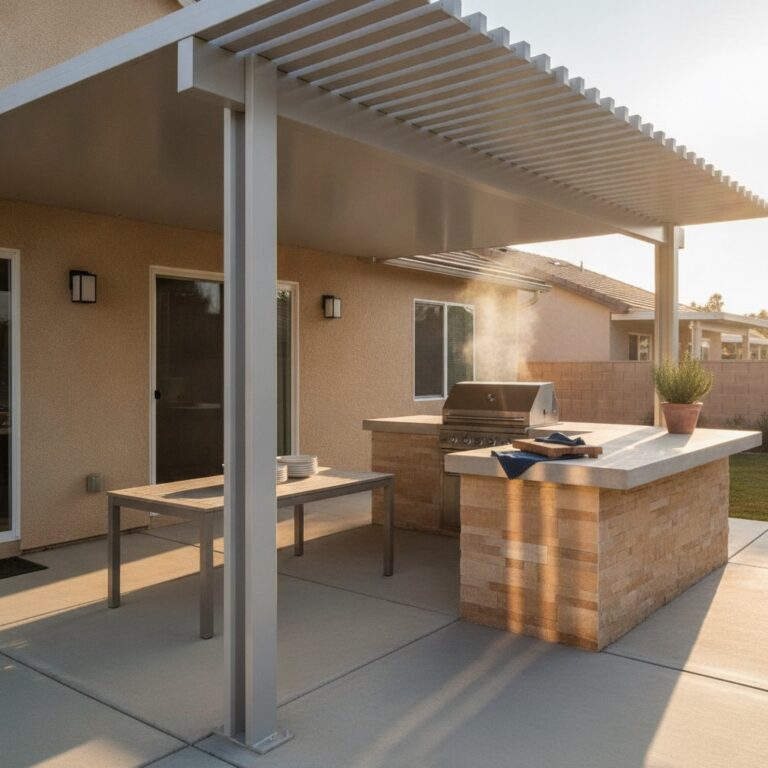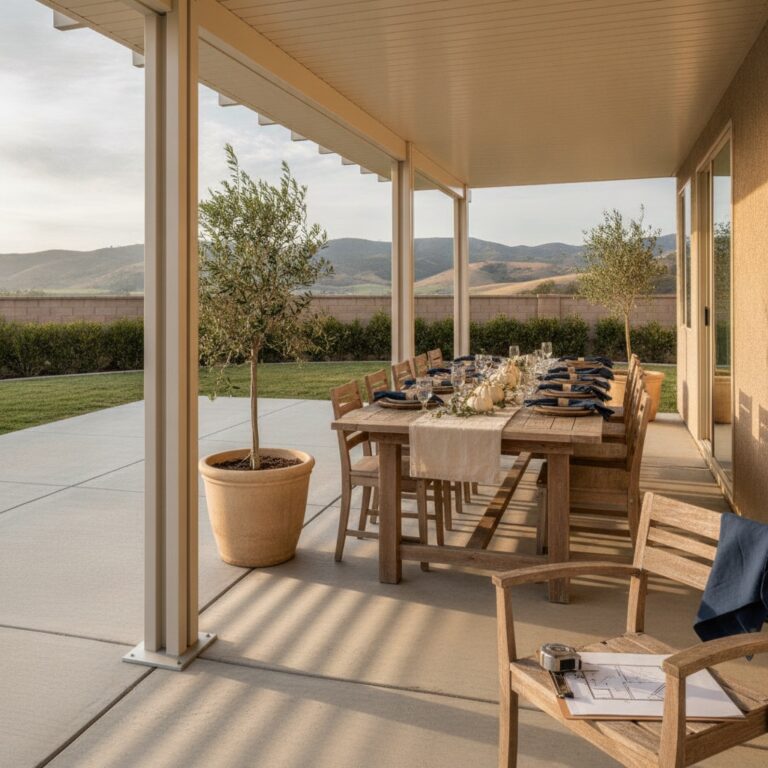

A Fullerton homeowner has a 16 by 20 concrete slab that faces due west. From 3 pm to about 6 pm in August, that slab reads like a griddle. At 7:40 pm, when the sun finally drops behind the neighbor’s roofline, the same slab turns into the best seat in the house. She wants shade. She does not want to give up the sky to get it. That tension is the entire argument for a lattice cover, and the answer lives in the spacing, not in the style name on the brochure.
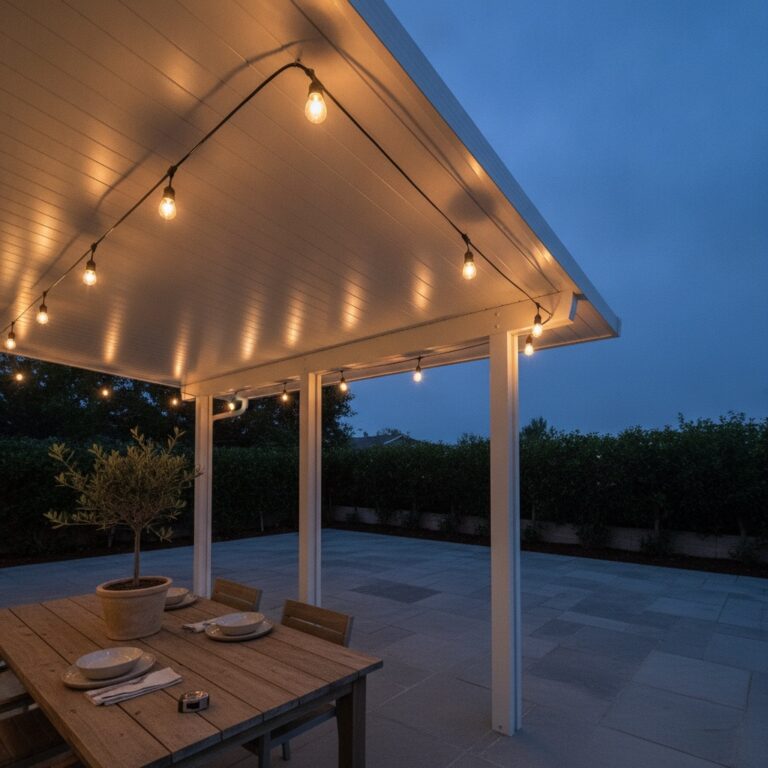
Sunset in Los Angeles on August 17 lands at 7:40 pm. By August 31 the day runs 55 minutes shorter than it did on the first. Those long evenings are the exact hours most SoCal families actually use the patio, and a full solid roof makes them go dark early. An open lattice keeps them lit. Picking between the two is really a question of which hours of the day you are protecting.
Spacing Is the Spec That Matters, Not the Word “Lattice”
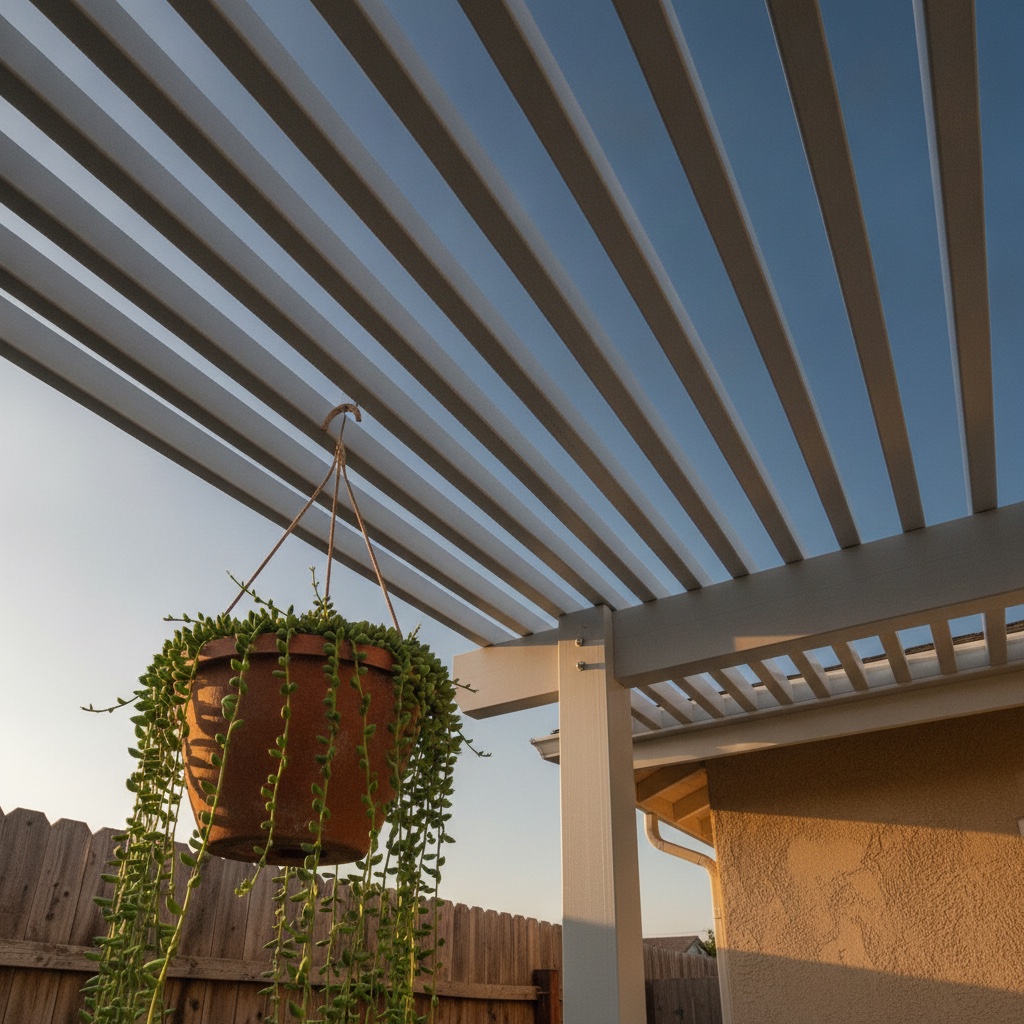
Every aluminum lattice cover looks about the same in a catalog photo. The number that changes how the patio actually feels is the on-center spacing of the lattice tubes. On-center means the width of the tube plus the gap next to it. A 2 inch tube with a 2 inch gap sits on 4 inch centers and blocks roughly 50 percent of overhead sun. Tighten that gap and shade climbs. Widen it and the sky opens back up.
Common Southern California configurations land between 40 and 60 percent coverage. A 1.5 by 1.5 inch tube on 1.5 inch spacing delivers about 50 percent. A 2 by 3 inch tube on 2 inch spacing pushes closer to 60 percent when the sun sits directly overhead. A 10 point difference sounds minor on paper. On a west-facing Fullerton slab in August, it decides whether the dining table works at 5 pm or only after 7.
What Each Spacing Feels Like Through a Real SoCal Day
Wide spacing near 40 percent coverage reads as dappled light. Morning coffee is comfortable. Noon is not. Evening is excellent, because low sun comes in sideways under the rafters regardless of what the roof does, and the open grid keeps the space bright right up to dusk. Homeowners in Long Beach and coastal Orange County often pick this. The marine layer already softens their afternoons, so the goal is definition and structure rather than deep shade.
Tight spacing near 60 percent behaves close to a solid roof at noon and still shows sky at 7 pm. Riverside and Corona homeowners lean this direction for a specific reason. During the July 31 heat dome, inland valleys hit 106 to 110 degrees while coastal Orange County held in the mid 90s. That 15 degree gap is why spacing is a comfort question inland and a style question at the coast.
One honest limit belongs in every lattice conversation. No lattice keeps rain off. The gaps pass water by design. A lattice cover in San Juan Capistrano will not rescue a January dinner during an atmospheric river. If dry space matters more than open sky, the correct answer is a solid pan roof, and a good contractor says that out loud instead of selling the prettier product.
The Combination Cover Most Homeowners Should Ask About
The layout that wins most often on a 16 by 20 slab is not all lattice or all solid. It is both. Run insulated solid panels over the 10 by 12 dining zone where the table lives and shade has to be reliable at 1 pm. Run open lattice across the remaining 10 by 16 lounge zone where two chairs face the yard and the sky is the whole point. Built as one structure, under one beam line, in one powder coat color.
Insulated solid panels drop the temperature underneath by 10 to 15 degrees during peak summer. The lattice section beside them stays bright and open. Guests sort themselves without being told. Anyone eating sits under the solid half. Anyone holding a drink drifts to the open half around 7 pm to watch the light turn orange. Two rooms, one cover, one permit, one inspection.
The Specs to Ask For Before Signing Anything
Start with extrusion alloy and wall thickness. Structural covers in this region use 6063-T5 or 6061-T6 aluminum, and the wall thickness of the beam matters more than how wide it looks from the yard. Ask for the engineered beam span in writing. A properly sized aluminum header carries 16 to 20 feet clear without a center post. That is the difference between a patio you walk through and one with a post planted in the middle of the path to the grill.
Then ask about the finish tier. AAMA 2604 powder coat holds color through roughly 5 years of SoCal UV before fade shows. AAMA 2605 is the higher tier, tested against 10 years of exposure, and it earns its price within a few miles of salt air in Huntington Beach or Carlsbad. Ask what the warranty covers on the coating specifically, not just the frame. Plenty of limited lifetime warranties cover structure for life and finish for only 10 years.
Ask about wind rating and anchoring last. Engineered aluminum covers here are commonly designed for 110 to 115 mph wind loads, which earns its keep during October Santa Ana events. Post bases need a slab at least 4 inches thick and free of major cracking. If the slab is thin or spalled, the honest answer is a poured footing, not a longer anchor bolt. Any bid that skips the slab inspection is guessing.
Budget and Timeline for a Lattice Build This Season
Installed lattice covers across Southern California run roughly $20 to $35 per square foot in 2026. A 12 by 20 lattice cover lands in the $5,000 to $8,500 range depending on post count, end-cut style, and color. A combination lattice and solid build on a 16 by 20 slab prices above the all-lattice version, because insulated panel costs more per square foot than open tube. The premium usually runs a few thousand dollars, not double.
Permits generally cost $150 to $400 with a 2 to 4 week plan review across most SoCal cities, and anything over 120 square feet or attached to the house needs one. Attached versus freestanding changes which setbacks apply, so that decision belongs in the design conversation, not after submittal. Starting now puts the cover up and inspected before Santa Ana season opens in October and well ahead of holiday hosting.
The spacing decision gets much easier standing on the slab than reading about it. Watch where the shadow line falls at 4 pm and where it falls at 6:30. That one observation usually settles whether the yard wants 40 percent, 60 percent, or a split cover. JNL Aluminum measures the slab, checks the sun angle, and prices the options side by side during a free in-home quote across Orange County, the Inland Empire, Long Beach, and San Diego County. Bring the spacing questions. That is the part worth getting right the first time.
Morning-context sources used: FOX 11 Los Angeles, July 31 2026 heat dome forecast; timeanddate.com Los Angeles sunrise and sunset table, August 2026; Houzz patio and pergola idea gallery, August 2026; Pergola Cave, Patio Cover Options Compared for Los Angeles Homeowners, 2026 costs; New Dawn Awning, lattice patio cover shade breakdown; Elite L.A. Patios, 2026 SoCal patio cover design guide; Duralum, lattice versus solid patio covers.