

School is already back in session across the Inland Empire. Corona-Norco Unified started August 3, so backpacks and homework folders returned weeks ago, and the National Weather Service still has Riverside County running upper 90s early in the week and at or just above 100 degrees from Wednesday through Saturday. Overnight lows are stuck in the low 70s. That puts a lot of SoCal families in the same 4 p.m. room: two kids at the kitchen island, the AC cycling hard, and a perfectly good concrete slab sitting empty ten feet away because nothing shades it until sunset.
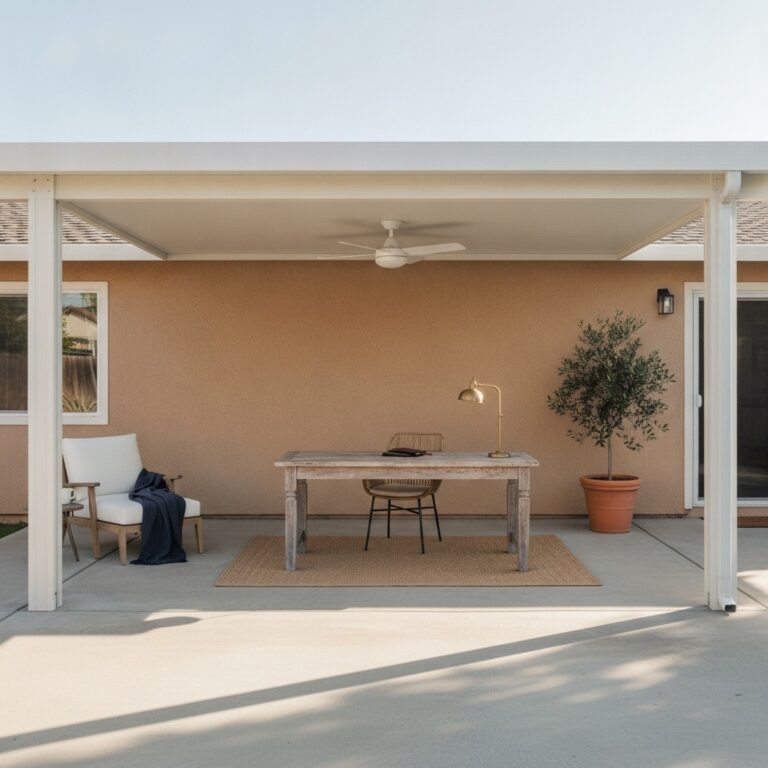
A covered patio fixes the shape of that afternoon more than most homeowners expect. Not because it makes the yard prettier. Because it adds a second usable room to the house for the exact hours when the inside of the house is most crowded. The example below is a layout pattern that shows up again and again across Corona, Eastvale, and Chino Hills every fall: one 20 by 12 attached cover, split into a homework end and a lounge end.
What 4 p.m. Actually Feels Like on a West-Facing Slab
Bare concrete facing west takes the full afternoon load. On a 100-degree Corona day, an uncovered slab surface reads 130 to 140 degrees by 4 p.m. and keeps radiating heat back up until well after dark. Nobody sits on that. Nobody does math homework on that. The slab is functionally deleted from the house for six months a year, which is why so many SoCal backyards have a patio table that only comes out in November.
Put a solid aluminum roof over the same slab and two things change at once. Direct sun stops hitting the concrete, so the surface never charges up. And with a 3 inch insulated roof panel overhead instead of a bare pan, the air under the cover typically runs 10 to 15 degrees cooler than the open yard on a triple-digit afternoon. Add moving air from a fan and the shaded slab becomes the coolest outdoor spot on the property, cooler than the family room with the slider open.
Geography matters here. Temecula Valley families are peaking in the low to mid 90s this week while Coachella Valley homes are pushing 110. The hotter the address, the more the insulated panel earns its upcharge, and the more a lattice cover starts feeling like the wrong tool for a west exposure.
Two Zones, 240 Square Feet, One Roof
A 20 foot by 12 foot attached cover off the kitchen slider gives you 240 square feet. That is enough to run two zones without either one feeling like an afterthought. Split it roughly 12 feet for the working end and 8 feet for the lounge end.
The working end holds a 72 by 38 inch table that seats six. Chairs need 36 inches of pull-back clearance behind them, so a 12 foot depth handles the table, the chairs, and a walking lane along the house wall without anyone scraping the stucco. Two kids spread out with notebooks on one half, a parent works from the other half, and there is still room to set down a tray at snack time.
- Table: 72 by 38 inches, seats six, leaves 36 inch chair clearance in a 12 foot depth
- Lounge end: two deep-seat chairs plus a 20 inch side table on a 5 by 8 outdoor rug
- Traffic lane: keep 36 inches clear between the two zones so nobody walks through a homework pile
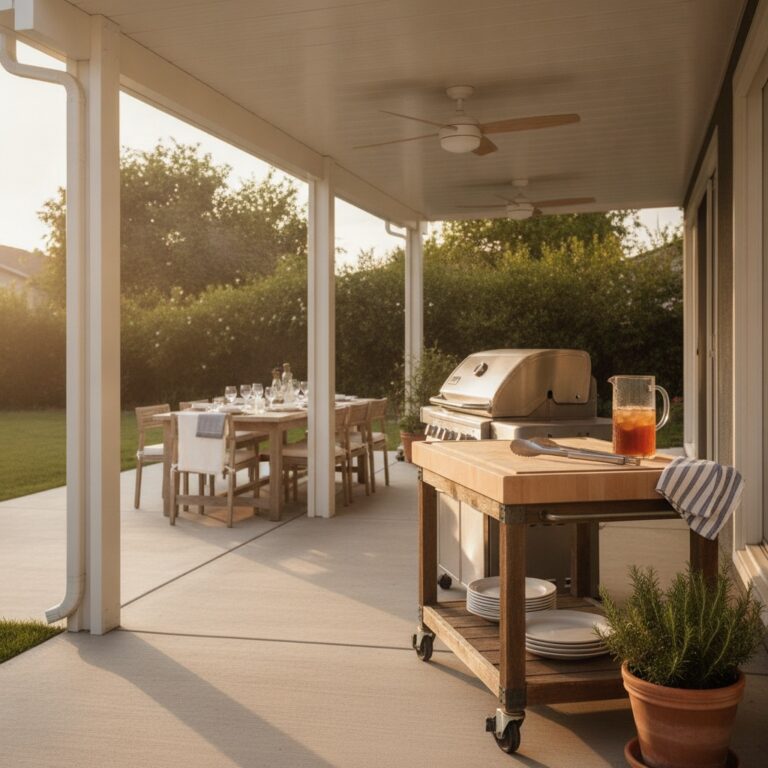
- Grill: park it outside the cover line, not under it, with at least 36 inches of clearance
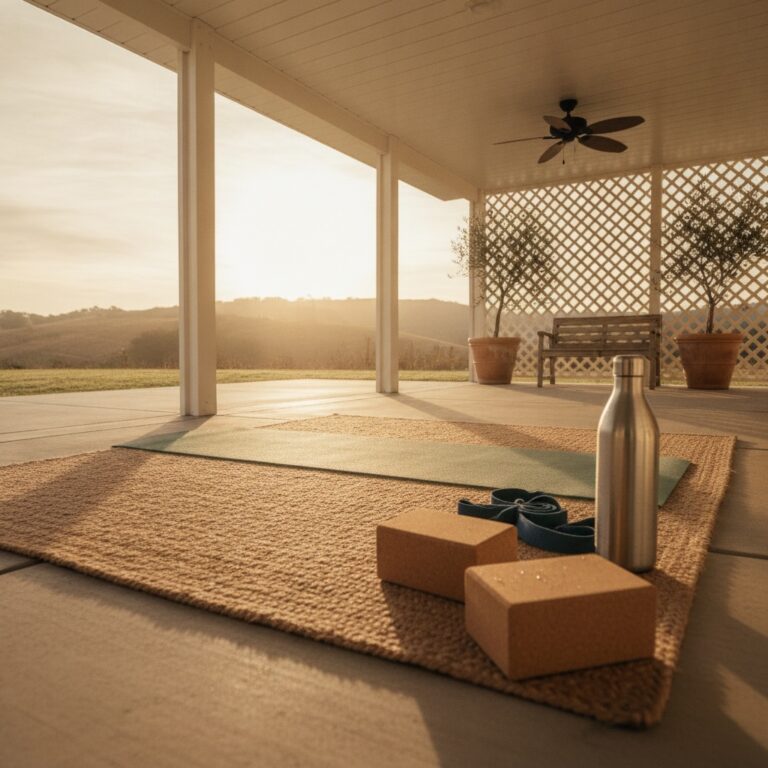
The lounge end is where the day changes over. Homework wraps around 5:30, the table gets cleared, and the chairs at the far end become where the adults sit while dinner cooks. Same roof, same slab, different hour, different purpose. That switch is the whole argument for a two-zone layout over a single dining set floating in the middle.
The Hardware That Turns a Roof Into a Room
A cover without power is a shade structure. A cover with power is a room. On a 20 foot run, plan for two 52 inch damp-rated ceiling fans rather than one, mounted with blades at roughly 8 feet 6 inches above the slab. Two fans spaced across the run keep air moving at both zones instead of creating one breezy spot and one dead one. Damp rating matters even inland, because morning marine layer and sprinkler overspray will find a dry-rated motor eventually.
Recessed LED lights installed directly in the roof pan are the second upgrade worth paying for. Four to six lights on a dimmer, wired to a switch inside the kitchen, means the patio is usable at 8 p.m. in October without anyone dragging out a lamp. String lights are lovely for a party. Recessed lights are what make a Tuesday homework session possible after the sun drops behind the neighbor’s roofline.
Two smaller details homeowners forget. First, put at least one GFCI outlet on a post at the working end, because laptop chargers and a table fan are going to live out there. Second, ask what powder coat spec the manufacturer uses. AAMA 2604 holds color for years in SoCal sun, AAMA 2605 is the higher tier and holds gloss and color noticeably longer on a west-facing exposure. On a cover that carries a limited lifetime structural warranty, paying up for the better finish is the cheaper decision.
What It Costs and When to Build It
Installed aluminum patio covers in Orange County and the Inland Empire generally run about $45 to $75 per square foot depending on roof type, span, and electrical. A 240 square foot attached solid cover with an insulated panel, two fans, and recessed lighting typically lands somewhere in the $12,000 to $18,000 range. A non-insulated W-pan roof on the same footprint comes in lower, closer to the bottom of that band, and is a reasonable choice for a north or east exposure where the panel upgrade does less work.
Timing is the part people get wrong. Most SoCal cities want a permit for an attached cover, and plan check plus inspection commonly adds two to five weeks on top of fabrication. Homeowners who call in October hoping for a Thanksgiving install are usually a month late. Homeowners who call in August are sitting under the finished cover for football season, the first cool evenings, and every homework afternoon between now and Christmas break.
If your slab has been sitting unused since June, it is worth having someone stand on it with you and take real measurements: the slider location, the fascia height, the exposure, and where the two zones would actually land. We do free in-home design walkthroughs across Orange County, Riverside County, and north San Diego, and you will leave that conversation with dimensions and a number, not a brochure. Request a quote and we will come look at the slab.
Morning-context sources used: National Weather Service Inland Empire heat forecasts reported by MyNewsLA on August 17, 2026 and August 4, 2026 (mynewsla.com) , https://www.foxla.com/news/southern-california-weather-extreme-heat-july-august-2026 , https://www.trex.com/deck-ideas/outdoor-living-trends-2026/ , https://www.barchart.com/story/news/130872/deckorators-releases-2026-outdoor-living-report-spotlighting-demand-for-front-of-home-spaces , https://www.californiaschoolcalendar.com/corona-norco-unified/2026-2027/