

The National Weather Service put an Extreme Heat Warning over the Inland Empire and inland Orange County starting Tuesday at 10 a.m. and running through Friday evening. Valley highs of 106 to 112. Downtown Los Angeles near 100. If you own a pool in Yorba Linda, Corona, or Chino Hills, you already know what that week looks like. The kids are in the water by 11. Everyone else is inside behind the slider, watching them through glass, because the deck itself is unusable.
That is the strange math of a SoCal pool. The water works fine. The 600 square feet of concrete around it does not. A family pays for a pool and then spends the hottest four days of the year in the living room.
What actually happens on an uncovered pool deck at 3 p.m.
Concrete and pavers absorb solar heat all afternoon and hold it. Dark decking surfaces can push past 130 degrees in direct July and August sun, which is why nobody sets a bare foot down without sandals and why the patio table gets abandoned by noon. The chairs are too hot to sit in. The tabletop cooks the food. The ice in a glass is gone in nine minutes.
So the pool deck becomes a transit zone. You cross it to get in the water and you cross it to get back inside. Nobody lingers. Nobody eats out there. The barbecue sits under a cover for four months because standing over it in full sun at 4 p.m. is miserable work.
Shade changes the surface temperature, not just the air temperature. That distinction matters more than most homeowners expect. Blocking direct sun off the slab keeps the concrete from loading up with heat in the first place, so the deck is still comfortable at 8 p.m. instead of radiating warmth back at you long after sunset. A shaded slab beside a pool behaves like a different piece of property.
The 20 by 12 that changed the schedule
Take a common Yorba Linda layout. Rectangular pool, roughly 15 by 30, running east to west along the back fence. A slab strip on the house side, about 22 feet wide and 14 feet deep, holding a table nobody uses and a grill nobody fires up before 7 p.m. West-facing, so the sun sits right on it from 2 p.m. until it drops behind the neighbor’s roofline.
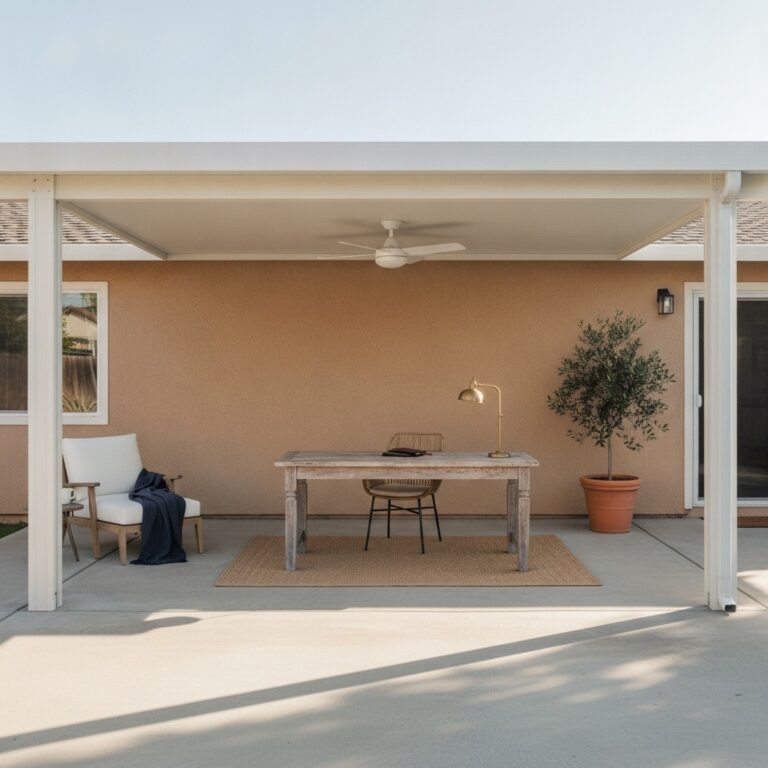
The fix is a 20 foot by 12 foot attached solid-roof aluminum cover over that slab strip. Insulated roof panels, 3 inch foam core, tied into the fascia with a proper flashed ledger. Two posts on the outer edge, spaced 20 feet apart with a 6 inch by 6 inch beam carrying that span, which keeps the field of view toward the water open. Nobody wants a post planted between the dining table and the pool.
The insulated panel is the part worth paying for on a pool deck. A standard non-insulated pan roof blocks the sun and does its job, but the underside gets warm and pushes some of that heat back down. A foam-core panel slows the transfer, so the air under the cover at 4 p.m. reads noticeably cooler than the air ten feet away over open concrete. On a 108 degree Chino Hills afternoon, that gap is the difference between people staying out and people going back inside.
Add a 52 inch damp-rated ceiling fan on a downrod, centered over the seating area. Aluminum roof structures give you a clean ceiling to mount it in, and the fan is doing the real comfort work once the shade takes care of the sun. Moving air at 3 mph across a wet swimsuit feels roughly like dropping the temperature by 6 to 8 degrees.
A real Saturday under the cover
Here is how the day runs once the shade is up.
Seven in the morning. Two lounge chairs sit on the shaded end of the slab, a small side table between them, coffee going. The east light comes in low and sideways under the cover, so the seating is bright but not hot. This is the hour the space belongs to the adults.
Eleven. The kids are in the pool. The towels live on a teak bench pushed against the house wall, out of the sun, so they are dry and not scorching when someone climbs out. A cooler sits under the table rather than out on open concrete where the ice would surrender by one o’clock.
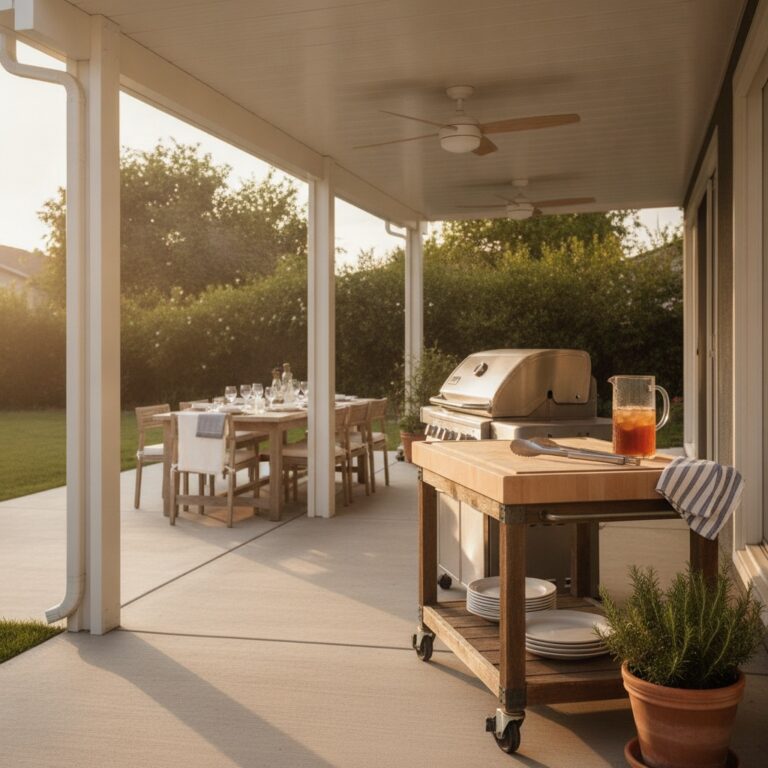
Two in the afternoon, peak heat, Extreme Heat Warning conditions. The dining table stays usable. A 72 inch by 40 inch rectangular table seats six comfortably under a 20 by 12 cover with room to pull chairs out. Lunch happens outside instead of inside. The fan runs on medium. Someone reads. The deck under the cover is warm but walkable barefoot, which the open slab twelve feet away is not.
Five thirty. The grill, sitting on the outer edge of the cover with clearance to the roof and open sky above it, finally earns its keep. Cooking in shade at 5:30 in late August is a completely different job than cooking in direct sun. The prep cart holds the platters. Nobody sprints back and forth to the kitchen.
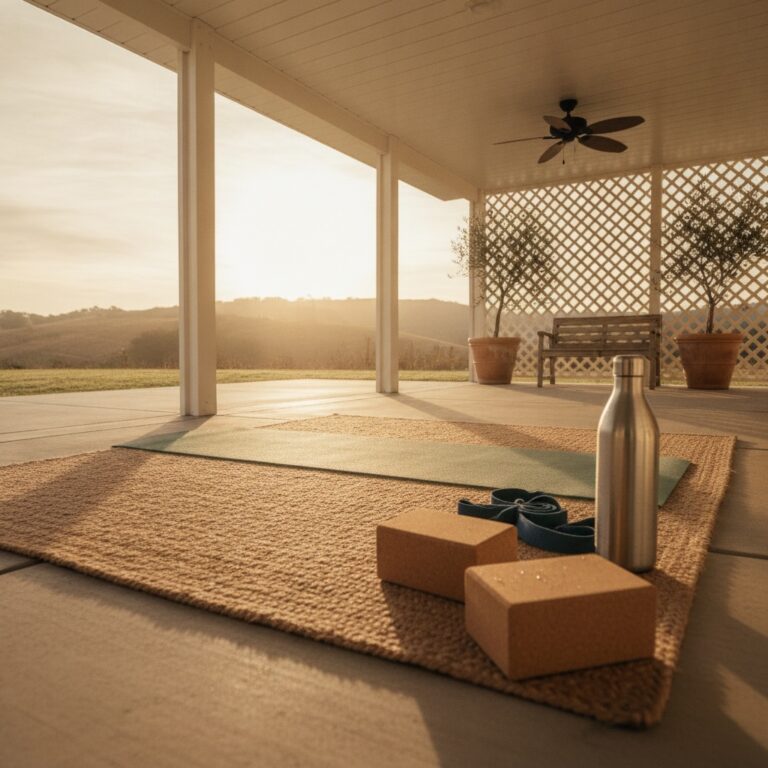
Eight. String lights run along the inside edge of the beam, warm white, 2700K, on a dimmer. Potted plants line the perimeter posts. Dwarf olive in a 24 inch pot at each post, rosemary and lavender in low terracotta along the house wall, because they take reflected heat and smell good when the evening air moves. The slab has cooled because it never loaded up. People stay out until ten.
That is a pool deck doing what a pool deck was supposed to do.
What to measure before you call anyone
Three numbers decide most of this, and you can collect all three yourself in about ten minutes.
- Slab depth from the house wall to the pool coping. You want a minimum of 10 feet of covered depth to seat a table plus chairs plus walking room. Twelve is better. If you only have 8 feet, a cover still works but the layout becomes lounge seating rather than dining.
- Fascia height and the slider header. An attached cover ties into the house above the door. If your fascia sits at 9 feet, you get a comfortable pitch out to 8 feet of clearance at the posts. Lower fascia means a lower outer edge, which changes how open the space feels toward the water.
- Where the sun actually lands at 3 p.m. in August. Stand out there this week and look. Homeowners routinely guess wrong by ten or fifteen feet, and a cover built over the wrong strip of concrete is an expensive mistake.
One pool-specific note. Post footings near a pool need attention to the existing deck and any bond beam below it. Core drilling a footing 18 inches from coping is a different conversation than setting posts in open yard, and it is worth having a builder look at the actual slab before anyone quotes a number.
Industry data keeps pointing the same direction. Requests for shade and cooling features climbed 13 percent year over year in the 2026 Yardzen outdoor living report, and pergolas and shade structures now show up routinely in premium pool projects alongside spas and outdoor kitchens. Homeowners with pools figured out that the water was never the bottleneck. The deck was.
If your pool deck sat empty through this week’s heat warning, that is worth a conversation before next summer. JNL Aluminum walks the yard with you, measures the slab, checks the fascia and the footing situation near the pool, and shows you where the shade line actually falls at 3 p.m. The in-home design walkthrough and the quote are free, and September is a good month to build something you want ready by May.
Morning-context sources used: FOX 11 Los Angeles, “Dangerous heat wave in Southern California to bring hottest temps of the year,” August 24, 2026 (https://www.foxla.com/news/dangerous-heat-wave-southern-california-late-august-2026); AccuWeather, “Los Angeles heat wave may extend to end of August,” August 2026 (https://www.accuweather.com/en/weather-forecasts/los-angeles-heat-wave-may-extend-to-end-of-august/1926235); Eye On Annapolis, “Essential Outdoor Shade Tips For Summer Entertaining,” August 22, 2026 (https://www.eyeonannapolis.net/2026/08/essential-outdoor-shade-tips-for-summer-entertaining/); Forbes, “Soft Yards, Party Patios: Yardzen’s 2026 Outdoor Living Trend Report,” July 8, 2026 (https://www.forbes.com/sites/terriwilliams/2026/07/08/soft-yards-party-patios-yardzens-2026-outdoor-living-trend-report/); Pool Magazine, “Understanding the U.S. Pool Market in 2026” (https://www.poolmagazine.com/industry-news/understanding-the-u-s-pool-market-in-2026/); Deckorators, “2026 Outdoor Living Report,” February 10, 2026 (https://www.deckorators.com/pages/press-release/deckorators-releases-2026-outdoor-living-report-spotlighting-demand-for-front-of-home-spaces).