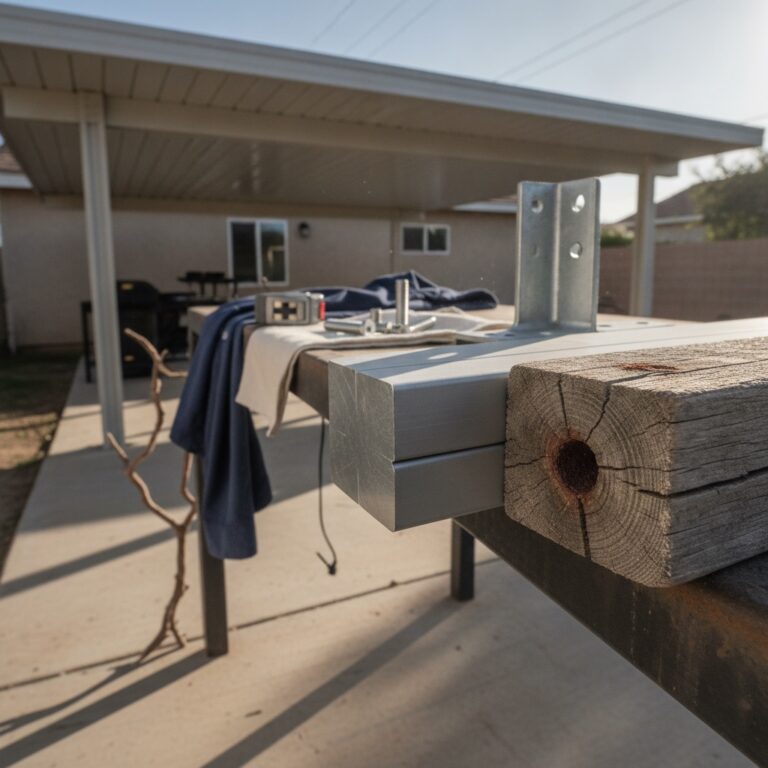

By June, the slab in Yorba Linda starts to glow at 4pm. The sun crosses west of the patio, hits the back wall, and bakes anything painted, plastic, or vinyl out there. A neighbor’s tan vinyl panel that used to read warm now reads pink. The lattice cover two doors down has gone from charcoal to a chalky gray. The question every honest homeowner asks before signing for a new aluminum cover: does this color last, or does it just look good in the showroom.
The short answer is yes, but only if the powder coat is specified to the right standard. The longer answer is that two homes ten miles apart can see very different color outcomes on the same finish. The coastal yard gets one set of threats. The inland yard gets another. That gap is what this post is about.
What July Sun Actually Does to a Powder Coat
UV radiation breaks down the resin that holds pigment in place. As the resin fails, pigment particles release from the surface in a process called chalking. The color looks faded because there is literally less pigment on the surface to reflect light. Heat speeds the reaction. So does humidity. So does salt.
Southern California stacks the deck on all three. The 2026 summer outlook from AccuWeather flags California as one of the warmer-than-average regions, with extended heat ridges expected through July and August. UV index forecasts for the state for late spring 2026 routinely hit 10 and 11 between 11am and 2pm. For context, anything above 8 is rated very high. Aluminum itself does not care. Powder coat does.
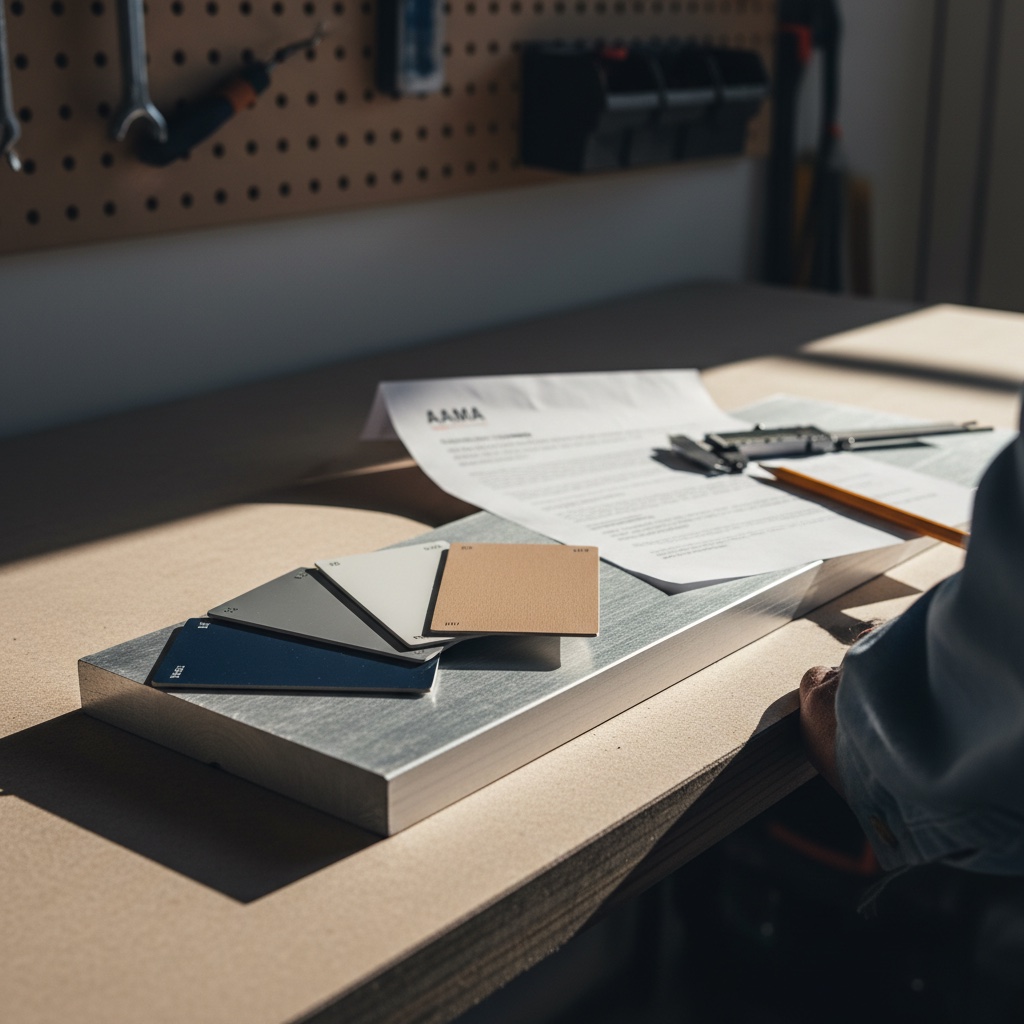
The two questions worth asking a contractor are which AAMA spec the finish meets, and how many years of color hold that spec actually buys in real outdoor exposure. The two specs that matter for residential patio covers are AAMA 2604 and AAMA 2605. Both are voluntary standards published by the Fenestration and Glazing Industry Alliance. Both are written to give buyers a clear performance line.
AAMA 2604 vs 2605: The Numbers That Matter
AAMA 2604 is the workhorse spec for residential aluminum. It requires five years of outdoor exposure testing in South Florida with a color change no greater than 5 Delta E units. Delta E is just a measurement of perceived color change. A Delta E of 1 is barely visible to a trained eye. A Delta E of 5 is noticeable side by side, but not jarring on a standalone surface. AAMA 2604 also requires a minimum of 30 percent gloss retention after those five years and 3,000 hours each of humidity and salt spray testing.
AAMA 2605 is the higher tier. Same color change ceiling of 5 Delta E, but measured at ten years of South Florida exposure instead of five. Gloss retention requirement is steeper. The coatings that hit this spec are typically 70 percent PVDF formulations, the same chemistry used on storefronts and curtain walls. For a residential patio cover, AAMA 2605 is overkill in most yards. It is the right call near the coast.
A practical translation. In San Diego coastal conditions, an AAMA 2604 powder coat reliably holds color for about 5 to 7 years before noticeable change. An AAMA 2605 finish in the same yard typically holds 10 to 15 years. Inland is gentler on the salt side and harsher on the heat side, which shifts those windows but does not invert them.
Coastal OC vs Inland Empire: Two Different Tests
A cover on a Newport Coast lot and a cover in Corona face different threats. Both need the same UV protection, but the failure modes diverge. The marine layer pulls one direction. The 105-degree afternoon pulls another. Specifying the right finish starts with knowing which one your yard sees more.
Coastal OC homes deal with marine layer most mornings from May through July. Salt-laden mist settles on every horizontal surface and dries in the sun. Over years, that salt cycles into the powder coat and pulls at the resin from underneath. A spec like AAMA 2604, designed against Florida exposure that includes humidity and salt spray, handles this for the warranty period. But the slope of degradation steepens after year six.
For homes within a mile of the surf line, the upgrade to AAMA 2605 with a 70 percent PVDF chemistry pays off across a 15 to 20 year hold period. The price difference at install is meaningful but small relative to the cost of recoating later. A new coat on an installed cover is not a straight repaint. It usually means partial disassembly and a shop finish.
Inland Empire homes in places like Riverside, Corona, and Rancho Cucamonga see lower humidity and no salt, but the surface temperatures of a south or west-facing aluminum cover routinely cross 150 degrees Fahrenheit on a July afternoon. The heat does not damage aluminum. It does accelerate UV degradation of the powder coat. For these yards, AAMA 2604 with a high-quality inorganic pigment formulation will hold its color into year seven without obvious change. Darker colors will read a little softer by year ten. Lighter colors hold better. Choosing a brushed silver, off-white, or warm sandstone over a deep espresso is a small adjustment that buys real years.
The split is not a coastal-versus-inland argument about quality. It is about matching the spec to the threat your yard actually faces. A 2604 finish in Corona earns its warranty. A 2604 finish in Carlsbad will probably still look fine at year five, but the homeowner who chose 2605 will be the one happy at year fifteen.
Color Hold Math and the Warranty It Buys You
Most quality aluminum patio cover programs in 2026 carry a powder coat warranty that runs 10 to 20 years against fade, chalk, peel, and crack. The 20-year warranty is contingent on the finish being installed by a certified dealer on prepped substrate. The 10-year version is the floor for an AAMA 2604 system. A 20-year warranty on an AAMA 2605 PVDF finish is the gold standard. A 1-year labor warranty stacked on top is standard practice. A 5-year structural warranty on the extrusions is a separate line item and worth confirming.
Worth asking on a quote. Which AAMA spec does the finish meet, what is the pigment family, and what is the warranty term in writing. The honest answer to all three should be on the quote, not a verbal at the kitchen table. A reputable dealer will print it. The pigment matters more than most homeowners realize. Iron oxide and titanium dioxide pigments hold up well under UV. Some organic pigments in the bright red and yellow families do not.
Two numbers to keep in mind when comparing two quotes. AAMA 2604 with a 10-year warranty is the residential floor. AAMA 2605 with a 20-year warranty is the coastal upgrade. Anything below either should give pause. A 3-year fade warranty on an unspecified finish is a red flag. So is a contractor who cannot name the AAMA tier on the spot.
If the cover is going on a slab in Yorba Linda, Anaheim Hills, or any inland yard, AAMA 2604 with a smart color choice is the right answer for most households. If the cover is going on a yard in Corona del Mar, Carlsbad, or anywhere within sight of the water, the AAMA 2605 upgrade earns its keep. JNL’s design team walks the yard, checks the orientation, and itemizes both options on the same quote so the comparison sits side by side. That in-home visit is the right time to ask about pigment families and warranty terms by name.
The cover should still look the way you picked it five Julys from now. A 10-minute spec check at the quote stage is what makes that true. A free in-home walkthrough from JNL is the easiest way to get both options priced on the same sheet, with the AAMA tier and pigment family written out in plain English.
Morning-context sources used: AccuWeather Summer 2026 forecast; UV Index California (May 20, 2026 reading); AMICO Architectural Metals on AAMA 2604 vs 2605; Aegis Industrial Finishing on AAMA 2603/2604/2605; Universal Powder Coating UV Resistant Guide 2026; CFR Patio residential warranty information.