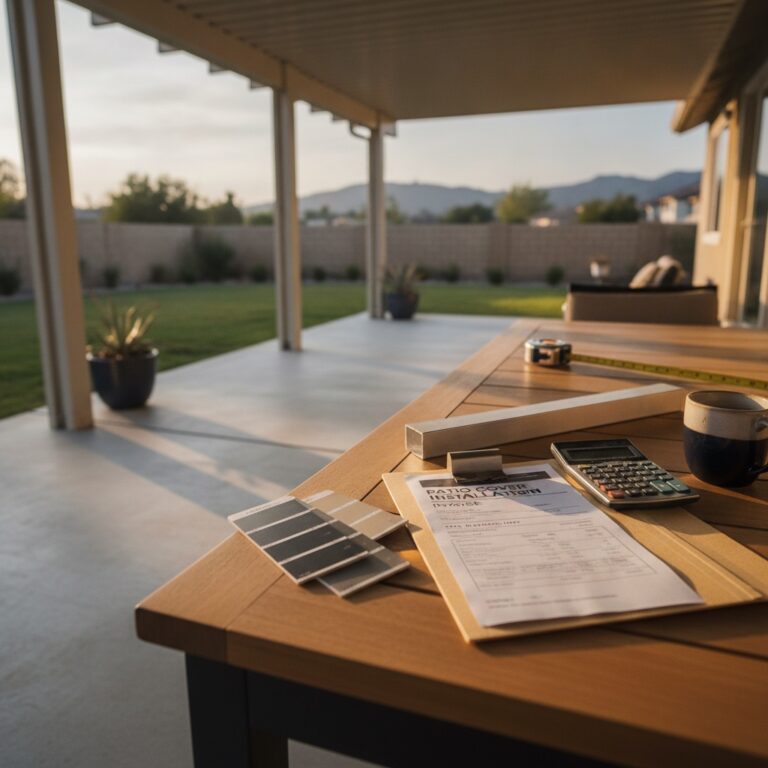

A homeowner in Irvine gets two quotes for the same 12 by 20 foot attached aluminum cover. One says $8,400. The other says $11,900. The cheaper number looks like the winner until the permit invoice, the footing work, and the electrician’s bill show up in week three. Most of the gap between patio cover quotes is not the aluminum. It is what each contractor chose to leave out of the number. This post walks through what a base price usually covers, the six items that often sit outside it, and how to compare two quotes line by line.
What the Base Price Usually Covers
For a standard solid-roof aluminum cover in Orange County, San Diego, or the Inland Empire, installed pricing in 2026 generally runs $20 to $50 per square foot. A 240 square foot cover in Irvine or Anaheim with 3 inch roof panels, a 3 by 8 inch beam, and four 3 by 3 inch posts will usually land between $7,200 and $10,800 before extras. Insulated roof panels with a foam core push that toward $45 to $70 per square foot, so the same footprint can reach $16,000.
That base number almost always includes the roof panels, beams, posts, header or ledger, standard fasteners, a factory powder-coat finish in a stock color, delivery, and labor for a typical one to two day install. It also usually assumes an existing concrete slab in good shape, a clean attachment point at the house, and no electrical work. Every one of those assumptions is a place where the final invoice can drift upward. The trick is knowing which ones apply to your yard before you sign.
Six Line Items That Often Sit Outside the Number
1. Permits, plans, and engineering. Most permanent covers in OC cities like Irvine, Anaheim, and Huntington Beach need a building permit. Permit fees commonly run $200 to $800, and stamped engineering calculations add $300 to $800 when the city asks for them. In OC, patio covers also go through Orange County Fire Authority review, which matters more if your lot sits in a high fire hazard zone. Ask whether the quote includes pulling the permit, paying the fees, and handling plan check corrections, or just the paperwork.
2. Footings and slab work. Posts need proper footings. Many older Tustin and Fullerton slabs are 3 to 4 inches thick with no footing where the post wants to land. That means cutting the slab, digging a footing roughly 18 by 18 by 24 inches, and pouring new concrete. Budget $150 to $350 per footing depending on access and soil. If the slab itself is cracked or too small, a new pour runs about $8 to $14 per square foot. A quote that says “posts set on existing slab” is not the same as one that says “new footings per engineering.”
3. Electrical. Ceiling fans, recessed LED lights, and an outdoor outlet turn a cover into a room. They also require a licensed electrician and often a separate electrical permit. For a typical fan, two light circuits, and one GFCI outlet, SoCal homeowners usually see $1,200 to $3,500. Some patio contractors pre-wire the beams and hand off the rest. Others include the full job. Find out which one you are buying, and whether the wire runs inside the beam or in surface conduit.
4. Attachment to the house. An attached cover needs a solid place to connect. Fascia attachment is simplest. A roof mount with riser brackets over concrete tile, common in Rancho Santa Margarita and Temecula, can mean pulling and resetting tiles and adding flashing. That often adds $300 to $1,000. Stucco patching around a new ledger adds more. Ask the estimator to name the attachment method in writing and state who repairs the roof or wall afterward.
5. Demo and haul-away. Replacing a tired wood lattice from the 1990s is one of the most common jobs in Orange and Riverside counties. Tearing it out, pulling old posts, and hauling off the debris typically costs $800 to $2,500 depending on size and whether the old posts are set in concrete. Some quotes include it. Many list it as an option or skip it entirely, leaving the homeowner with a pile of rotted rafters and a dumpster rental.
6. Finish and accessory upgrades. Stock white or tan powder coat is usually in the base. Custom colors, AAMA 2605 grade finishes, gutters with downspouts, fan beams, and end caps are often extras. None of these are frivolous. A AAMA 2605 finish carries a much longer color and chalk warranty than AAMA 2603 or 2604 in inland heat. Just make sure each upgrade shows up as a named line with a price, not buried in a single “options” total.
The Fine Print: Price Locks, Tariffs, and Rates
This fall adds a wrinkle. Aluminum mill shape prices are up roughly 27 percent year over year, and the 50 percent Section 232 tariff on imported aluminum is still in place. Manufacturers pass those increases to dealers in waves, so a quote written in August may not hold in November. Look for the validity window on the quote. Thirty days is common. Ask whether the price is locked once you sign and pay the deposit, or whether a material surcharge clause lets it move before install.
Financing costs moved too. The Federal Reserve raised its benchmark rate on September 16 to a 3.75 to 4 percent range, the first increase since 2023. Bankrate’s national average HELOC rate sat at 7.28 percent on September 23, while fixed home equity loans averaged around 7.35 percent. A variable HELOC balance will follow the Fed. If you plan to finance a $12,000 cover, compare a fixed home equity loan, a variable HELOC, and any dealer promo side by side on total interest, not just monthly payment.
Deposits deserve the same attention. California law caps the down payment on a home improvement contract at $1,000 or 10 percent of the contract price, whichever is less. A contractor asking for 40 percent up front before any work starts is a red flag, no matter how good the per square foot number looks. Progress payments should track real milestones like permit approval, footing inspection, and final walk.
How to Read Two Quotes Side by Side
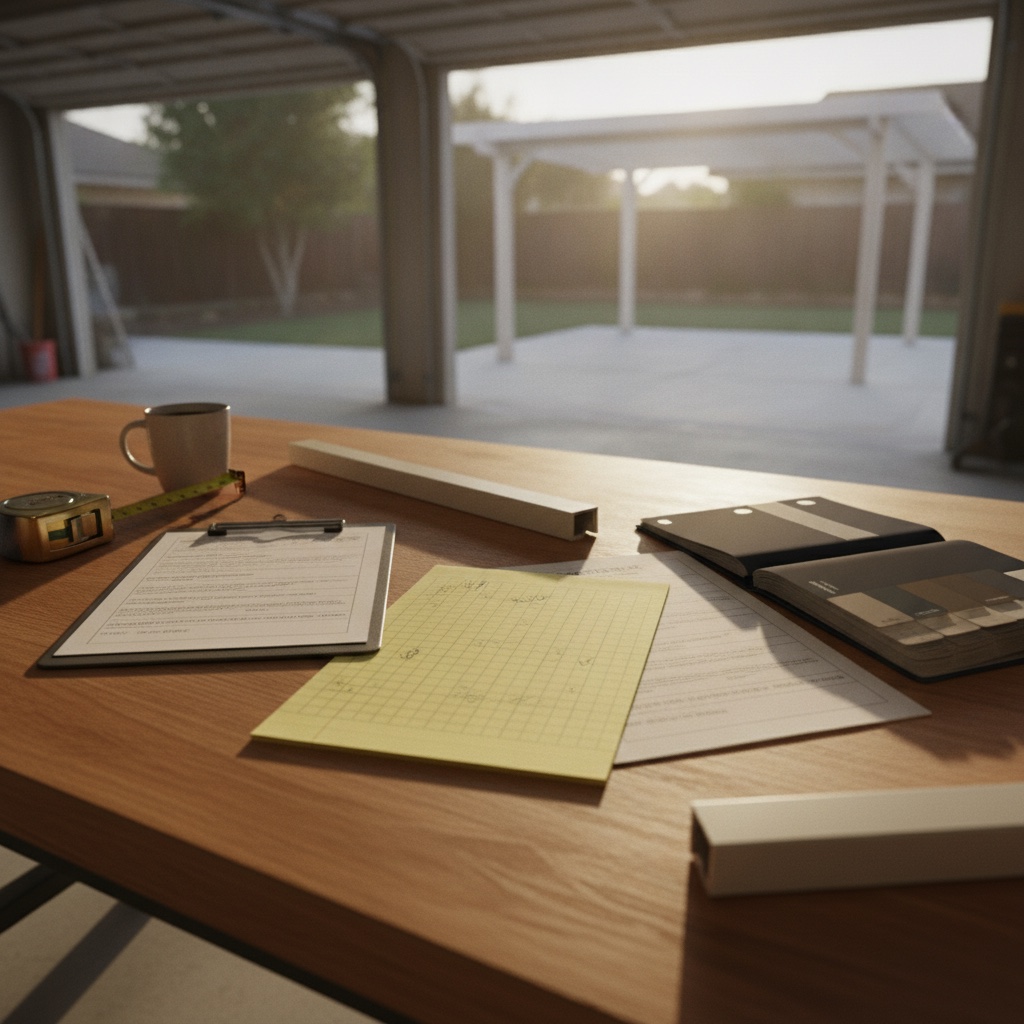
Put both quotes on the kitchen table and make a simple grid. Rows are the six items above plus the base structure. Columns are each contractor. Mark every cell as included, priced as an option, or not mentioned. “Not mentioned” is the dangerous one. It usually means the homeowner pays for it later, either to the same contractor as a change order or to a separate trade. Then add the realistic cost of every gap to that quote’s total.
Run that exercise on the Irvine example and the $3,500 gap often shrinks to a few hundred dollars. The lower quote left out footings, the permit fee, and haul-away. The higher one included all three plus a AAMA 2605 finish. Also compare the spec itself: panel thickness, beam size, post size and wall thickness, and the wind and snow load the engineering calls for. A 2.5 inch panel spanning 12 feet is not the same product as a 3 inch panel, even at the same color.
Finally, check the paperwork behind the price. The contractor should list a California CSLB license number on the quote, carry workers’ comp and liability coverage, and name the manufacturer warranty in years, not adjectives. A clear quote is usually a sign of a clear install week. If you want a line-by-line quote for your own yard, with permits, footings, attachment, and finish spelled out before you commit, we can walk your slab and write it up at your kitchen table. Book a free in-home consult with JNL Aluminum and bring your other quotes along.
Morning-context sources used: Bankrate HELOC rates (Sept 23, 2026); CNBC Fed rate decision (Sept 16, 2026); Lendmesh home equity weekly (Sept 18, 2026); USGlass aluminum prices and tariffs; Southern California patio cover cost guide 2026; OC Development Services permit FAQs.