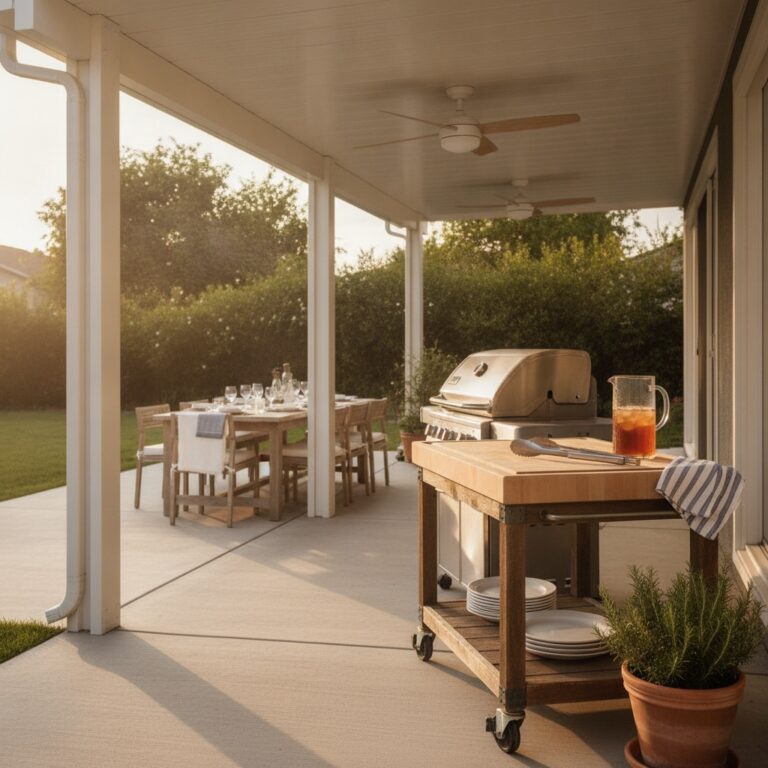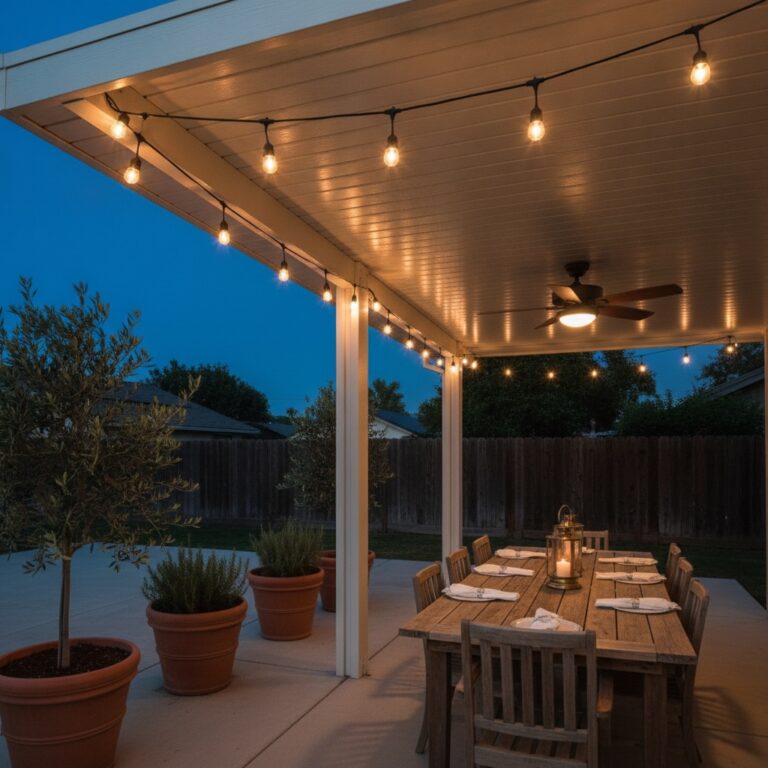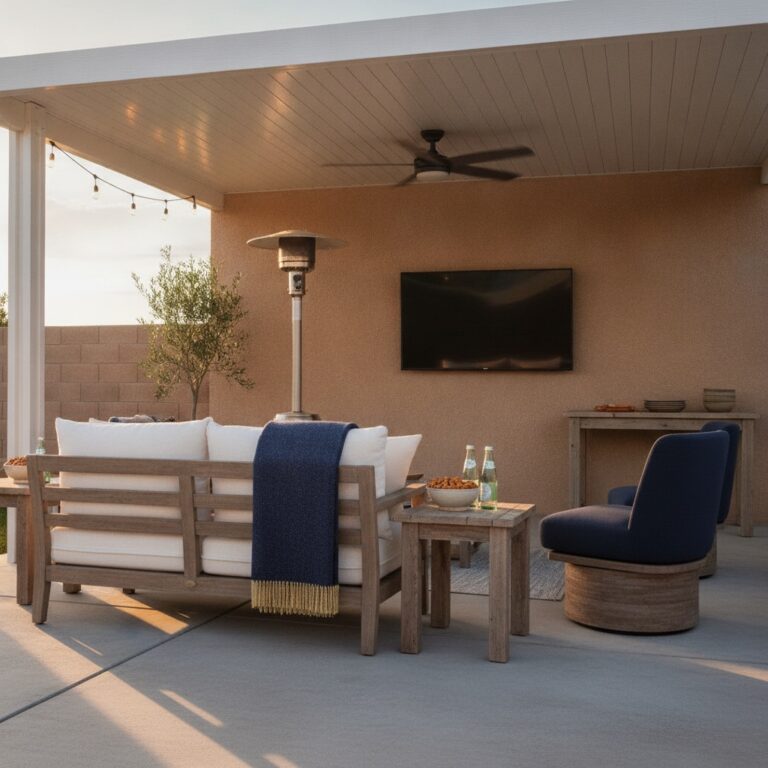
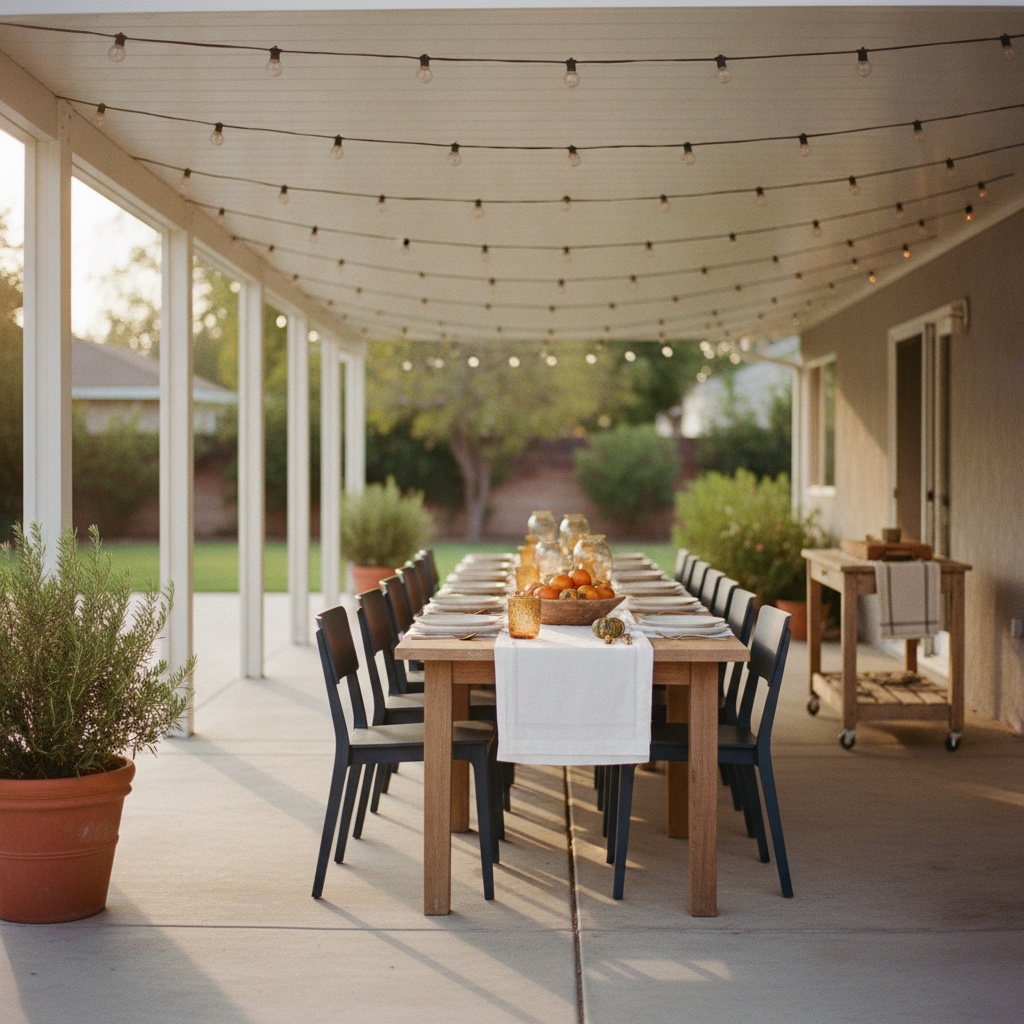

The dining room in most Fullerton tract homes seats ten. Thanksgiving 2026 lands on Thursday, November 26, and in a lot of SoCal households the head count that day sits closer to eighteen. That gap is why somebody’s nephew eats off a folding table in the hallway every single year. The fix is not a bigger house. It is the 16 by 24 slab off the back door, the one that sits empty in November because nobody wants to eat under open sky at 5 p.m. when it is 58 degrees and the only light out there is a single bulb by the door.
Run the Seating Math Before You Buy Another Folding Table
Table edge is the number that decides everything else. Plan 24 inches of edge per adult, 30 inches if plates are full size and the serving bowls stay on the table instead of a side cart. A 96 by 40 inch rectangular table seats eight in comfort and ten with two people at the ends. A 60 inch round seats eight. Two 96 inch tables pushed end to end give you 16 feet of run and seat sixteen to eighteen, which is the whole overflow problem solved in one line item.
Then add the floor around it. Chairs need 36 inches of clearance behind them to push back and stand, 48 inches if that chair backs onto the walking lane between the table and the grill. So a sixteen-seat run actually wants about 22 feet of length and 10 feet of width in clear floor.
A 16 by 24 patio cover gives you 384 square feet to work with. Run the long table down the middle of the 24 foot direction and the table plus chairs takes roughly 9 feet of the 16 foot width. That leaves a 7 foot band for a buffet, a drink cart, and somewhere for the four-year-olds to be four-year-olds.
Worth saying plainly: the second table outdoors is not the punishment table. Under a covered patio with warm light and a heater running, it is the seat people fight over. The hallway card table has never once been that.
What November 26 Actually Looks Like in Orange County
Sunset in Fullerton on Thanksgiving falls right around 4:44 p.m. Serve at 3 and you are cutting pie in the dark. The slab drops into the high 50s by 7 p.m., and a west-facing patio that baked at 95 degrees in August gives all that heat back within an hour of sundown in late fall. None of that is a reason to stay inside. It is a reason to plan light and heat before you plan the tablecloth.
Rain is the other variable, and this year it is a live one. NOAA’s Climate Prediction Center put the odds of a very strong El Nino above 90 percent for fall and winter 2026-27 in its September 10 update, with sea surface anomalies past 3.0 degrees C in the eastern Pacific and the heaviest precipitation signal aimed at coastal California. The wettest months still look like January through March, but a wet late-November Thursday is no longer a long shot in Orange County.
That settles the cover question fast. A lattice cover throws beautiful dappled shade in July and does nothing for a wet Thursday in November. A solid roof, flat pan or insulated panel, keeps the table dry, holds a few degrees of warmth underneath, and gives you structure to mount lights and a fan to. For a Thanksgiving-first patio in Fullerton, Placentia, or Brea, solid is the answer. Put the lattice on the side yard where the herbs grow.
Laying Out 384 Square Feet for Nineteen People
Build it as two zones under one cover. Dining takes the 24 foot run nearest the kitchen slider, so the turkey travels 12 feet instead of 40 and the gravy is still hot when it lands. Lounge takes the far third, past the last post: two deep-seat chairs at about 34 inches wide each, a 20 inch side table between them, and an 8 by 10 outdoor rug to tell people where that room starts. The kids find the rug within four minutes of arriving. That is the point of the rug.
Post placement decides whether the layout works or just looks fine on paper. Aluminum beam spans let you set posts 10 to 20 feet apart, so on a 24 foot open side you can usually run three posts instead of five. Ask for the shop drawing with the actual tables and chairs drawn on it, not just the cover outline. A post landing 18 inches off the end of your table is the difference between a real seat and a spot nobody sits in twice.
Homeowners are clearly moving this direction already. The 2026 Houzz Outdoor Trends Study found shade structures jumped 15 percentage points to a 35 percent adoption rate among renovating homeowners, close behind decks at 43 percent, and 71 percent of those projects involved a hired pro. Dining areas showed up in 55 percent of outdoor renovations. The backyard is being built as a room now, not a leftover.
Light, Heat, and Air From 2 p.m. to 8 p.m.
String lights carry the mood. Four runs of commercial-grade S14 strand at 24 feet each, clipped to the underside of the pans and spaced about 4 feet apart, cover a 16 foot width and draw under 100 watts total on 2-watt LED bulbs. Add two surface-mount fixtures on a separate switch over the serving zone, because carving a turkey by string light is genuinely a bad idea. Put both circuits on dimmers and the same patio reads bright at 3 p.m. and warm at 7 p.m.
Heat is where budgets get wasted. A freestanding 40,000 BTU propane mushroom warms a circle roughly 9 to 12 feet across and needs real overhead room, commonly 18 inches of clearance and an 8 foot ceiling minimum, so read the label before rolling one under an aluminum roof. The cleaner setup under a solid cover is a pair of beam-mounted 1500-watt electric infrared units aimed down the length of the table, each on its own 15-amp circuit. They warm people rather than air, and they work with a wall switch instead of a propane run to the hardware store on Thanksgiving morning.
Airflow still matters in November. A solid roof plus twenty bodies plus a running heater gets close and stuffy faster than people expect. One damp-rated 52 inch ceiling fan centered over the table, blades at least 7 feet off the slab and ideally 8 to 9 feet, set to the lowest speed, keeps air moving without blowing out candles or chilling the far end. Have the fan box and the light circuits roughed in during the cover install. Adding them after the fact means a second crew and a second invoice.
Book Now if the Table Has to Be Ready by November
Two months is a workable window, not a generous one. City plan review across Orange County typically runs two to five weeks for a patio cover permit, fabrication adds one to three, and installing a straightforward attached solid cover takes a day or two once footings cure. Booking in mid-September for a Thanksgiving table is comfortable. Booking in late October means betting on somebody else’s cancellation.
On cost, plainly: an attached solid-roof aluminum cover in the 14 by 24 to 16 by 24 range generally lands between $7,400 and $14,200 installed in Orange County, depending on panel thickness, post count, and whether the fan, lights, and heater circuits go in up front. Ask what powder coat is on the extrusion. AAMA 2604 holds color well inland through Corona and Chino Hills. AAMA 2605 is the spec to insist on if you live close enough to the water to smell it. Get the warranty years in writing, not in conversation.
The honest test of a patio cover is not a July afternoon. It is the fourth Thursday in November, when the house is full, the kitchen is loud, and six people need somewhere good to sit. If your slab could be that room this year, JNL Aluminum will come out, measure the space, put your actual tables and chairs on the drawing, and leave you with a free in-home quote and real numbers on it.
Morning-context sources used: https://www.cpc.ncep.noaa.gov/products/analysis_monitoring/enso_advisory/ensodisc.shtml (NOAA CPC ENSO Diagnostic Discussion, Sept 10, 2026); https://www.claimsjournal.com/news/national/2026/09/10/340061.htm (Sept 10, 2026); https://unofficialnetworks.com/2026/09/10/noaa-upgrades-el-nino-threat/ (Sept 10, 2026); https://coyotegulch.blog/2026/09/12/the-latest-elnino-southern-oscillation-enso-diagnostic-discussion-is-hot-off-the-presses-from-the-climate-prediction-center-9/ (Sept 12, 2026); https://pro.houzz.com/pro-learn/blog/2026-houzz-outdoor-trends-report (2026 Houzz Outdoor Trends Study); https://www.wf-vision.com/design-and-trends/shading-structures-drive-outdoor-living-trends-in-2026/; https://www.veranda.com/outdoor-garden/a69739522/patio-and-porch-trends-2026/ (June 25, 2026).