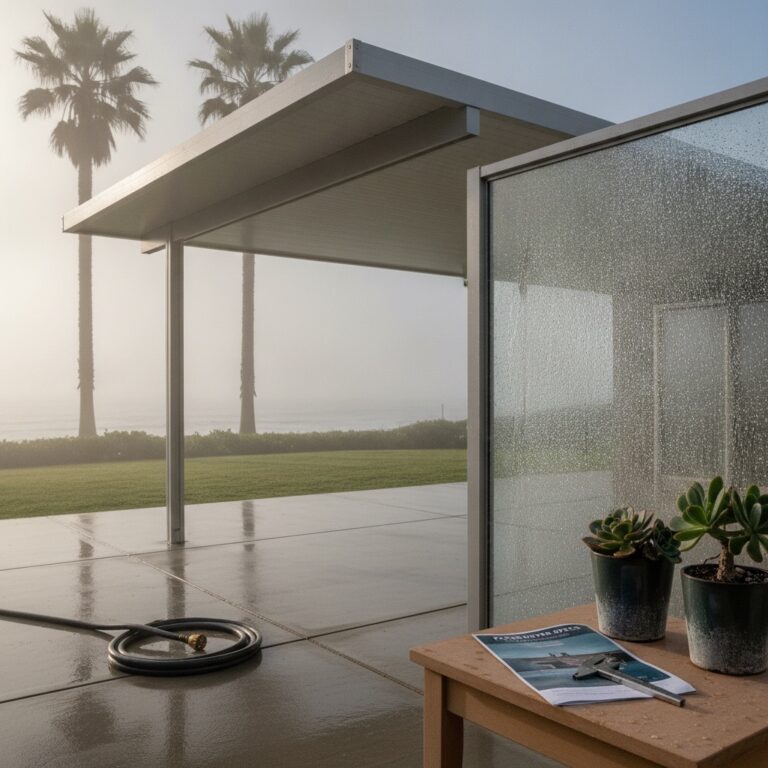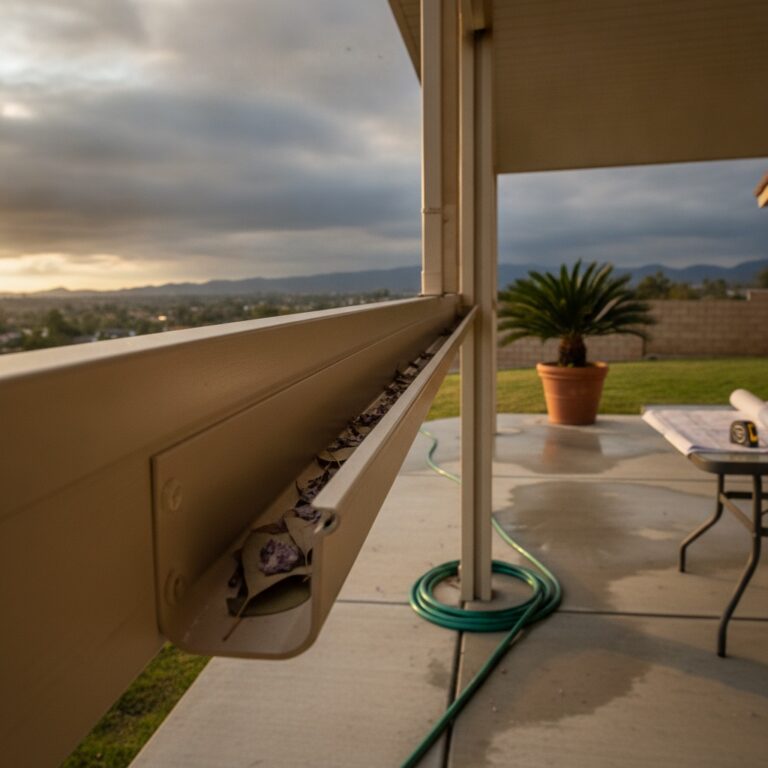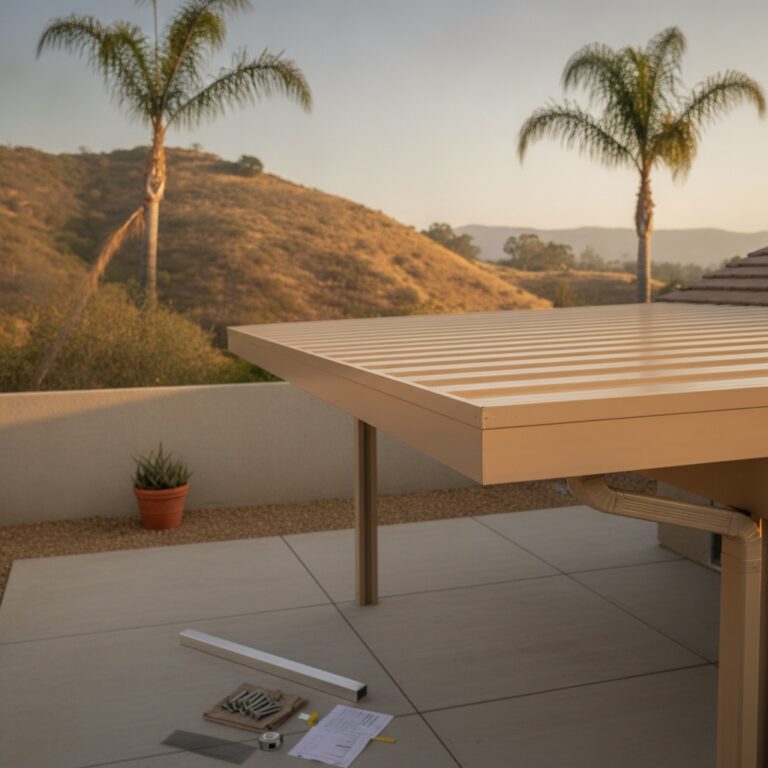
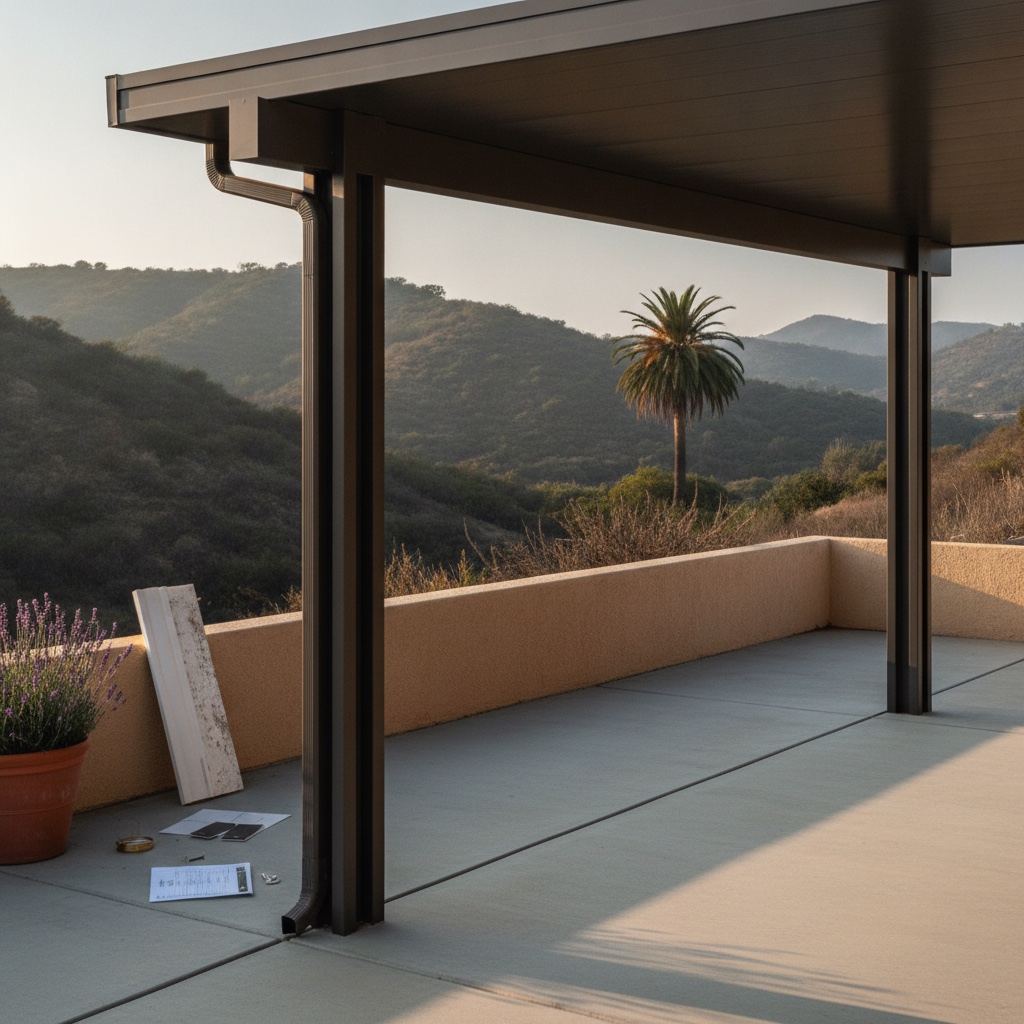

Fall arrived in Escondido at 5:05 in the afternoon on Tuesday, September 22, and the weather ignored it. Inland San Diego County ran 84 to 92 degrees on Wednesday, with Friday and Saturday forecast to climb another few degrees. Forecasters called for highs 3 to 10 degrees above normal and a brief shot of monsoon humidity on Thursday. For a patio cover in the inland valleys, the calendar page means very little. The sun is still doing real work on every surface it touches, and some surfaces are about to take more of it, not less.
That second part surprises most homeowners. They assume the patio gets a break once summer ends. The roof pan does get a small break. The fascia, the posts, the beam faces, and the gutter front do not. This post walks through why fall sun in Escondido, San Marcos, and Valley Center is hard on vertical finishes, what that means for vinyl versus aluminum, and which powder-coat tier to write into your quote so the color you pick in September still matches in 2036.
September UV in the Inland Valleys Is Still Very High
The UV index does not drop off a cliff at the equinox. Across Southern California, the typical September midday UV reading averages around 8, which sits in the “very high” band on the WHO scale. Readings of 6 or higher run from March through September in Los Angeles, and inland San Diego County tends to run a touch higher because the marine layer burns off earlier and returns later. On a clear Escondido afternoon this week, a south-facing patio sees roughly the same UV dose a coastal patio saw in early June.
Heat and UV work together on patio finishes. UV breaks the chemical bonds in pigments and resins. Heat speeds that chemistry up and makes plastics move. When a week of 92-degree afternoons lines up with a UV index of 8, a dark-colored surface in direct sun can run well past 150 degrees. That combination is exactly the test that separates a finish built for inland SoCal from one built for somewhere milder. The coast gets salt. The inland valleys get this.
The Lower Fall Sun Hits Your Fascia and Posts Harder
Escondido sits at about 33 degrees north latitude. At the June solstice, the noon sun stands about 80 degrees above the horizon, nearly straight overhead. It mostly strikes the flat roof of the cover and leaves the vertical faces in partial shadow. At the September equinox, noon sun sits at about 57 degrees. By the December solstice it drops to roughly 33 degrees. As the sun sinks lower, it stops skimming the vertical surfaces and starts hitting them nearly head-on.
On a typical 12 by 20 foot attached cover, the vertical surfaces include the front fascia, the gutter face, three or four 3 by 3 inch posts, and the exposed side of every beam. On a south- or west-facing slab, those faces pick up their heaviest direct sun between October and February. Summer bleached the roof. Fall and winter go to work on the parts of the cover you actually see from the kitchen window. This is why a fading cover almost always shows it first on the fascia and the sunny side of the posts.
For homeowners in Rancho Bernardo, Ramona, and the San Pasqual Valley, the effect stacks with the afternoon heat. Late September and October regularly bring 90-degree days to these neighborhoods, and the occasional offshore wind event pushes them higher. The finish on a west-facing fascia in Escondido may see more hours of hard, direct sun between Halloween and Valentine’s Day than it did in July.
Where Vinyl Gives Up First
Vinyl patio covers have real strengths. They never need paint, they do not rot, and a clean white vinyl cover looks sharp on day one. The trouble shows up on the timeline. PVC relies on UV stabilizers and white pigment to protect itself. As those stabilizers are used up, the surface starts to chalk. Run a hand across an older vinyl fascia and you will pick up a fine white powder. That powder is the top layer of the material breaking down.
Color is the bigger limit. Most vinyl patio covers come in white, almond, or a light tan for a reason. Darker vinyl absorbs far more heat, and PVC begins to soften at temperatures a dark surface can reach on an inland September afternoon. Manufacturers across the vinyl industry acknowledge that dark vinyl colors fade and degrade much faster than light ones. So a homeowner in Escondido who wants a bronze or charcoal cover to match dark window frames will usually be steered away from vinyl altogether.
Heat movement adds a second problem. Vinyl expands and contracts far more than aluminum as temperatures swing. Inland San Diego County can see a 30-degree swing between a 62-degree dawn and a 92-degree afternoon. Over years of those daily cycles, long vinyl spans can bow, joints can open, and panels can pull at their fasteners. None of this happens overnight. It shows up in year six or year nine, right when the warranty fine print starts to matter.
The Powder-Coat Tier to Put in Writing
Aluminum solves the structural side of the problem. It does not soften at patio temperatures, and it moves far less with heat. The color, though, depends on the finish. Powder-coated aluminum is rated against AAMA specifications, and the tier matters more in Escondido than almost anywhere else in the county. There are three levels worth knowing.
- AAMA 2603. The entry tier. It requires one year of South Florida sun exposure with only slight color change. Fine for interior trim. Not what you want on a west-facing fascia in the inland valleys.
- AAMA 2604. The mid tier. It requires five years of South Florida exposure with color change held to 5 Delta E units or less, plus limits on chalking and gloss loss. This is a solid baseline for most inland covers.
- AAMA 2605. The top tier. It requires ten years of South Florida exposure with the same 5 Delta E color limit and tighter gloss retention. This is the tier to ask for on dark colors, on south- or west-facing slabs, and anywhere the cover faces the afternoon sun.
Here is the practical rule for Escondido and the inland North County. If you are choosing white or a light almond, AAMA 2604 will usually hold up well for the life of the cover. If you are choosing bronze, charcoal, or any dark color, or if the slab faces south or west, ask for AAMA 2605 by name. On a typical 12 by 20 foot cover the upgrade is modest compared with the cost of the cover itself, and it is the difference between a fascia that still matches the posts in ten years and one that does not.
Three other spec points round out an inland UV package. First, ask for factory-finished cut ends where possible, since field-cut edges are where finish failure often starts. Second, ask for stainless or coated fasteners with color-matched heads so the screw line does not fade to a different shade. Third, ask for the finish warranty in writing, in years, separate from the structural warranty. A limited lifetime structural warranty tells you nothing about how long the color is covered.
Weather will keep testing the finish long after the install crew leaves. This weekend brings more heat, and tropical moisture from Hurricane Polo could push humidity and a chance of showers into the region late Sunday into Monday. Humid heat followed by hard sun is one more cycle a good finish shrugs off and a weak one does not. If your slab faces the afternoon sun in Escondido, San Marcos, or Rancho Bernardo, we can come out for a free in-home assessment, check the exposure with you, and write the finish tier and fastener spec directly into the quote.
Morning-context sources used: ABC 10News San Diego, “San Diego’s Weather Forecast for September 22, 2026: Warmer for the first days of fall,” 22 September 2026 (https://www.10news.com/weather/san-diegos-weather-forecast-for-september-22-2026-warmer-for-the-first-days-of-fall); ABC7 Los Angeles, “SoCal to see significant warm-up Wednesday with return of summer-like temps,” 23 September 2026 (https://abc7.com/post/los-angeles-weather-temperatures-southern-california/58983/); ABC7 Los Angeles, “Hurricane Polo could bring rip currents, large swells to Southern California coast,” September 2026 (https://abc7.com/post/hurricane-polo-could-bring-rip-currents-large-swells-southern-california-coast/19857521/); MyWild, “UV Index in California 2026: Today and by Month” (https://mywild.report/uv-index-california); Products Finishing, “Understanding AAMA Specifications” (https://www.pfonline.com/articles/understanding-aama-specifications); American Sign Products, “Stop the Fade” (https://americansignproducts.com/news/stop-the-fade/).