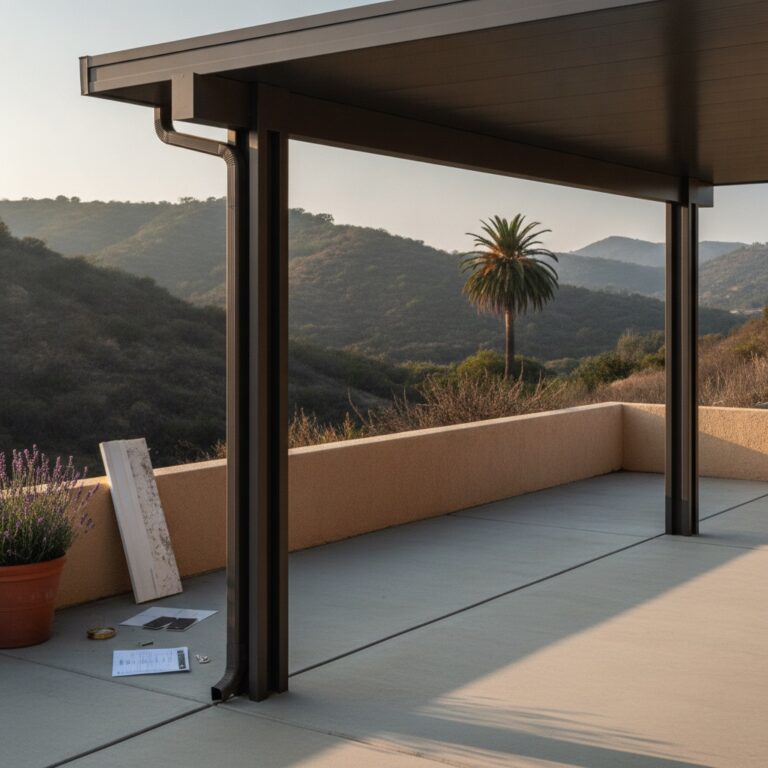

Labor Day weekend put salt water on Ocean Blvd in Long Beach. Hurricane Marie never came closer than about 700 miles to San Diego, but its swell reached 6 to 10 feet on south-facing beaches, stacked onto a high tide, and pushed water across the Alamitos Peninsula. Seal Beach flooded the same morning. Most of Los Angeles County took a quarter inch to an inch of rain, which is rare for early September. Every coastal patio in that onshore flow got a salt bath along with it.
The flooding was the visible damage. The salt aerosol that rode inland for three days is the part that keeps working after the streets dry. On a patio cover, that salt lands on the roof pan, collects in the gutter channel, settles into the fastener heads, and sits there until something rinses it off. What happens over the next ten years depends almost entirely on which powder-coat tier and which fastener metal went on the job at install.
What Salt Air Actually Does to an Aluminum Cover
Aluminum does not rust. That is true, and it is why aluminum belongs on a coastal patio in the first place. Bare aluminum grows a thin oxide skin within seconds of meeting air, and that skin blocks most further attack. The problem in Seal Beach and Sunset Beach is not rust. It is pitting. Chloride ions punch through the oxide layer at weak points and open small, deep craters. On a cover you see it first as a chalky white bloom around a screw head or along a cut edge that was trimmed on site.
Distance from the water sets the pace. Homes inside about a mile of the surf line sit in what coating specifiers treat as a severe marine zone. One to five miles inland is moderate. Past five miles, in places like Westminster or Fountain Valley, salt deposition drops far enough that a standard architectural finish holds up fine. A cover in Corona del Mar and the same cover in Yorba Linda are not doing the same job, even when the extrusion is identical.
AAMA 2604 or AAMA 2605, and How to Tell Which You Need
Powder coat on architectural aluminum gets graded against AAMA specifications. AAMA 2603 is the entry tier and belongs on interior or low-exposure work. AAMA 2604 is the middle tier. It calls for 3,000 hours of continuous salt fog under ASTM B117 and holds color and gloss for roughly five years. AAMA 2605 is the top tier. It holds color and gloss for about ten years and adds a cyclic salt test, ASTM G85 Annex A5, that runs wet and dry phases instead of constant fog.
That cyclic test is the detail worth understanding. Real coastal exposure is not a continuous soak. It is spray at night, dry heat by noon, spray again the next night. Salt concentrates as the surface dries, and that concentration is harder on a coating than steady wetness. The G85 method reproduces the pattern, which is why specifiers reach for AAMA 2605 on coastal buildings. For a patio cover within a mile of the water in Seal Beach or Huntington Beach, 2605 is the right call.
The upgrade is not free, and an honest quote says so. Moving from a standard architectural finish to a 2605-rated coating typically adds somewhere between $1.50 and $3.00 per square foot of covered area. On a 16 by 20 attached cover, that is roughly $480 to $960. Five miles inland, that money buys very little. Two blocks from the sand, it buys the difference between a cover that still looks right in 2036 and one that looks tired by 2031.
The Fasteners Usually Fail Before the Finish Does
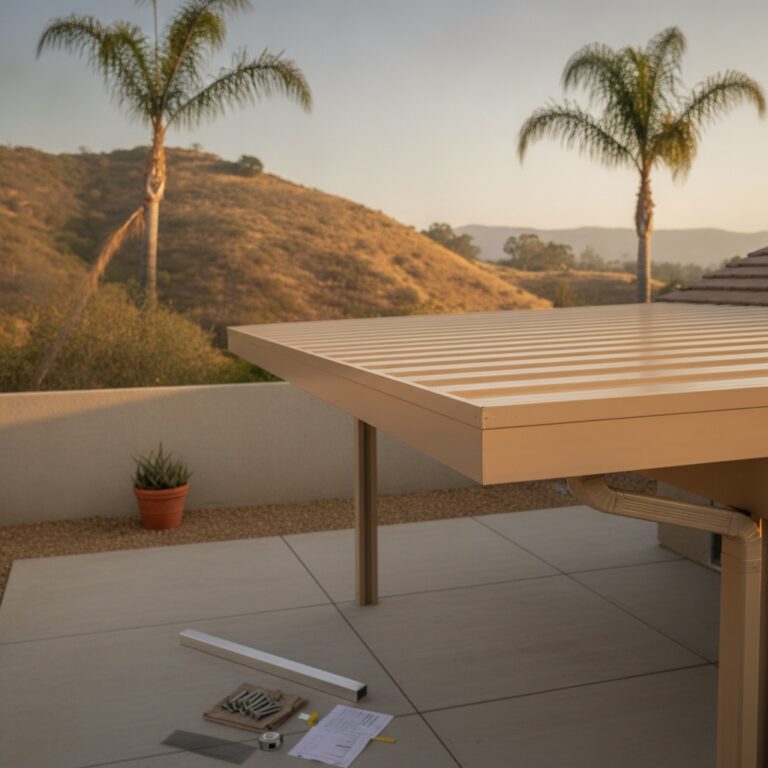
Walk a ten-year-old coastal patio and check the screws, not the beams. The coating on a quality extrusion often outlives the hardware holding the structure together. Zinc-plated steel screws are the common shortcut. They cost pennies, they pass the final walkthrough, and they bleed rust streaks down a white fascia inside three winters. On an oceanfront lot they can lose real structural section in under a decade.
Type 304 stainless is the usual step up and does fine a few miles inland. Inside the severe marine zone, 316 stainless earns its cost. The added molybdenum is what resists chloride pitting specifically. Ask any installer quoting a Newport Beach or Sunset Beach job to write the fastener grade on the proposal. If the line item just says stainless, that word covers both 304 and 316, and the price gap between them is wide enough that the distinction matters.
Dissimilar metals deserve one more note. Stainless against aluminum forms a mild galvanic couple, and in constant salt moisture that couple works slowly against the aluminum surrounding the fastener. Good coastal detailing calls for isolation washers or a sealant bed at every through-bolt into a beam. It is a small labor line on the quote. It is also the difference between a clean joint at year twelve and a weeping one.
A Four-Minute Rinse Beats Every Warranty Claim
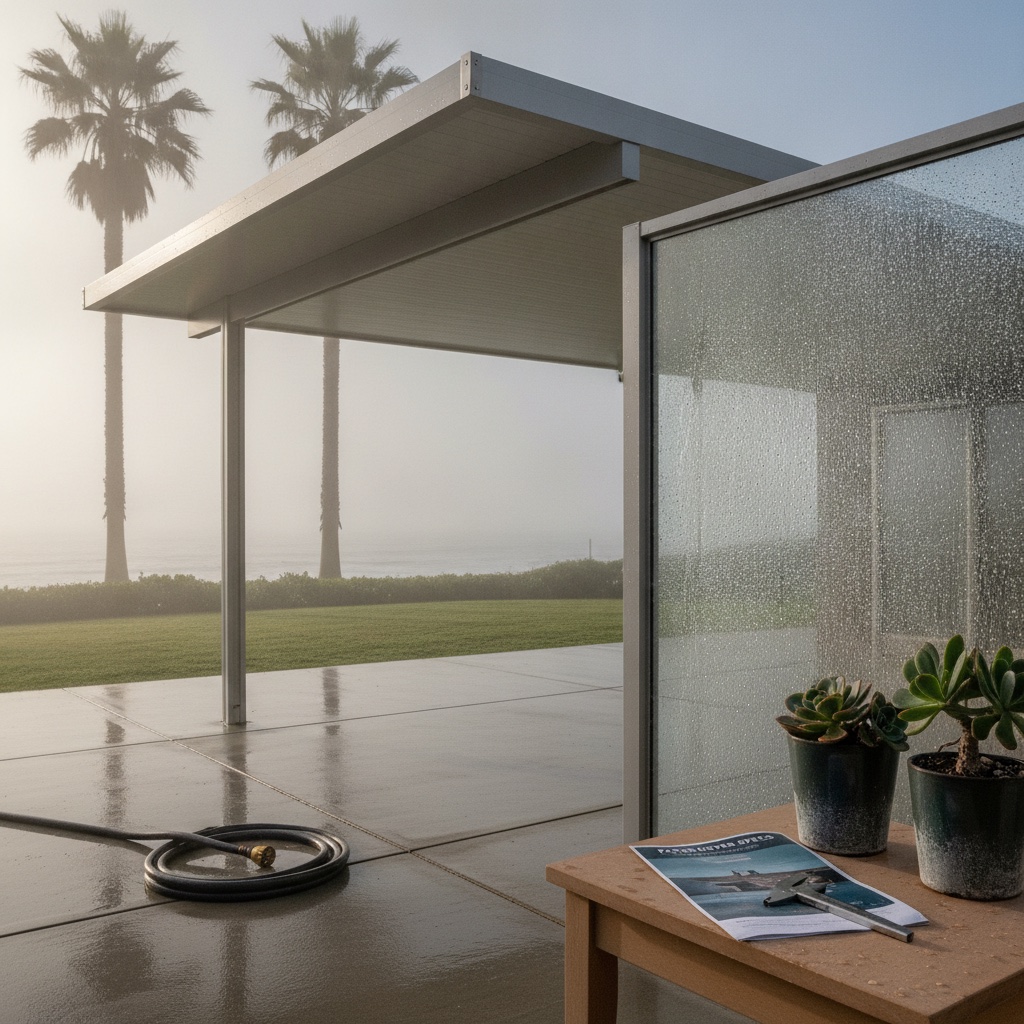
Manufacturers know salt shortens finish life, so most finish warranties carry a coastal clause requiring regular fresh-water rinsing. Homeowners skip it, then hear about it during a claim. The rinse itself is easy. A garden hose on a fan nozzle, top of the roof pan down to the gutter, five to ten minutes of work. Monthly inside a mile of the water. Quarterly from one to five miles in. After any onshore storm event, whatever the calendar says.
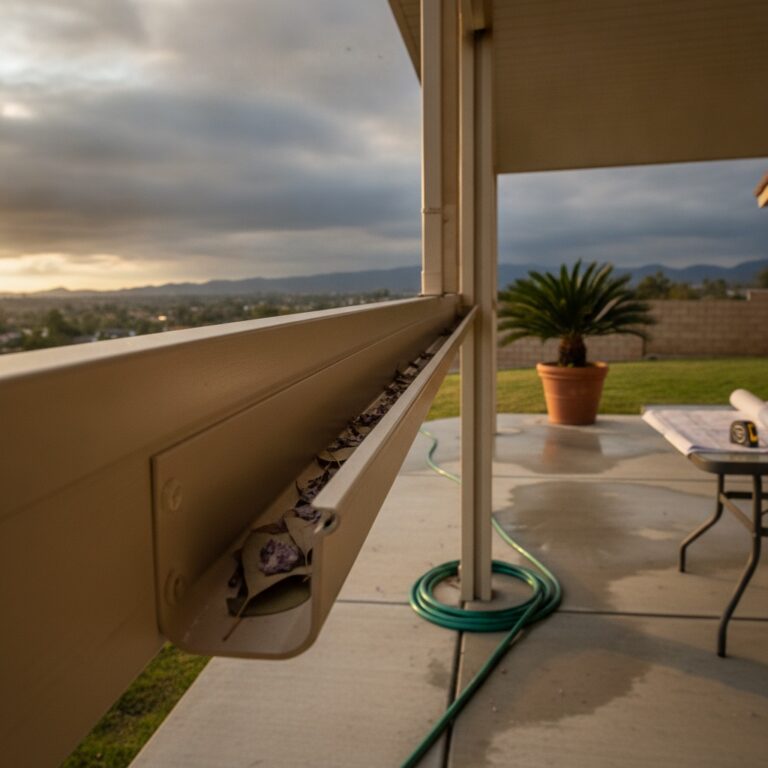
Two more habits pay off. Clear the gutter channel before rain season, because standing salt water in an aluminum trough is the wettest and saltiest place on the whole structure. Then check the cut ends of any field-trimmed rafter. Some shops coat extrusions before cutting and some after, and a raw cut edge left exposed on a coastal job will bloom white long before the painted surface shows anything at all.
Why This Winter Raises the Stakes
NOAA’s Climate Prediction Center issued its ENSO discussion on September 10 and put a greater than 90 percent chance on a very strong El Nino through fall and winter 2026-27. Sea surface temperature anomalies in the eastern equatorial Pacific passed 3.0 degrees Celsius above average, with the Nino-1+2 index at plus 3.4. CPC gives the October through December window a 75 percent chance of producing an event stronger than anything on record back to 1950.
For a coastal Orange County homeowner, that forecast turns into a specific patio problem. CPC’s late-August seasonal maps put above-normal precipitation odds for coastal California above 50 percent from December through February and on through the February to April window, with coverage peaking January through March 2027. More storms means more onshore flow, more airborne salt carried inland, and more standing water sitting in gutter channels through the wet months.
A cover specified for inland conditions is going to work harder this winter than it was built to. If your slab sits inside that first mile of coastline, the spec conversation is worth having before the rain starts rather than after. JNL Aluminum itemizes coastal quotes with the powder-coat tier, the fastener grade, and the isolation detail written out, so you can compare line by line against anything else sitting on your kitchen table. Book a free in-home assessment and we will walk the yard, measure the exposure, and put the right spec in writing.
Morning-context sources used: NOAA Climate Prediction Center, ENSO Diagnostic Discussion, 10 September 2026 (https://www.cpc.ncep.noaa.gov/products/analysis_monitoring/enso_advisory/ensodisc.shtml); StormBag, “Hurricane Marie Flooded Long Beach and Seal Beach,” 8 September 2026 (https://stormbag.co/blogs/news/hurricane-marie-flooded-long-beach-and-seal-beach-a-southern-california-wake-up-call-for-el-nino-winter); StormBag, “NOAA’s New Winter Outlook,” 20 August 2026 (https://stormbag.co/blogs/news/noaas-new-winter-outlook-el-ninos-rain-arrives-late-hits-california-and-the-southeast-hardest); AMICO Architectural Metals, “Understanding AAMA 2604 vs. AAMA 2605” (https://amicoarchitectural.com/specifying-aama2604-vs-aama2605/); Products Finishing, “Understanding AAMA Specifications” (https://www.pfonline.com/articles/understanding-aama-specifications); Huntington Beach Salt Air Corrosion Metal Protection Guide (https://aymilau.com/blog/protect-metal-fixtures-in-huntington-beachs-salt-air).