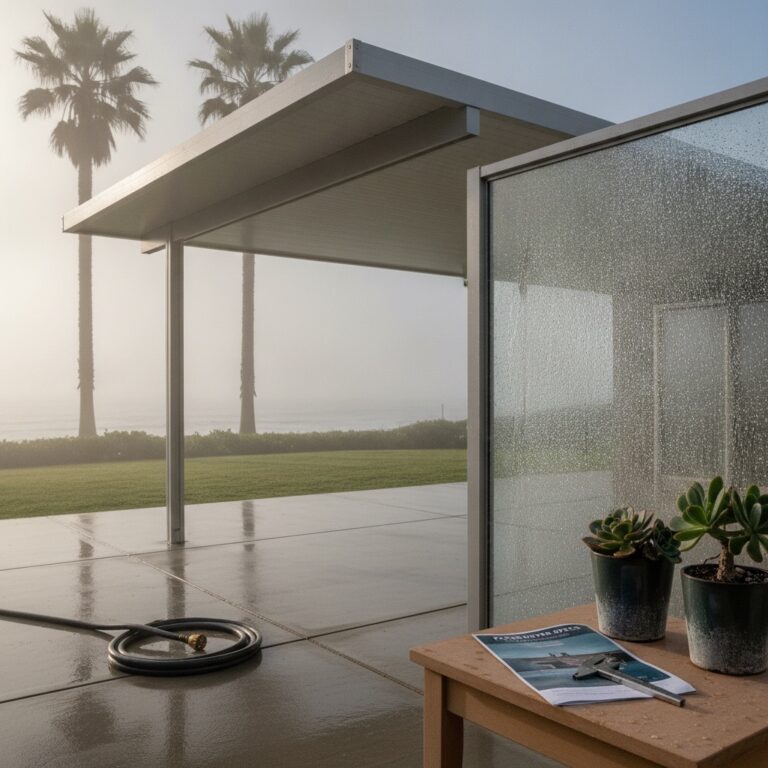
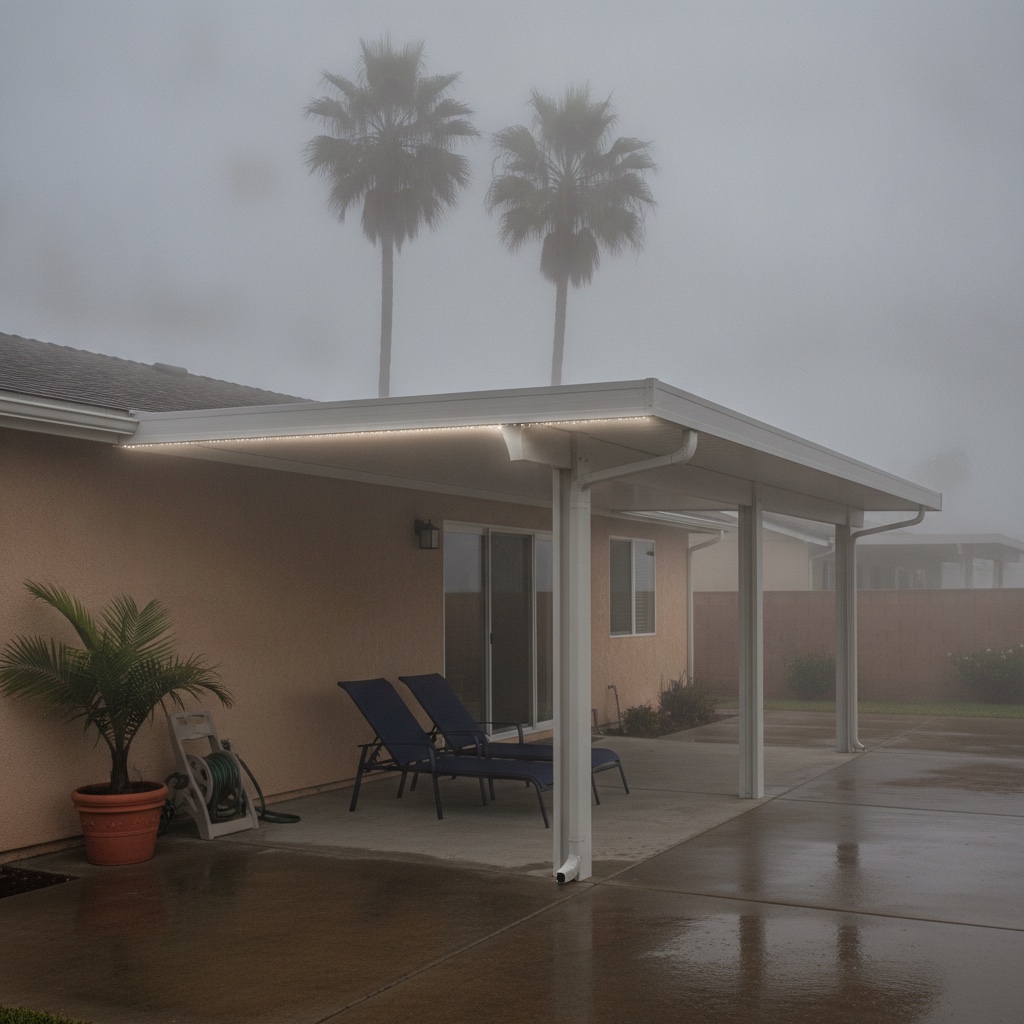

Walk out to a Carlsbad patio at 7 a.m. in July and everything is wet. The table drips. The chair cushions feel like sponges. The concrete is dark with dew, and the sky is a flat gray ceiling sitting somewhere around 1,000 feet. The National Weather Service in San Diego calls it a shallow marine layer. Locals call it No-Sky July. Either way, your patio spent the whole night inside a cloud, and it shows.
This week’s forecast discussions out of the San Diego NWS office describe low clouds redeveloping every night and pushing about 15 miles inland, with bases around 800 to 1,200 feet. Coastal highs hold at 71 to 75 while inland valleys run 10 degrees warmer. That pattern repeats most mornings from May through August. If you live west of the 15, your patio cover does not just fight sun. It fights water, every single night.
What 80 Percent Humidity Does to a Coastal Patio
Overnight humidity along the San Diego coast routinely climbs past 80 percent in summer, and it often touches 90 before sunrise. Air that saturated gives up its moisture to every cool surface it touches. Your patio furniture, your slab, and the underside of your cover all sit below the dew point by 4 a.m. Condensation forms whether or not fog ever rolls through the yard.
That nightly soak matters more than rain in a place like Encinitas or Point Loma. San Diego averages about 1 millimeter of rain in July. The marine layer, though, delivers a light rinse of moisture 25 or more nights a month. Add airborne salt within a mile or two of the water and you get the exact recipe corrosion engineers use in lab testing: salt plus moisture plus time.
Salt is the multiplier. Airborne chloride particles settle on surfaces during the day, then the marine layer wets them at night. Dissolved salt pulls moisture out of the air even after the fog burns off, so treated surfaces stay damp longer than clean ones. Coastal building guides published this spring make the same point about beach homes from HVAC cabinets to railing hardware. The metal never gets a full day off.
Why Aluminum Handles the Wet-Dry Cycle Better Than Wood
Wood moves when it gets wet. A 4×8 wood beam over a Del Mar patio takes on moisture every night and releases it every afternoon. That daily swell-and-shrink cycle opens checks in the grain, works fasteners loose, and gives mildew a foothold in every crack. Paint slows the cycle but cannot stop it, which is why coastal wood covers need recoating every 3 to 5 years and still gray out.
Aluminum does not absorb water. A 6063 alloy extrusion weighs the same on a foggy morning as it does at 3 p.m. Nothing swells, nothing shrinks, and there is no grain for mildew to colonize. Bare aluminum protects itself with an oxide film, and the powder coat over it seals the surface completely. The wet-dry cycle that slowly destroys wood is, to a coated aluminum beam, just weather.
Honest caveat: salt chemistry can attack aluminum too. Chlorides disrupt that natural oxide film on bare, scratched, or cheaply coated metal, which shows up as white pitting on bargain covers near the beach. The metal is not magic. The finish system and the hardware are what make an aluminum cover a 30-year structure in a marine zip code, which is why the spec sheet matters more here than anywhere inland.
The Spec Sheet for Marine-Layer Zip Codes
Start with the powder coat tier. AAMA 2604 is the workhorse spec, built to hold color and gloss through years of UV and humidity. AAMA 2605 is the marine tier, tested to 4,000 hours of salt spray under ASTM B117 and typically warrantied for 10 years or more on finish. West of the 5 in Carlsbad, Leucadia, or Ocean Beach, 2605 is worth the roughly 10 to 15 percent premium on the cover portion of the job. East of the 15, 2604 serves fine.
Fasteners come next, and they are the most common failure point we see on older coastal installs. A powder-coated panel with plain zinc-plated screws will streak rust down the fascia within 3 to 5 years of nightly marine-layer wetting. Spec 300-series stainless fasteners throughout. On a typical 10 by 20 foot cover that is a difference of about 40 dollars in hardware. It buys decades.
Roof style matters for dew, too. A solid 3-inch roll-formed pan roof sheds overnight condensation to a gutter and drip edge, so the slab under it stays dry enough for morning coffee. An open lattice looks great at sunset but strains fog all night and drips it onto whatever sits below. Coastal homeowners who want lattice should plan for a solid section over the seating zone, or accept wiping chairs down each morning.
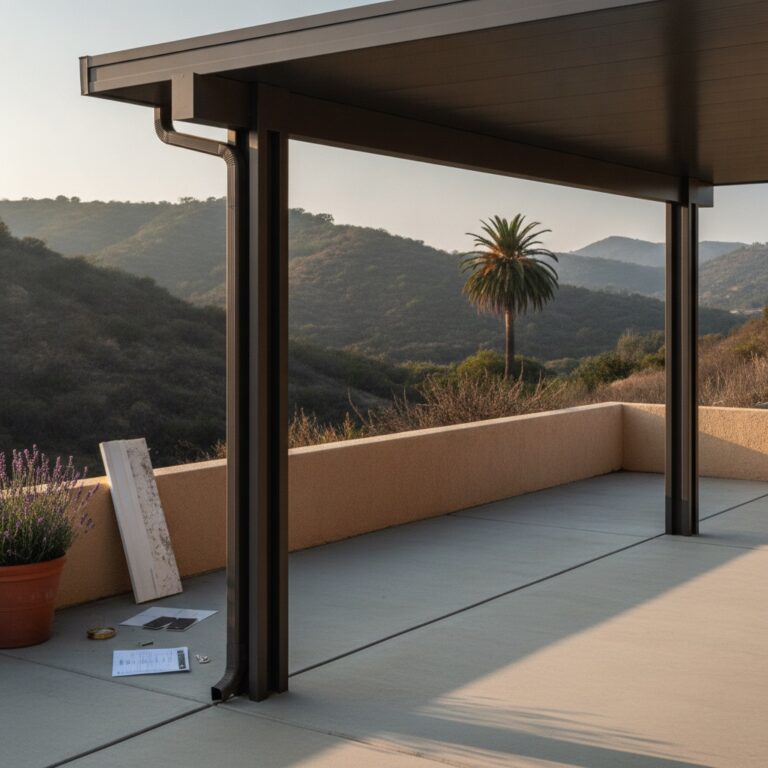
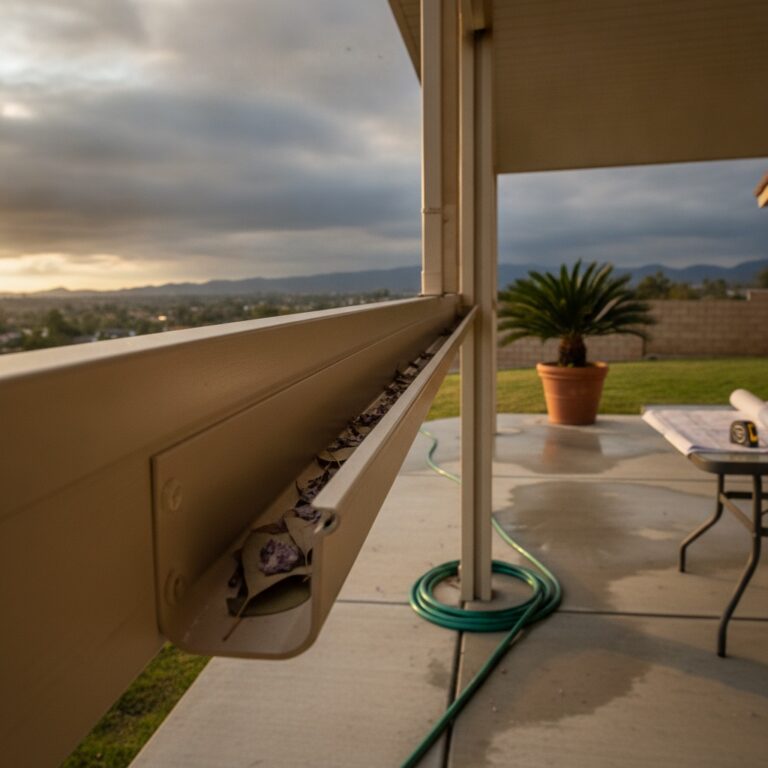
Finish the spec with drainage. A cover in a marine microclimate should carry an integrated gutter with downspouts placed so condensation and the occasional winter storm exit away from posts and footings. Standing water at a post base is the one place coastal moisture can reach unprotected metal and concrete year after year. Good installs drain everything, even fog.
A Maintenance Routine That Takes Ten Minutes a Quarter
Aluminum in a salt-air zone asks one thing of you: a fresh-water rinse. Every 2 to 3 months, hose off the top of the cover, the fascia, the underside edges, and the posts. The rinse clears settled chloride before it can concentrate, which is the same maintenance rule marine finish suppliers publish for waterfront hardware. Within a mile of the beach, make it monthly. That is the entire program. No sanding, no staining, no recoating.
Compare that against the coastal wood alternative: annual mildew treatment, fastener checks, and a full sand-and-restain cycle every few years at 1,500 to 3,000 dollars per pass. Over a 20-year horizon, the aluminum cover’s maintenance budget is a garden hose and a Saturday morning per season. The structure carries a limited lifetime warranty, and a 2605 finish carries its own 10-year paper on color and film integrity.
The marine layer is not going anywhere. It is the reason a Carlsbad backyard sits at 72 degrees while Escondido bakes at 88, and most coastal homeowners would not trade it. The right cover lets you keep the cool mornings and skip the wet furniture. If you are within that 15-mile fog line, JNL will come walk your yard, measure the exposure, and write a quote that names the coat tier, the fastener spec, and the drainage plan line by line. The in-home visit is free, and it is the fastest way to get a cover built for your microclimate instead of a catalog’s.
Morning-context sources used: NWS San Diego Area Forecast Discussion, July 2026 (forecast.weather.gov/product.php?site=sgx&issuedby=SGX&product=AFD); NWS Zone Forecast, San Diego County Coastal Areas, July 2026 (forecast.weather.gov/MapClick.php?zoneid=CAZ043); 10News San Diego forecast, July 2, 2026 (10news.com/weather/san-diegos-weather-forecast-for-july-2-2026-subtropical-moisture-surges-in-starting-friday); NBC 7 San Diego, May Gray and June Gloom explainer (nbcsandiego.com/news/local/san-diego-may-gray-june-gloom/3521695/); Breaking AC, Salt Air Corrosion: Tips to Minimize Threats to Beach Homes, April 15, 2026 (breakingac.com/news/2026/apr/15/salt-air-corrosion-tips-to-minimize-threats-to-beach-homes/); AlloyPro, PVDF vs Powder Coating for Coastal Use (alloypro.net/pvdf-vs-powder-coating-best-aluminum-finish-for-coastal-use/).