
This week handed Orange County a break. ABC7 had Tuesday at 82 degrees across Los Angeles and Orange counties, 84 in the valleys and Inland Empire, with a mild warm-up back into the upper 80s by Friday. That swing is the exact stress test a patio cover lives under. A vinyl panel that looks fine at 82 degrees behaves differently at 104. Homeowners in Corona and Chino Hills usually notice the difference in year six or seven, at the panel seams, right after a hot September.
What Actually Goes Wrong With Vinyl in Year Seven
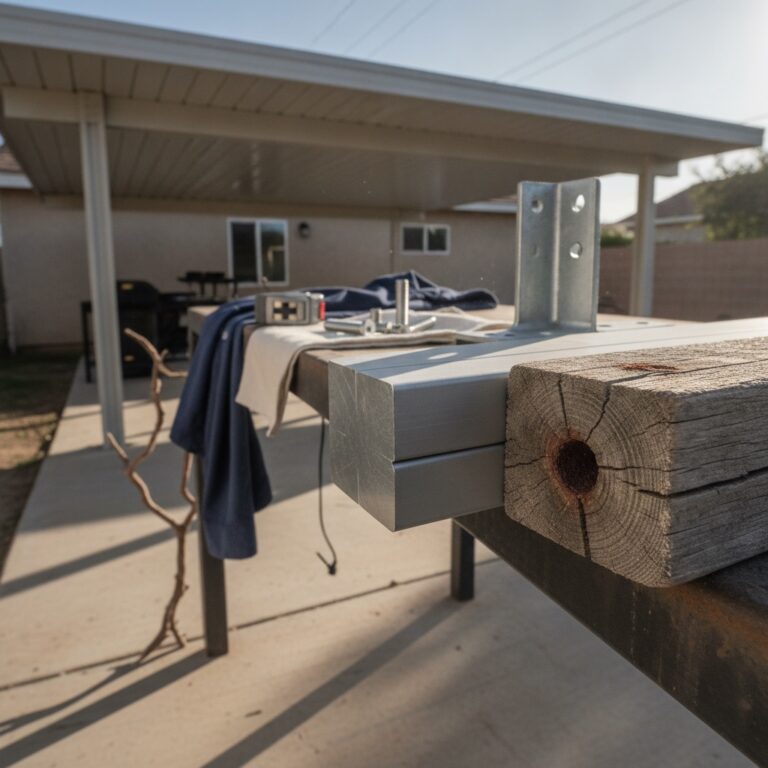
Vinyl patio covers are PVC. PVC does not fail all at once. It fails by chain scission, which is the plain-language version of ultraviolet light and heat cutting apart the long polymer chains that give a panel its stiffness. The result shows up as chalky white patches, hairline cracks at stress points, and panels that snap instead of flex when a eucalyptus branch lands on them during a Santa Ana.
A 2026 study in the journal Materials aged PVC samples under combined UV and thermal stress for 1,248 hours. Samples with little or no calcium carbonate filler finished the run with whitish regions, surface cracking, and clear embrittlement. Samples loaded with 5 to 7.5 percent filler held up noticeably better. That is a lab bench, not a backyard, but it explains the pattern installers keep seeing. Cheap vinyl gets brittle. Well-filled vinyl gets brittle slower.
Southern California runs that same experiment for free. A south-facing slab in Riverside or Moreno Valley takes roughly 2,800 hours of direct sun a year, and surface temperatures under a thin panel push past 120 degrees on a 105-degree afternoon. Seven seasons of that is a serious dose. The panel that cracks is almost never the shaded one.
Where Vinyl Genuinely Wins
The honest answer is that vinyl wins on two things. First is upfront price. A basic vinyl cover typically comes in 15 to 25 percent under an equivalent aluminum structure at the same footprint. On a 16 by 20 patio, that is a gap of roughly $1,200 to $2,400. If the plan is to sell the house inside four years, that math is not crazy, and nobody should pretend otherwise.
Second is rain noise. Uninsulated aluminum pan roofing can drum during a heavy December storm. Insulated aluminum panels close that gap almost completely, but they cost more, so a straight comparison of vinyl against thin aluminum favors vinyl on sound. Vinyl also will not dent the way 0.019 inch aluminum pan stock can when a ladder slips against it.
Color is the third point worth conceding. Vinyl carries its color all the way through the material, so a scratch does not expose something different underneath. On a powder-coated aluminum beam, a deep gouge shows bare metal until somebody touches it up with a matched pen.
What Aluminum Buys, in Numbers
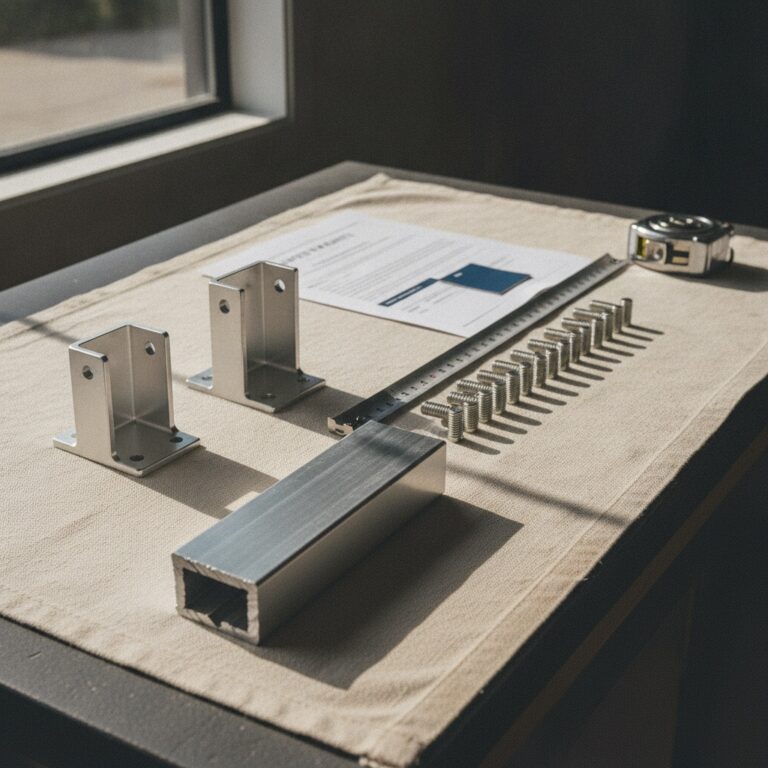
Structural aluminum for patio covers is typically 6063-T6 extrusion in the beams and posts, running 0.050 to 0.125 inch wall thickness depending on the member. That gets a 3 by 8 beam out to a 20 foot clear span in most inland SoCal wind zones with no mid-post breaking up the view. Vinyl does not do that on its own. Vinyl spans of any real length require an aluminum or steel insert inside the member, which means the structure is already part metal and the vinyl is mostly a skin.
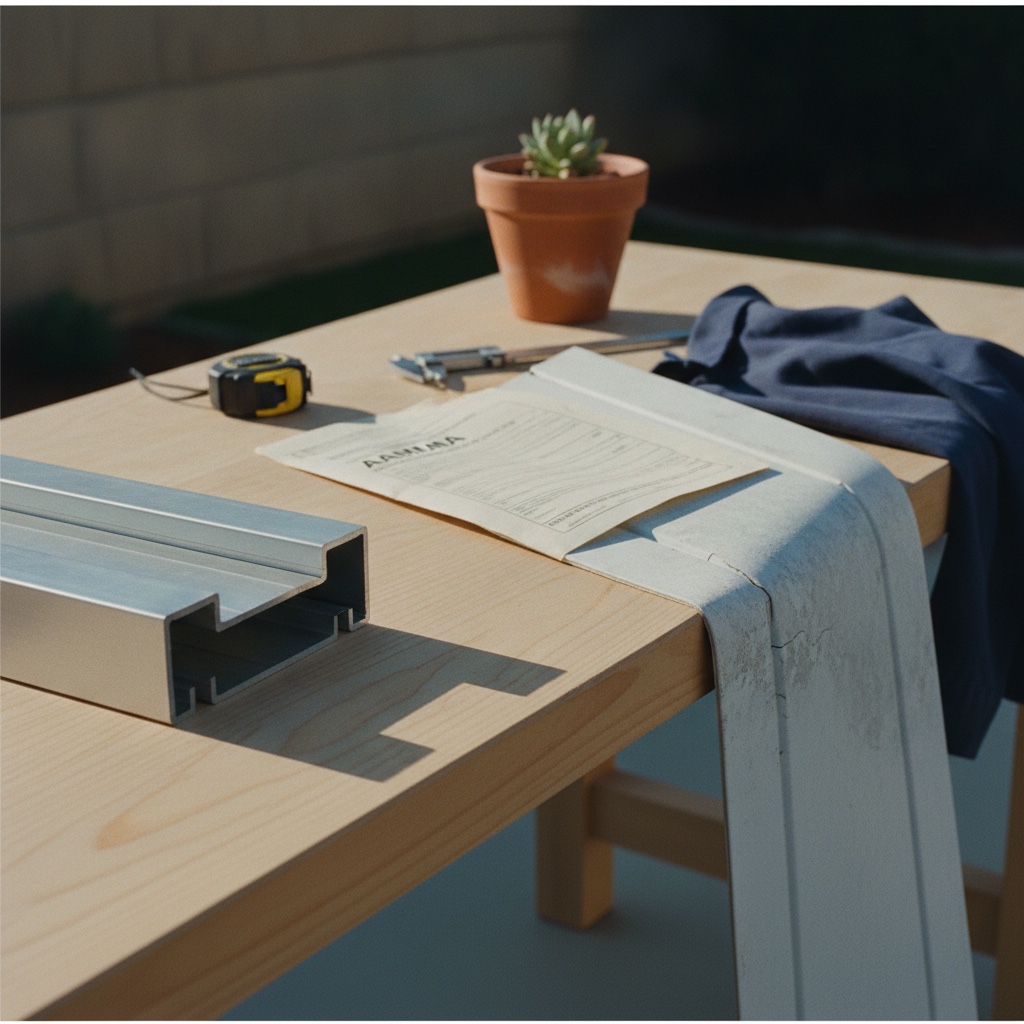
Then there is the finish, and this is the question most homeowners never think to ask. AAMA 2603 is the entry specification, and plenty of budget covers carry it. AAMA 2604 is the intermediate tier, tested against five years of South Florida exposure with hard limits on chalk and color change. AAMA 2605 is the top tier, tested to ten years. For Fullerton, Corona, Hemet, or anywhere with a punishing west exposure, 2604 is the sensible floor and 2605 is worth pricing.
The practical effect is simple. A 2604-or-better powder coat holds its color well enough that the eye struggles to see the shift after a decade. A commodity vinyl panel in the same yard is usually a half shade lighter by year eight, and the fade is uneven, because the south face cooks while the north face barely changes.
Warranty Language Tells You What the Manufacturer Believes
Read the warranty before the brochure. Most vinyl patio covers sold in SoCal carry a limited warranty somewhere in the 10 to 20 year range, and nearly all of them carve out fade, chalking, and normal weathering. That carve-out is the whole ballgame, because fade and chalking are precisely how vinyl fails in this climate. A 20-year warranty that excludes the failure mode is a 20-year warranty against nothing.
Quality aluminum covers usually split the promise into three pieces. A limited lifetime structural warranty on the extrusion. A separate finish warranty, commonly 10 to 20 years on the powder coat, with a color-change limit written as an actual measured number. And labor, which is its own line and its own fight. One year of labor is common and thin. Two to five years is better. Ask for all three in writing before signing anything.
If a bid will not commit the finish warranty to paper with a stated color-change limit, that refusal is useful information all by itself. The same goes for a salesperson who answers a question about AAMA tier with the word premium. Premium is not a specification. A tier number is. Any manufacturer running a 2604 or 2605 line publishes that fact, and any installer who sells it can produce the sheet in about thirty seconds.
How to Settle It on Your Own Slab
Walk the yard at 3 p.m. in September, not at 9 a.m. Note where the sun actually lands and how long it stays. A covered patio on the north side of a Long Beach house lives on a completely different UV budget than a west-facing slab in Moreno Valley. If the exposure is mild and the budget is genuinely tight, vinyl is a defensible choice. If the slab bakes every afternoon from June through October, vinyl is a replacement scheduled for year ten.
Compare bids on specification, not on the bottom line. The line items worth demanding: alloy and wall thickness of the beams and posts, pan or panel thickness, AAMA tier of the finish, post footing size and depth, and whether the attachment to the fascia includes a properly flashed ledger. Two bids that look $900 apart on paper often differ by a full gauge of metal and an entire AAMA tier underneath.
We put those numbers into every estimate rather than leaving homeowners to guess at them. If you want a written, itemized spec for your patio, including the finish tier and the clear span you would actually get on your slab, request a free in-home quote. We will measure the slab, check the fascia, and put the whole thing on paper before you owe anybody a dollar.
Morning-context sources used: ABC7 Los Angeles, “SoCal is finally getting relief from the heat” (Sept 15, 2026), https://abc7.com/post/los-angeles-weather-temperatures-southern-california/58983/ ; “Role of CaCO3 in Retarding UV- and Thermally Induced Degradation of PVC Compounds,” Materials (MDPI), 2026, https://doi.org/10.3390/ma19153270 ; “Characterization of PVC/CaCO3 Nanocomposites Aged Under the Combined Effects of Temperature and UV-Radiation,” Materials (MDPI), https://doi.org/10.3390/ma18174001 ; AMICO Architectural Metals, “Understanding AAMA 2604 vs. AAMA 2605,” https://amicoarchitectural.com/specifying-aama2604-vs-aama2605/ ; Linetec, “Paint AAMA Specifications,” https://linetec.com/paint/aama-specifications/ ; Angi, “The Cost Of An Outdoor Living Space in 2026,” https://www.angi.com/articles/cost-outdoor-living-space.htm