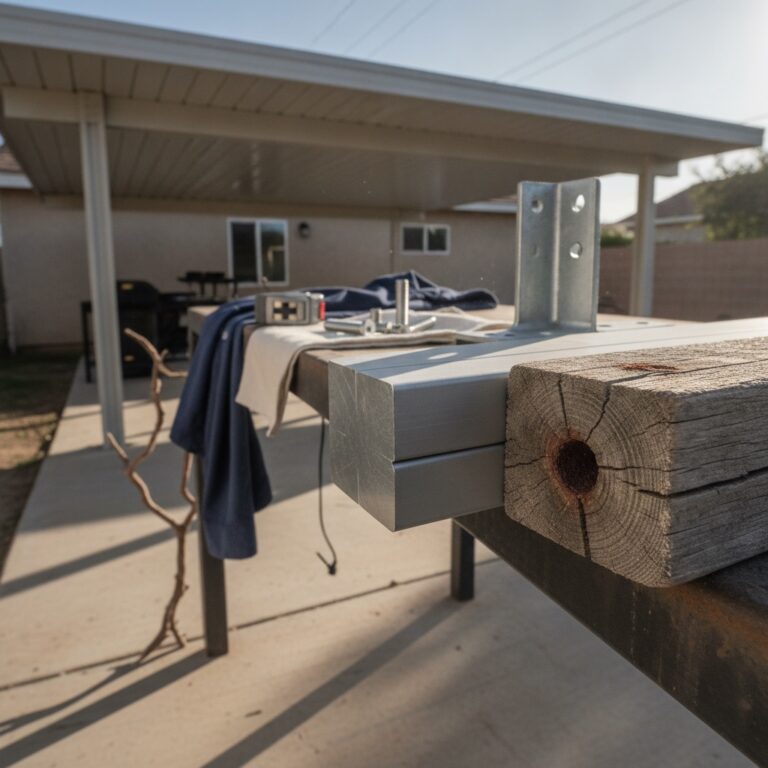
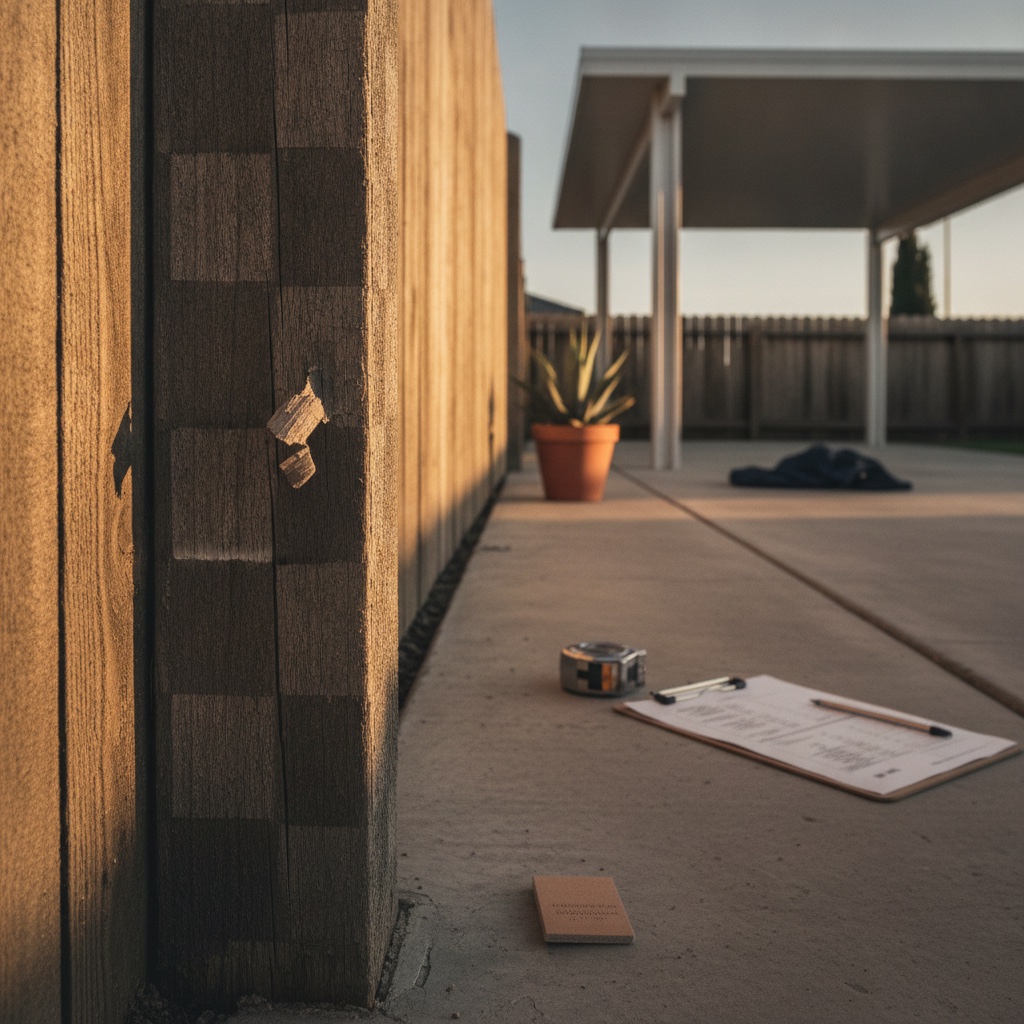

Stand on any cul-de-sac in Rancho Cucamonga this week, in 100 degree heat, and you can date the wood patio covers from the curb. The 2016 builds sit gray and checked, with stain peeling off the south face of every post. One yard over, a powder-coated aluminum cover from the same era still reads the color it was on install day. Ten years of SoCal sun is the most honest product review there is.
What Ten Years of Sun Does to a Wood Cover
Years one and two look fine, mostly. UV grays untreated cedar within one to two seasons, and even a professional stain job in the LA basin shows visible fading by year two. SoCal UV runs harder than the national average. The Inland Empire hit UV index 11 this month, and stain pigments break down faster here than the label on the can promises.
Years three through five bring checking. Dry heat pulls moisture out of the grain and the wood splits along its length, first at the end grain, then anywhere the sun sits after noon. Maintenance now becomes a schedule: re-stain every two to three years at $300 to $600 per professional cycle, plus a day of cleaning and sanding before each coat goes on.
Sun exposure also varies by orientation, and wood shows it. A west-facing cover in Corona or Menifee takes the full afternoon load from 1pm to sunset, and its rafters fade and check a full season ahead of the shaded side. Homeowners end up staining the west half more often than the east, or living with a two-tone cover. The sun never spreads the damage evenly, and wood keeps the receipts.
Years six through ten decide the cover’s fate. Post bases and beam-to-post joints hold moisture from winter rain and sprinkler overspray, and rot starts where you cannot see it. Subterranean termites work year-round in Southern California, and repair bills run $200 for a small patch to $1,000 or more for a structural member. A Burbank pergola company’s 2026 maintenance guide puts wood’s ten-year upkeep at $2,900 to $7,900. With diligent care a wood cover lasts 10 to 15 years. Skip the care and significant deterioration shows in five to eight.
The Same Ten Years on Powder-Coated Aluminum
Aluminum does not play the same game. A powder coat certified to AAMA 2604 has already survived five years of South Florida test-fence exposure for color retention, gloss, and chalk resistance before it earns the rating. In practice that finish holds its color for 15 to 20 years in SoCal sun without refinishing. The metal underneath does not absorb water, does not feed termites, and does not split when July runs ten straight days over 95.
Heat itself is not aluminum’s enemy either. The panels reflect a large share of the solar load, and a solid roof drops the felt temperature on the slab below by a wide margin on a 100 degree afternoon. The metal expands and contracts on a predictable curve, which the fastener layout is designed around. Wood moves with both temperature and moisture at once, which is why its joints loosen and its fasteners work free over the years.
The maintenance list is short enough to memorize. Rinse the cover with a hose once or twice a year. Wipe off bird droppings and tree sap when you see them, since both are mildly acidic and can etch a finish left dirty for months. Snug the visible fasteners once a year after a summer of thermal cycling. Total time, about 45 minutes annually, at roughly the cost of dish soap.
The spec matters, so ask for it in writing. JNL builds with extruded aluminum beams, 0.024 to 0.032 inch roll-formed roof panels, stainless or coated fasteners, and an embossed wood-grain finish available in cedar and walnut tones. From ten feet away the grain reads as wood. At year ten it reads better than wood, because it never grayed.
The Ten-Year Math, Side by Side
Add up the decade for wood. Three to five stain cycles at $300 to $600 each. A repaint or two on painted builds at $400 to $800 per pass. Rot and termite repairs somewhere in the middle years. LA-area estimates put the ten-year total between $2,900 and $7,900, plus 80 to 150 hours of your own weekends on ladders.
The same decade on aluminum totals $20 to $230, mostly cleaning supplies, across five to eight hours of effort. Then run the lifespan math. A wood cover that retires at year 12 needs a full replacement while an aluminum cover is barely past its warranty midpoint. Aluminum’s 20 to 30 year service life spans two complete wood lifecycles, and the warranty paperwork says so: limited lifetime coverage on aluminum panels and finish, against a one-year workmanship guarantee on a typical stain job.
Where Wood Honestly Wins
Wood keeps three real advantages, and pretending otherwise would insult your judgment. Nothing fully replicates true grain at arm’s length. A craftsman home in Pasadena with period woodwork may deserve matched cedar overhead, and no embossed finish carves like the real thing. Some homeowners also like the ritual: the sanding, the staining, the Saturday with a brush. If that describes you, wood can be a rewarding choice made with open eyes. Just price the ritual honestly. A cover that costs $3,000 less up front and $5,000 more over ten years is not the cheaper cover. It is the same cover with the price moved into your weekends.
Run the Test This Week
This month made the case better than any brochure. The National Weather Service put much of Southern California under heat advisories in mid-July, with an extreme heat warning pushing the valleys and the far interior toward 100 to 110 degrees. Walk your street during the next one. Find a wood cover past year seven and press a thumbnail into the south-facing post. Then find an aluminum cover of the same age and look for chalking or fade at the fascia. The sun has been running this comparison for a decade. You are just reading the results.
If the results point the way we think they will, get the replacement priced properly. We offer a free in-home quote that itemizes the full spec: panel gauge, beam sizing, powder-coat tier, fastener grade, and the warranty years behind each line. Bring your neighbor’s sagging cover as the before photo. Your slab deserves the after.
Morning-context sources used: Okanagan Patio Covers, “Aluminum vs Wood Patio Covers: An Honest Comparison” (updated July 8, 2026, okanaganpatiocovers.ca/guides/aluminum-vs-wood-patio-cover/); Pergola Cave, “Pergola Maintenance: The Complete 2026 Care Guide” (2026, pergolacave.com/blogs/blog/pergola-maintenance); FOX 11 Los Angeles, “SoCal Heat Advisory: Triple-digit temperatures forecasted through Friday” (July 2026, foxla.com/news/southern-california-heat-advisory-triple-digits-july-2026); KTLA, “Extreme heat warning as Southern California highs climb toward 110 degrees” (July 2026, ktla.com/news/california/southern-california-extreme-heat-warning-forecast/).